CLM & CVM
Co-Brand Cards 2026: Is the Partner Card Still Worth It – and What Is It Really For?
Series lead: market figures from Delta to Payback, why Europe runs on different numbers and why the card is the key to the customer lifecycle.
•
acceleraid Redaktion
10 min read
In 2025, Delta Air Lines collected $8.2 billion from American Express, up 11 percent on the year, and signed up more than a million new cardholders for the fourth year running (Delta, full-year 2025 results). That same year, Wells Fargo walked away from its card with the rent-payment startup Bilt after the Wall Street Journal reported losses of up to $10 million a month (Fintech Business Weekly). And in Germany, Bertelsmann is shutting down the DeutschlandCard loyalty scheme on 30 November 2026 after Edeka, its largest partner, defected to Payback (Süddeutsche Zeitung).
Three headlines, one business model, three very different outcomes. That is why co-brand cards are a topic on which banks, retailers, airlines and mobility providers are currently re-sorting their positions. This series works through the questions that come up most often in practice, and it follows one thread throughout: a partner card is not a payment product. It is the entry point to a customer relationship that only pays off if it is managed across the entire lifecycle.
Six questions decision-makers actually ask
Anyone weighing a co-brand programme today rarely asks "card, yes or no". The questions are more specific:
Does the card make money directly, or does it pay off only indirectly through retention, frequency and data?
Is the card the key to the data opt-in, that is, to the unified customer profile that makes personalised communication possible in the first place, and does it connect offline and online purchases?
Is a co-brand programme still viable in Europe after interchange regulation, and who bears which costs between bank and partner?
Are points and miles as a currency of their own the stronger loyalty tool, or is cash back more honest and cheaper?
How do consumer and commercial cards differ, especially fuel and travel cards?
Do B2B cards make any sense as a loyalty instrument at all?
Each of these questions gets its own article in this series. This lead article maps the market and sets out the thesis that ties the parts together.
What the market is showing right now
In the United States, co-brand cards have grown into an industry of their own. According to Javelin Strategy & Research, co-brand products made up 62 percent of consumer credit cards in the portfolios of twelve large issuers, and the CFPB counted more than $28 billion that banks paid to their partners in 2022 (NerdWallet). At American Express, co-brand portfolios accounted for roughly 26 percent of worldwide billed business and 36 percent of card loans at the end of 2025; Delta alone stood for 13 percent of billings and 21 percent of loans (View from the Wing, citing Amex disclosures).
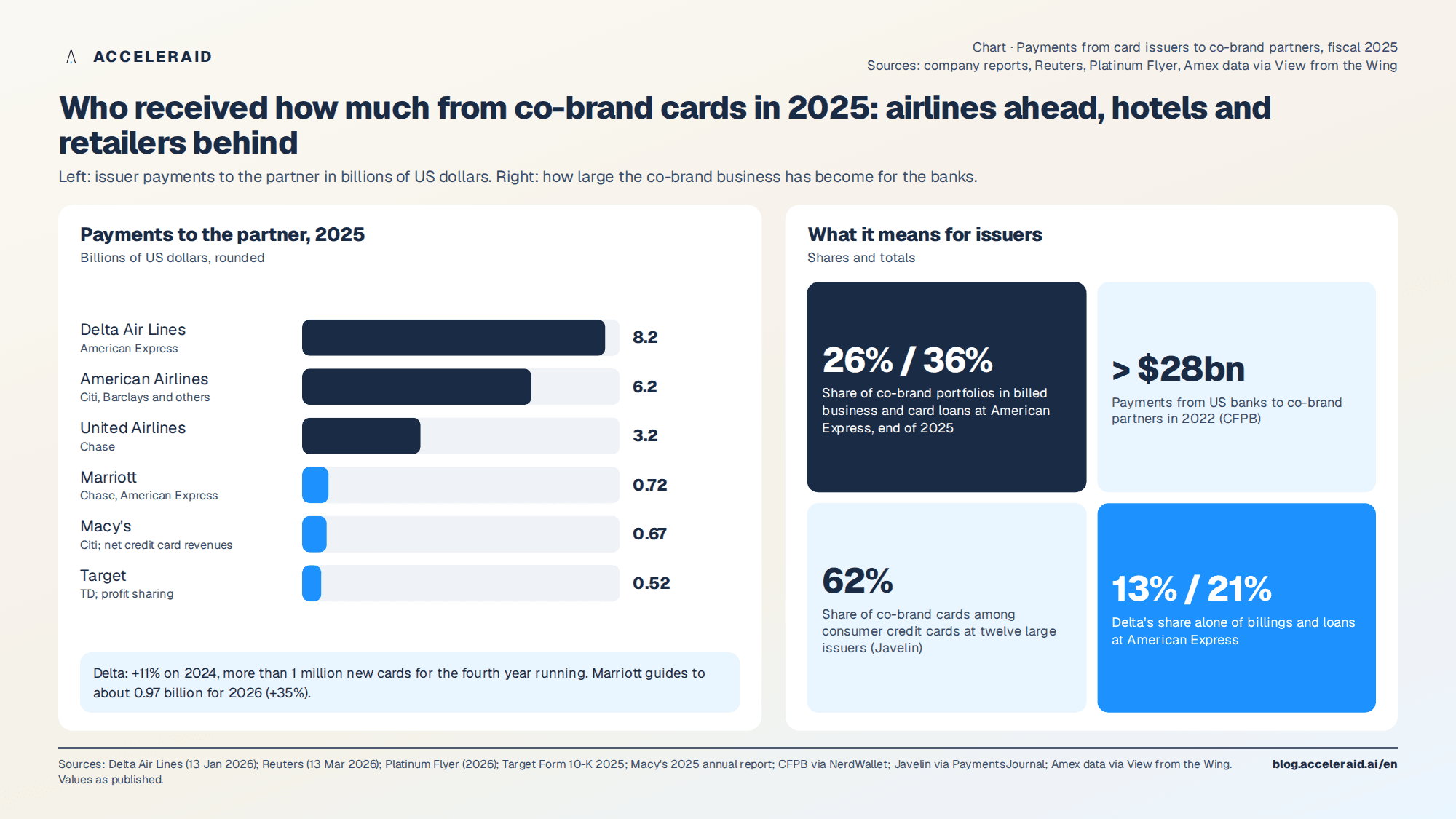
The flip side is a shift in bargaining power. Delta's $8.2 billion from American Express equalled about 14 percent of its adjusted operating revenue; American Airlines took in $6.2 billion from card and other partners, roughly four times its adjusted operating income (Reuters). Marriott expects around $966 million in card fees for 2026, about 16 percent of its total fee revenue, after renegotiating its per-transaction cut with Chase and American Express (Platinum Flyer). For the partners, the card is a high-margin earner. For the banks, it is increasingly a lending business: one market observer describes the situation as partners having captured the spend economics while issuers depend on interest income (Payments in Full).
Where that arithmetic fails, the parties separate. Apple Card is moving to JPMorgan Chase after more than $1 billion in losses at Goldman Sachs; JPMorgan is booking a $2.2 billion credit provision for the deal, and American Express, Synchrony and Barclays had all dropped out of the process beforehand (CNBC). Walmart and Capital One ended their agreement early in 2024 (Reuters). When Amazon put its card out to tender in 2021, it insisted on a permanent 5 percent reward on Amazon purchases, a share of loan revenue and an interchange rebate; Chase kept the programme in the end (CNBC). Amazon's small-business cards are moving from American Express to U.S. Bank in 2026, which expects about $1.6 billion in loans and $75 million to $85 million in quarterly revenue from the deal (Banking Dive).
Why Europe runs on different numbers
Europe starts from a fundamentally different position. The Interchange Fee Regulation (EU) 2015/751 caps interchange on consumer cards at 0.2 percent for debit and 0.3 percent for credit; commercial cards and three-party schemes are exempt (EUR-Lex). Before the cap, the UK average was around 0.8 percent; the US average is still around 1.8 percent, with premium cards above 2 percent (Head for Points). The effect was immediate: in 2017 MBNA withdrew eight airline cards, three quarters of the UK line-up, because 0.3 pence per pound cannot fund a mile that costs 0.5 to 1 pence (This is Money).
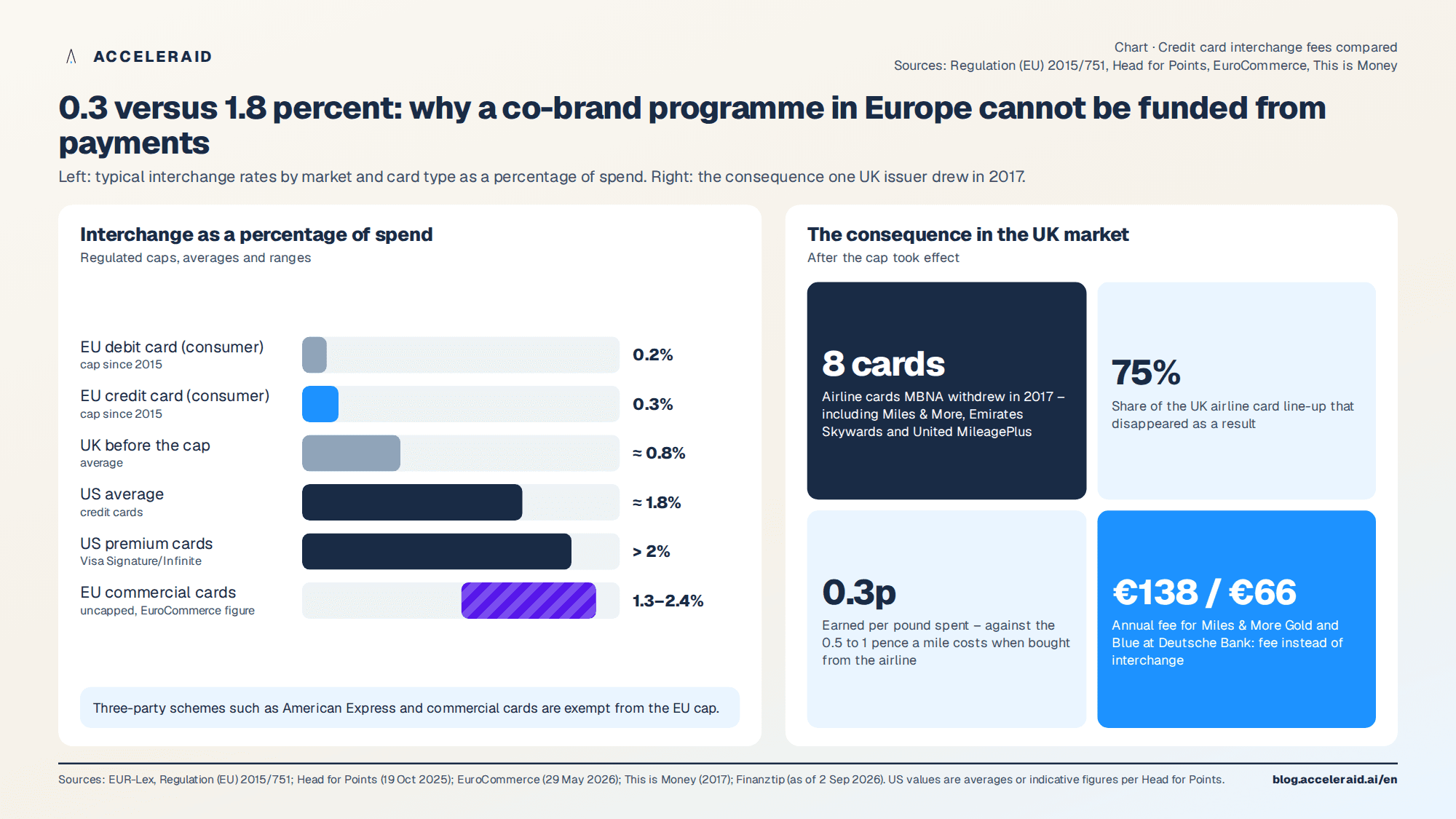
Germany shows what programmes look like under these conditions. The Miles & More credit card has been issued by Deutsche Bank since 2025 and costs €138 a year in the Gold version and €66 in the Blue version (Finanztip). The new Amazon Visa from Zinia (Santander) has no annual fee but awards only one point per euro at Amazon, in other words 1 percent, considerably less than the discontinued predecessor card from Landesbank Berlin (Stiftung Warentest). Loyalty schemes without a credit card, meanwhile, keep growing: Payback counts more than 35 million active users and 18 million app users, and 95 percent of points are redeemed (Payback). Rewe left the scheme at the end of 2024 and is reported to save close to €150 million a year in fees (Lebensmittel Praxis).
The numbers lead to a sober conclusion: in Europe, a card cannot fund its programme out of payments. If it is to pay off, the value has to be created somewhere else.
What the card is really for: identity, not payment
That somewhere else is the customer relationship. At Kroger, 96 percent of all transactions are tied to the loyalty card, yielding behavioural data on 60 million households (84.51°). Tesco personalises the online grocery journeys of all active Clubcard customers one-to-one and regularly offers personalised coupons to more than 9 million customers; its banking partnership with Barclays serves around 4 million customers (Tesco, preliminary results 2025/26). In Deloitte's survey of 5,564 loyalty programme members, 72 percent say programmes make them more likely to buy from their preferred brand and 56 percent say they spend more (Deloitte via WSJ).
So the card does something that no advertising and no app does on its own: it identifies the customer at the till, in the web shop, at the petrol station and on the aircraft with the same identity. It delivers the consent, because the customer receives a tangible benefit in return. And it joins the bank's payment data with the partner's basket and travel data. That is the foundation for what we described in our Customer Brain series as a unified, purpose-bound customer memory (Customer 360 is not yet a Customer Brain). Without that foundation, AI-driven personalisation remains a promise; McKinsey's analysis of customer value management in banking locates the revenue lever precisely in individual engagement (McKinsey: AI personalisation in banks).
The card across the customer lifecycle
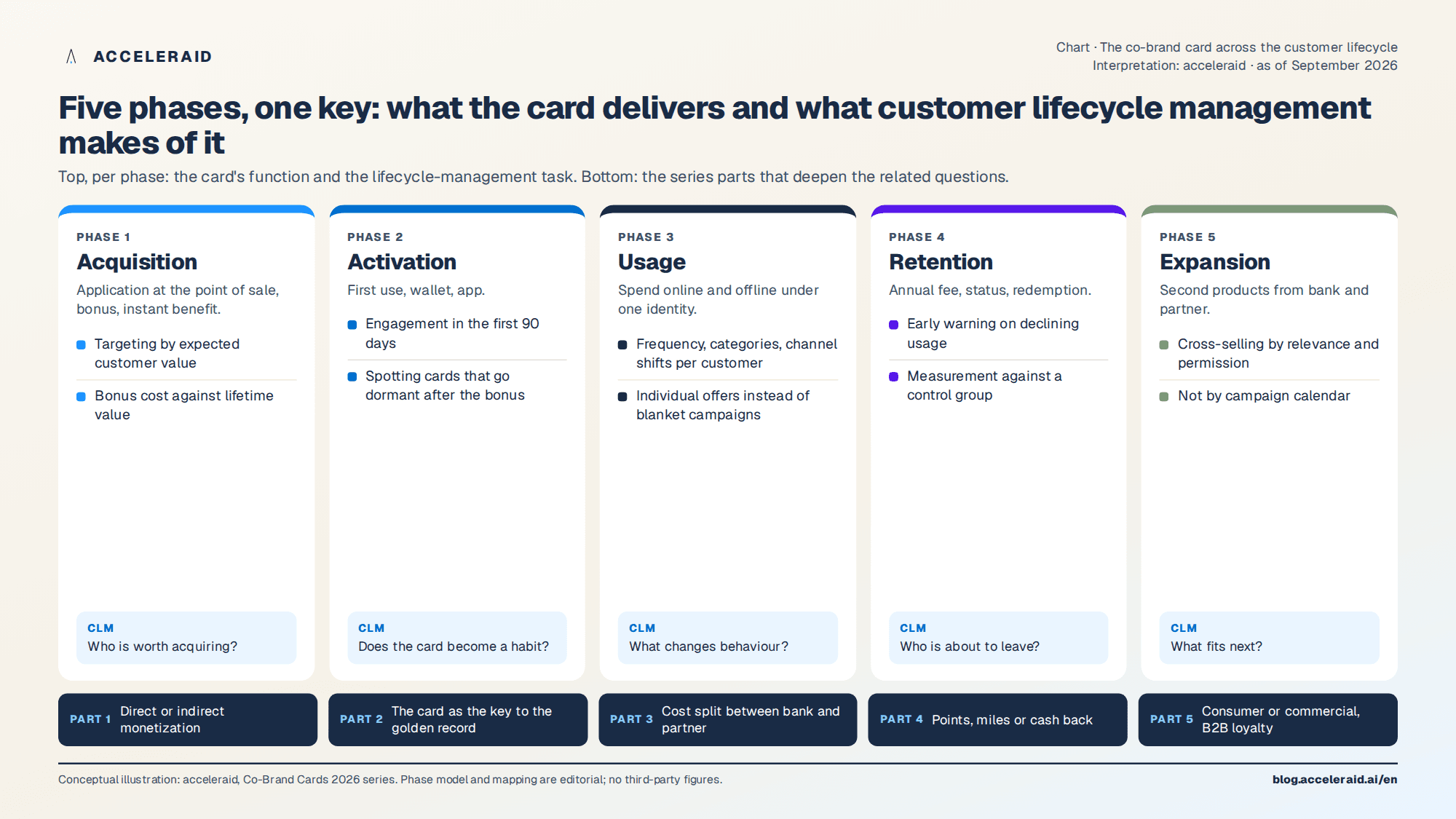
If the card is the key, customer lifecycle management is the lock. The relationship can be described along the phases every card programme passes through:
Phase | What the card delivers | What CLM makes of it |
|---|---|---|
Acquisition | Application at the point of sale, sign-up bonus, instant benefit | Targeting by expected customer value rather than volume; weighing bonus cost against lifetime value |
Activation | First use, wallet provisioning, app | Time-critical engagement in the first 90 days; spotting cards that go dormant once the bonus is banked |
Usage | Spend online and offline under one identity | Behavioural signals per customer: frequency, categories, channel shifts; individual offers instead of blanket campaigns |
Retention | Annual fee, status tiers, redemption | Early warning on declining usage, targeted countermeasures, measurement against control groups |
Expansion | Second products from the bank and the partner | Cross-selling by relevance and permission, not by campaign calendar |
The decisive element is the feedback loop. A programme that pays out rewards but never learns which reward changes which customer's behaviour is distributing money by intuition. A programme that treats every contact as an experiment with a control group knows after a year which segments respond to cash back, which to status and which to nothing at all. We described this principle for churn prevention as a learning retention loop (From a static churn score to a learning retention loop); it applies just as much to co-brand programmes, only with two partners who both need to learn.
The Bilt case shows what happens when that learning is missing. Wells Fargo assumed that 65 percent of spend would occur outside rent payments; the actual figure was around 35 percent. The bank expected 50 to 75 percent of spend to revolve; actual revolving ran at 15 to 25 percent (Fintech Business Weekly, citing WSJ reporting). Both assumptions could have been tested against a few months of data. A programme that continuously reconciles its assumptions with actual behaviour would have adjusted terms earlier or cut the product differently.
What this means for bank and partner
For the bank, the card is not a distribution channel for credit but a route to customers it would otherwise never reach. The revenue comes from annual fees, from the share of customers who genuinely revolve, from second products and from a cost base kept low by digital processes. That presupposes that the bank is allowed to get to know the partner's customers, within a framework that stands up to data protection and supervisory scrutiny; BaFin has explicitly monitored customer-facing AI since July 2026 (BaFin monitors AI in finance).
For the partner, the card is the link between till, web shop, app and customer account. Anyone who leaves that dataset unused is paying rewards to customers who would have come anyway. Anyone who uses it can observe and influence frequency, basket and channel shifts customer by customer.
For both sides, contract terms of five to ten years (PaymentsJournal) are long enough to build a shared data foundation and shared metrics, and too long to leave wrong assumptions uncorrected.
The series at a glance
The five articles deepen the questions raised at the start. Read them in order, or start with the question that is most pressing for you.
PART 1 · MONETIZATION
Direct or indirect monetization – where the money is really made
Interchange, annual fees, interest and partner payments versus frequency, basket size, data and second products. With numbers from Delta to Macy's.
PART 2 · DATA
The card as the key to the golden record
Opt-in, linking offline and online purchases, and the prerequisites for AI-driven personalisation.
PART 3 · COSTS
Who bears which costs? Bank, partner and the interchange question
What the interchange cap did to programmes, why Apple Card almost found no issuer, and how the numbers can be made to work in Europe.
PART 4 · REWARDS
Points, miles or cash back – which reward actually retains
What customers prefer, what programmes cost, what balance sheets reveal, and how rewards can be steered by segment.
Read part 4: Points or cash back →
PART 5 · COMMERCIAL
Consumer or commercial – fuel cards, travel cards and B2B loyalty
Why commercial cards are regulated differently, what fuel and travel cards deliver, and whether B2B cards can build loyalty at all.
Read part 5: Consumer or commercial →
Five takeaways
In the US, co-brand programmes have become a profit pillar for the partners: Delta receives $8.2 billion a year and Marriott is heading towards almost $1 billion. The banks increasingly carry the credit risk in return.
In Europe, the Interchange Fee Regulation limits payment income to 0.3 percent. A programme here cannot be funded from payments, only from the customer relationship.
The card's real job is identification: one identity at the till, in the web shop, at the petrol station and on board, tied to a consent for which the customer receives something in return.
Without customer lifecycle management, a programme hands out rewards by intuition. With continuous measurement against control groups, it learns which reward works for which customer.
Bilt, Apple Card and Walmart show that assumptions about customer behaviour must be tested against data early. Contract terms of five to ten years leave enough time for that and punish omissions severely.
Illustration: AI-generated. AI-assisted content: We use AI technologies and automated agents in the creation of our articles, including from Microsoft, Google, OpenAI, Anthropic and other providers. Topics, editorial direction and final approval remain with our team.
