CLM & CVM
Co-Brand Cards, Part 2: The Card as the Key to the Golden Record
At the checkout the customer stays anonymous. How the card links opt-in, offline and online purchases, and what AI personalisation can build on it.
•
acceleraid Redaktion
7 min read
Co-Brand Cards 2026 series · Part 2 of 5. The lead article maps the market; part 1 covers direct and indirect monetization.
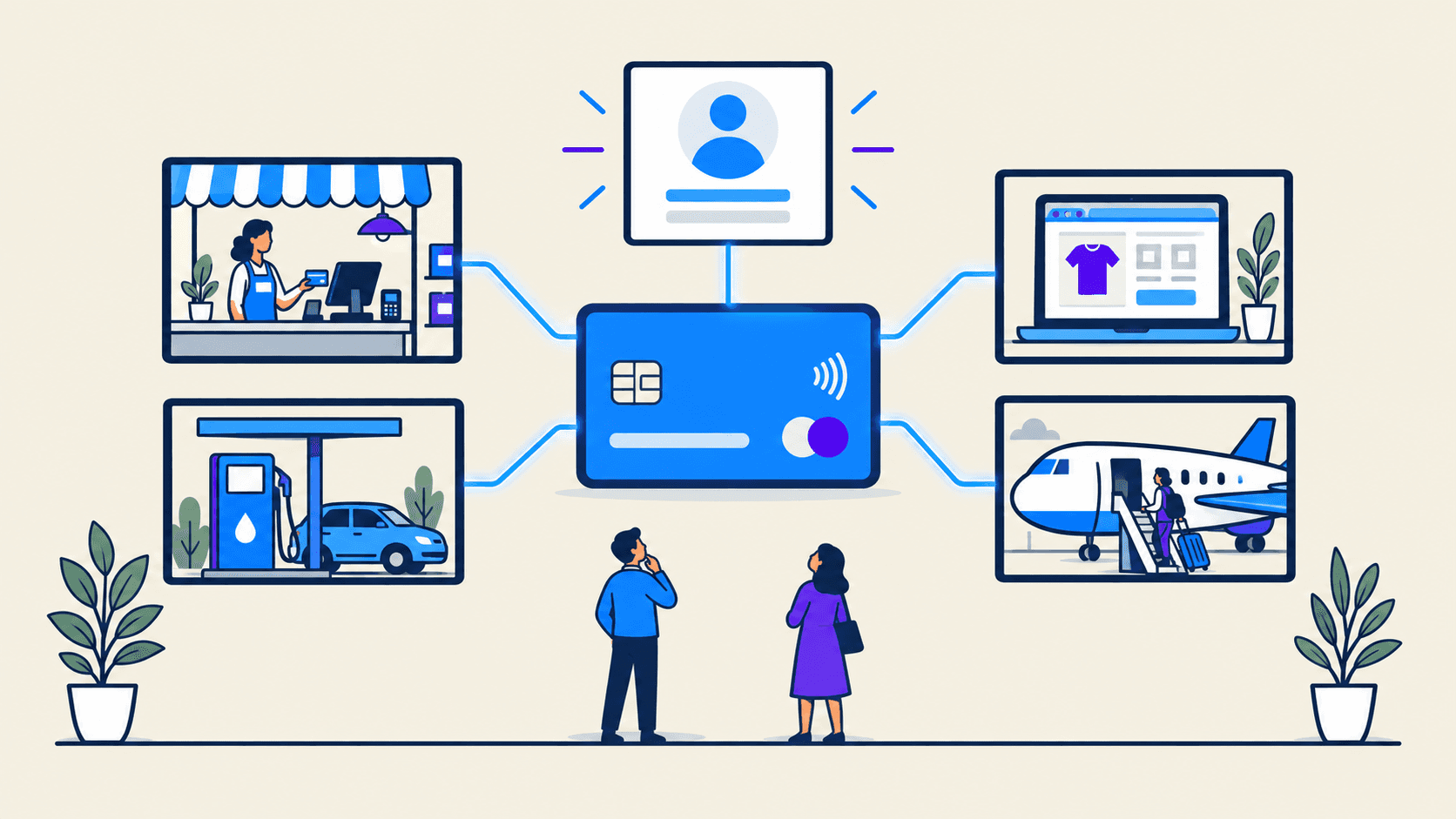
At the checkout, the customer is a stranger. In Germany, 45 percent of all payments in 2025 were still made in cash, 26 percent by debit card, 10 percent by mobile and just 5 percent by credit card (Bundesbank). None of these payment methods tells the retailer who is buying, and even a card payment yields only a card number that cannot be linked to a customer account. This is exactly where the co-brand card comes in: it is not primarily a means of payment but a means of identification, one the customer agrees to voluntarily because there is something in it for them.
Why the checkout is the problem
Online retailers know their customers because every purchase requires a login. Physical stores, petrol stations, restaurants and airlines at the gate do not, unless the customer identifies themselves. Without that identification, two data worlds stay apart: the online history with baskets, searches and returns, and the offline history sitting in the till system as anonymous receipts. A golden record, a single cleansed customer profile across all channels, is impossible under these conditions.
The programmes that have solved the problem show what is possible. At Kroger, 96 percent of all transactions are tied to the Plus Card, producing behavioural data on 60 million households (84.51°). Tesco personalises the online grocery journey of every active Clubcard customer one-to-one, regularly offers personalised coupons to more than 9 million customers and launched "Your Clubcard Prices" for 1.5 million customers in March 2026 (Tesco). At Starbucks, 42 percent of transactions in US company-operated stores run through the Starbucks Card, and the programme counts 35.5 million active members (Starbucks, Q1 FY26 dashboard). Payback reaches more than 35 million active users in Germany, 18 million of them in the app, and 95 percent of points are redeemed (Payback).
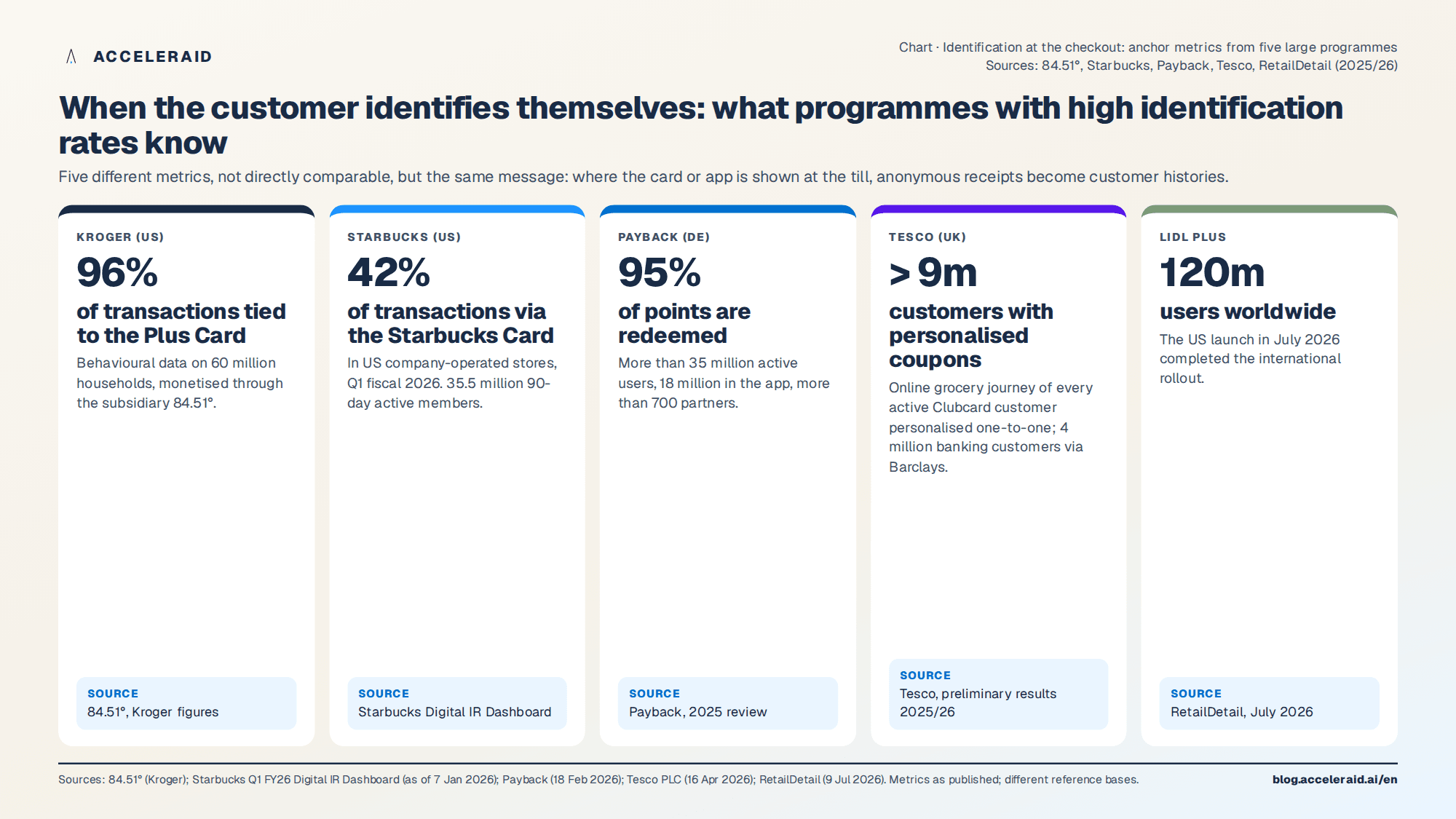
None of these figures is a credit card figure. They describe loyalty cards and apps. The co-brand credit card adds a layer that neither a loyalty card nor an app has: it also captures spend outside the partner, and it brings the bank into play as a second data holder.
The value exchange decides the opt-in
Customers hand over their data when they get something for it and trust how it is handled. In Deloitte's 2025 loyalty survey, 89 percent of Gen Z and 87 percent of millennials say they would share personal data for tailored offers (Deloitte via WSJ). An Ipsos study for Payback ranks what consumers expect from loyalty schemes: 88 percent value ease of use, 86 percent saving money and 76 percent careful handling of their data (Payback, Ipsos study).
The value exchange does not replace the legal basis, however. Slovakia's data protection authority found, when inspecting a loyalty scheme, that issuing the loyalty card could not be made conditional on consent to newsletters and advertising, because such consent is no longer freely given (decision summary at thedpo.eu). For co-brand programmes this implies a layered model: the card agreement and programme membership form the base; marketing consent and consent to profiling are separate and individually revocable; and data sharing between bank and partner is governed by contract and transparent to the customer.
Connecting offline and online
The card is the connector because it carries the same identity at every touchpoint. A purchase in store, an order in the web shop, a fill-up at the pump and a flight ticket all land under the same customer number. Only then can questions be answered that separate data worlds cannot: Does a customer buy online what they looked at in store? Is a customer migrating from the branch to the web shop, or leaving the brand? Does a coupon in the app translate into a purchase at the till?
The operators themselves show that the link works: Payback reports response rates of 60 percent on coupons, and app users redeem 50 percent more coupons than users without the app (Payback). Lidl Plus has passed 120 million users after its global rollout (RetailDetail). The credit card adds the bank's payment data, which shows where else the customer shops, how much they spend overall and whether their behaviour is changing. That this data may flow between bank and partner only with consent and only for defined purposes is not a limitation of the model; it is its precondition.
From golden record to AI personalisation
A complete customer profile is not yet personalisation. It is the data foundation on which a system can decide which customer receives which message, when and through which channel. We drew this distinction in our Customer Brain series: a Customer 360 collects, a Customer Brain decides and learns (Customer 360 is not yet a Customer Brain).
For a co-brand programme, hypothetically speaking, that looks like this: a customer who used the card only for the sign-up bonus in the first 60 days receives an activation message with an offer from the category they buy most often at the partner. A customer whose spend with the partner is falling while their total card spend stays stable is flagged as a churn risk for the partner, not for the bank. A customer who regularly revolves large amounts is not sent more spending incentives but an instalment-loan offer that reduces their risk. Each of these decisions is measured against a control group, and the outcome feeds the next decision.
The data layers that have to come together for this are clearly delineable:
Data layer | Content | Holder | Use in the programme |
|---|---|---|---|
Payment data | Spend at all merchants, categories, balances, payment behaviour | Bank | Share of wallet, risk signals, activation |
Partner transaction data | Items, store, time, channel, returns | Partner | Basket analysis, channel shifts, offer selection |
Programme data | Points balance, redemptions, tier, coupons | Programme operator | Reward steering, early warning on inactivity |
Interaction data | Responses to messages, app usage, service contacts | Both | Channel choice, frequency control, learning loop |
Consents | Purposes, channels, withdrawals, timestamps | Both, synchronised | Clearance for every single message |
The last row is the most important. Without a shared, up-to-date view of consent, no system can engage customers automatically without risking errors. BaFin has explicitly monitored customer-facing AI since July 2026 (BaFin monitors AI in finance), and bank customers' trust in AI-driven engagement is limited (Bank customers' trust in generative AI). A programme that treats consent as a technical precondition of every decision is not only compliant but also more credible.

Assessment
For bank and partner, the value of a co-brand card lies less in the spend it processes than in the identity it establishes at every touchpoint. In Europe, where the credit card plays a minor role at the checkout, this function matters all the more: it turns anonymous receipts into customer histories and separate data worlds into a profile on which AI personalisation can build. The Antavo 2026 report shows where things stall: 91 percent of programme owners struggle to analyse their loyalty data (Antavo). The data is there. What is missing is the layer that turns it into decisions.
Five takeaways
In Germany, only one payment in twenty goes through a credit card. At the checkout the customer stays anonymous unless they identify themselves via card or app.
Programmes with high identification rates show the lever: Kroger ties 96 percent of transactions to the card, Tesco personalises the online journey of every active Clubcard customer.
The opt-in follows the value exchange: ease of use, savings and careful handling of data. Consent must be freely given and separate from the card agreement.
The credit card links offline and online purchases under one identity and adds the bank's payment data to the partner's data, purpose-bound and governed by contract.
A golden record is a foundation, not a result. Personalisation only happens when a decision layer checks every message against consent and a control group, and learns from the outcome.
Illustration: AI-generated. AI-assisted content: We use AI technologies and automated agents in the creation of our articles, including from Microsoft, Google, OpenAI, Anthropic and other providers. Topics, editorial direction and final approval remain with our team.
