CLM & CVM
Co-Brand Cards, Part 5: Consumer or Commercial – Fuel Cards, Travel Cards and B2B Loyalty
Commercial cards are exempt from the interchange cap, for now. What fuel and travel cards deliver and when B2B cards build loyalty.
•
acceleraid Redaktion
7 min read
Co-Brand Cards 2026 series · Part 5 of 5. The lead article maps the market; part 4 compares points, miles and cash back.
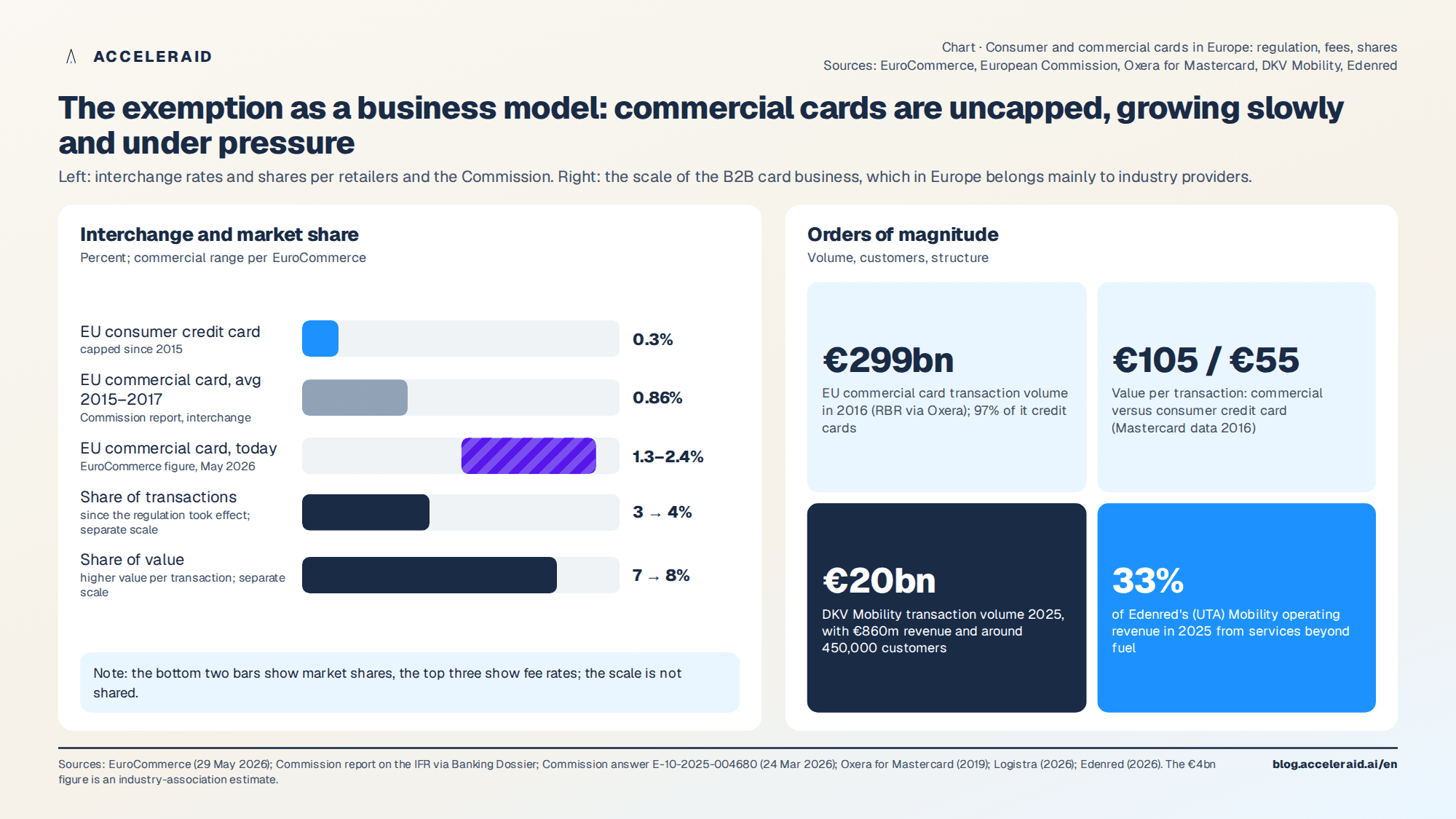
On 29 May 2026, the European retail association EuroCommerce called on the EU institutions to cap interchange fees on commercial cards. Its reasoning: while consumer cards have been capped at 0.2 and 0.3 percent since 2015, commercial card fees range between 1.3 and 2.4 percent; their share of transactions has grown from 3 to around 4 percent and their share of transaction value from 7 to 8 percent, and merchants paid at least €4 billion "too much" in 2025 (EuroCommerce). The figures are an industry position, but they describe a business that has grown in Europe precisely because it is exempt from regulation. This final part of the series asks what distinguishes commercial cards from consumer cards, what fuel and travel cards deliver, and whether a B2B card can generate loyalty at all.
What makes commercial cards different
The Interchange Fee Regulation defines commercial cards narrowly: they may only be issued to undertakings, public-sector entities or self-employed persons, used only for business expenses, and charged directly to the account of the undertaking (European Commission, answer of 24 March 2026). Within that definition, fees are unregulated. The Commission's report on the regulation put average interchange for 2015 to 2017 at 0.95 percent falling to 0.86 percent, and the average merchant service charge at around 1.2 percent (Banking Dossier, citing the Commission report); the 1.3 to 2.4 percent range EuroCommerce cites today sits above that.
Commercial cards are also a different product. According to an Oxera analysis for Mastercard, European transaction volume stood at €299 billion in 2016; 97 percent of commercial cards are credit cards, and the average transaction value was €105 compared with €55 for consumer credit cards (Oxera for Mastercard). The decisive difference is not the fee level but the separation of decision-maker and user: the company chooses the card, the employee uses it. Loyalty therefore has to reach two audiences with different interests.
Fuel cards and travel cards
The largest B2B card programmes in Europe are not bank products but industry solutions. DKV Mobility reached a transaction volume of €20 billion and revenue of €860 million in 2025 with around 450,000 customers (Logistra). At Edenred, the parent of UTA, 33 percent of the Mobility segment's operating revenue in 2025 already came from services beyond fuel, such as tolls, charging, maintenance and invoicing (Edenred). In travel, SEB Kort consolidated Eurocard's corporate cards under the AirPlus brand in September 2025, having acquired AirPlus in 2024 (SEB).
These programmes retain not through points but through integration: a fuel card that also settles tolls, records charging sessions and prepares VAT is expensive to replace. Loyalty arises from the effort of switching and from the benefit of consolidated billing, not from a reward.
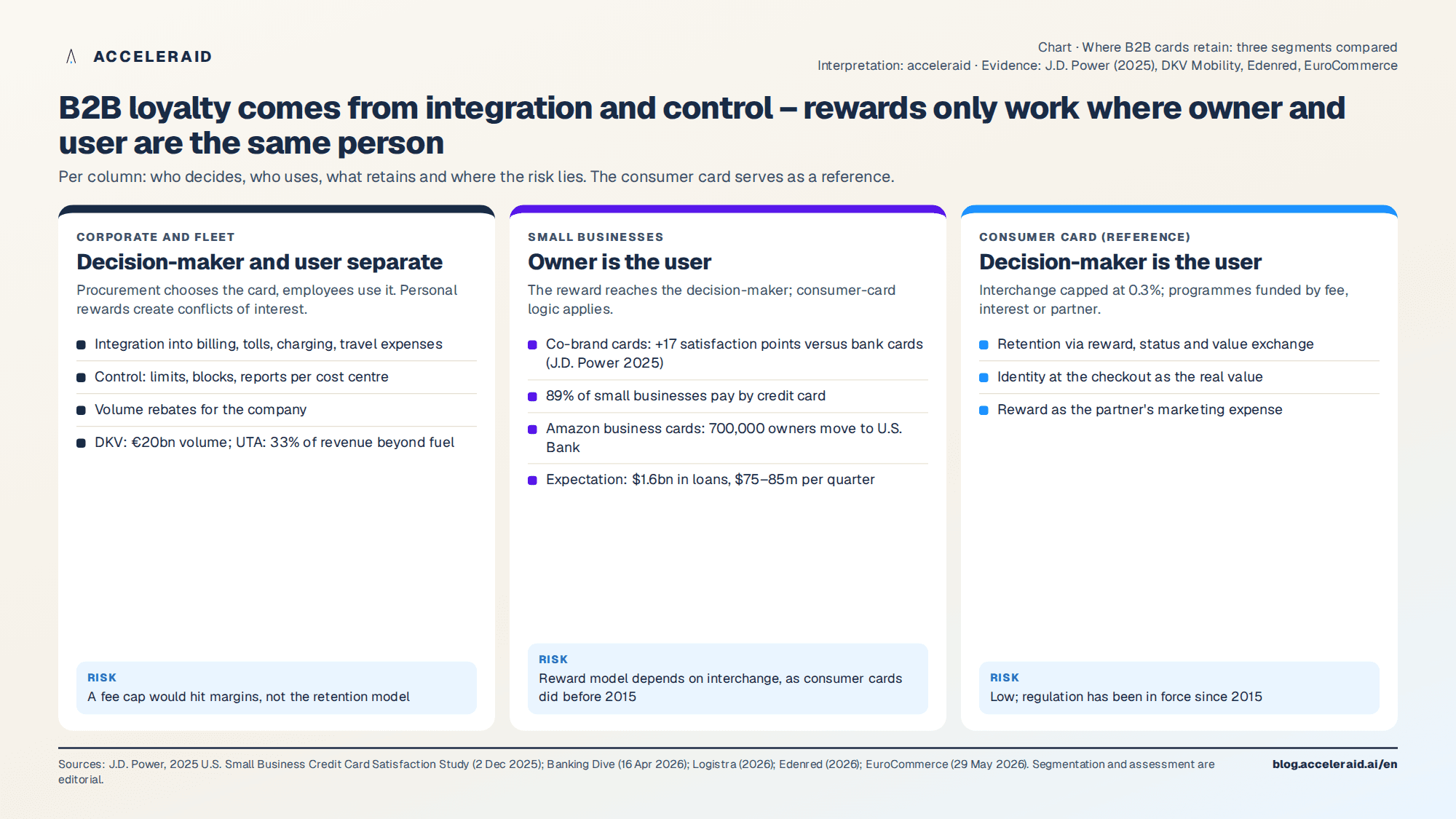
The small-business segment, where owner and user are the same person, looks different. In its 2025 US Small Business Credit Card Satisfaction Study, J.D. Power finds that co-brand small-business cards score 17 points higher than bank-branded cards, driven mainly by rewards and benefits with retail, airline and hotel partners; 89 percent of small businesses pay for purchases by credit card (J.D. Power). This is exactly the segment that is currently changing issuer: Amazon's business cards move from American Express to U.S. Bank in 2026, giving the bank access to 700,000 small-business owners and, by its own expectation, around $1.6 billion in loans and $75 million to $85 million in quarterly revenue (Banking Dive).
Feature | Consumer card | Commercial card (corporate, fleet) | Commercial card (small business) |
|---|---|---|---|
EU interchange | 0.3 percent, capped | Unregulated, 1.3 to 2.4 percent according to retailers | Unregulated, provided it qualifies as a commercial card |
Decision-maker and user | Identical | Separate: procurement decides, employee uses | Largely identical |
Retention lever | Reward, status, value exchange | Integration, billing, control, volume rebate | Reward and partner benefits, similar to consumer |
Typical transaction value | €55 | €105 | In between |
Data access | Customer consent | Contract with the company, data per card and cost centre | Contract with the owner |
Regulatory risk | Low, cap in place | High: retailers demand a cap | High, same demand |
Are B2B cards a loyalty instrument?
The honest answer is that it depends on the segment, and on what one means by loyalty.
In corporate and fleet business, personal rewards are the wrong tool. An employee who pays with the company card and collects miles privately has an incentive that does not match the employer's interest; procurement policies have to manage that conflict, and the obvious solution is to credit benefits to the company rather than the employee. Loyalty here arises from three other levers: the depth of integration into invoicing, travel expenses and fleet management; control, meaning limits, blocks and reports per cost centre; and volume rebates credited to the company. The DKV and UTA programmes are loyalty instruments in this sense: they make switching expensive because they save work.
In the small-business segment, by contrast, consumer-card logic applies. The owner decides and uses, the reward reaches them, and the J.D. Power figures show that partner benefits measurably raise satisfaction. Co-brand cards work here, but with the same dependence on interchange as the consumer business before 2015. Should the cap demanded by EuroCommerce arrive, the small-business reward model in Europe would face the same question that MBNA answered for airline cards in 2017 by withdrawing.
The lifecycle of a commercial card
What we described for consumer cards in the lead article applies to commercial cards too: value is created across the lifecycle, not at issuance. The signals are different. A fleet customer whose fuel volume per vehicle is falling while its vehicle count stays flat is filling up elsewhere. A customer who does not run tolls and charging through the card although it could is using only part of the offer. A small business whose card spend with the partner is rising while total spend stagnates is shifting purchases and is a candidate for credit lines or payment terms. Translating these signals into engagement, with control groups and a learning loop (From a static churn score to a learning retention loop), is rarer in B2B than in consumer business, but not harder. The customer count is smaller, the hierarchy of company, cost centre and card is clearer, and the value per customer is higher. We described the building blocks for this in our Customer Brain series (AI in banking: the Customer Brain roadmap).
Closing assessment for the series
Across five parts, one picture holds for consumer and commercial cards alike. In Europe, the card does not earn from payments. It earns when it identifies customers, links consent with a value exchange, brings offline and online behaviour together, and when bank and partner steer the reward by effect rather than by blanket distribution. Commercial cards enjoy the advantage of unregulated fees and the disadvantage that this advantage is under political attack. A B2B programme built on interchange is built on an exemption. One built on integration, data and lifecycle survives a cap.
Five takeaways
Commercial cards are exempt from the interchange cap. Retailers cite fees of 1.3 to 2.4 percent and have demanded a cap since May 2026; that is the biggest risk to B2B reward models in Europe.
Europe's largest B2B card programmes are industry solutions: DKV with €20 billion in volume, UTA with a third of revenue beyond fuel. They retain through integration, not points.
In corporate and fleet cards, decision-maker and user are separate. Personal rewards create conflicts of interest; loyalty arises from billing, control and volume rebates for the company.
For small businesses, consumer logic applies: co-brand cards score 17 points higher in satisfaction according to J.D. Power, and U.S. Bank is taking on 700,000 Amazon business customers on that expectation.
The lifecycle applies in B2B too: falling volume per vehicle, unused services and shifted purchases are signals that a programme with control groups and a learning loop can translate into engagement.
Illustration: AI-generated. AI-assisted content: We use AI technologies and automated agents in the creation of our articles, including from Microsoft, Google, OpenAI, Anthropic and other providers. Topics, editorial direction and final approval remain with our team.
