CLM & CVM
Many Acronyms, One Goal: How CLM, CVM, CLV and Customer Data Fit Together in the Age of AI Agents
Banks hire CVM managers, suites promise personalisation, what they mean is often cross-sell. Why sequence matters once agents make the decisions.
•
acceleraid Redaktion
8 min read

Anyone reading job adverts from banks and telecom operators at the moment comes across a role that hardly anyone knew a few years ago: TF Bank is looking for a Head of Customer Value Management, ING is filling the same position in Bucharest, Vodafone is advertising a churn and revenue-per-customer manager within Customer Value Management. The job description at Orange puts it in one sentence: maximise customer lifetime value through targeted campaigns, innovative offers and lifecycle management.
In parallel, software vendors sell Customer Lifecycle Management suites that promise personalisation. Consultancies build Customer Lifetime Value models. Data teams consolidate customer data into platforms that carry acronyms of their own. And anyone who sits in the meetings where these terms collide notices that they all describe the same goal from a different side. Satisfied customers stay, buy more and recommend. Profit follows.
The question is why this so rarely comes together in practice. And what changes once AI agents start making decisions at the customer interface.
Four terms, one goal
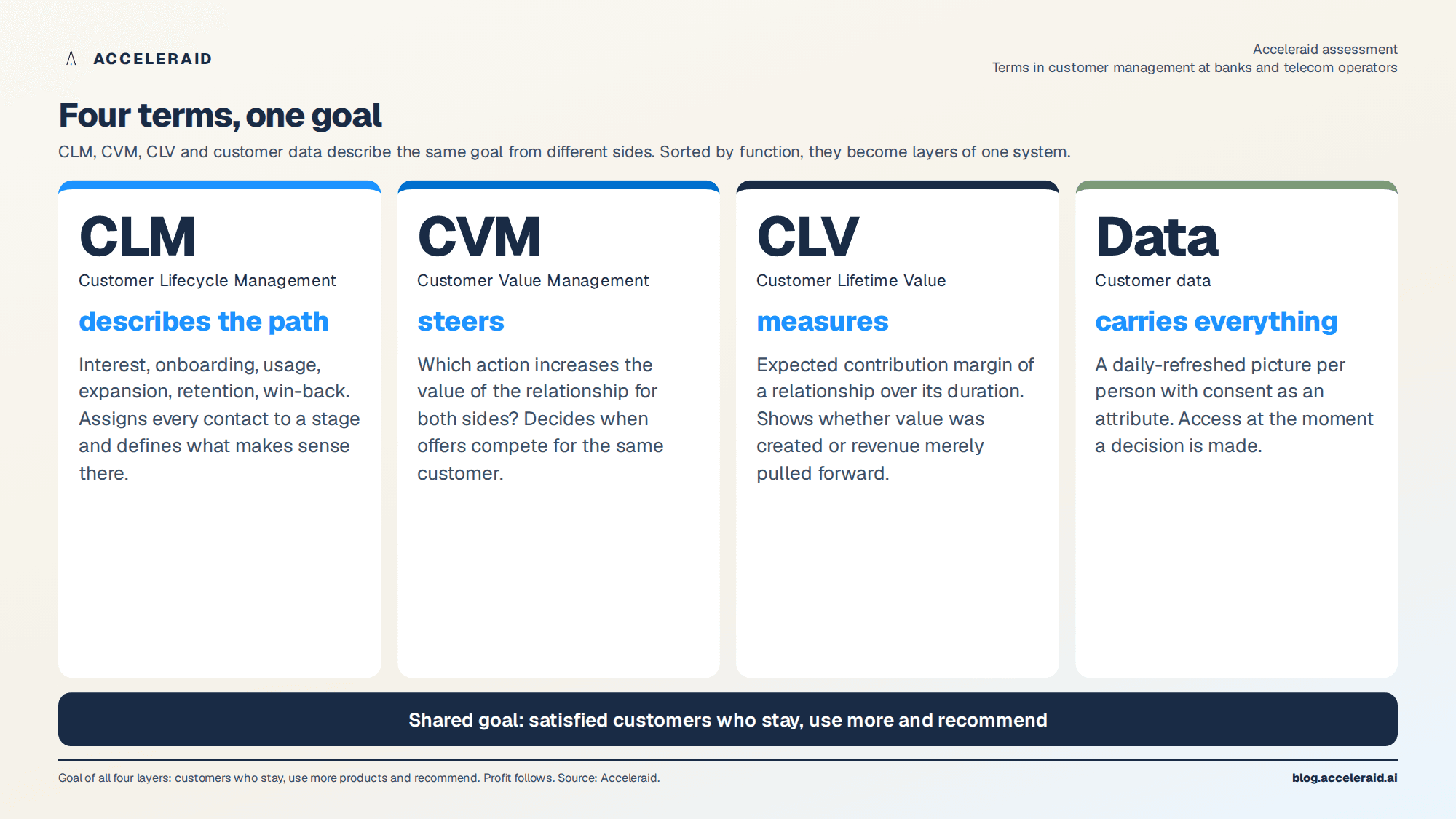
The terms are less confusing once they are sorted by function.
Customer Lifecycle Management (CLM) describes the path: interest, onboarding, usage, expansion, retention, win-back. It assigns every contact to a stage and defines what makes sense in that stage. A customer in her second week after opening an account needs something different from one who has used three products for eight years and has shown declining activity for three months.
Customer Value Management (CVM) describes the steering: which action increases the value of this relationship, for both sides? CVM originated in telecoms, where churn and revenue per customer have been measured daily for two decades, and is now moving into banking. The CVM owner decides on priorities when several offers compete for the same customer.
Customer Lifetime Value (CLV) is the measure: the expected contribution margin of a customer relationship over its duration. It shows whether an action created value or merely pulled revenue forward. Without CLV, CVM is an opinion.
Customer data is the foundation for all three. No lifecycle without signals, no steering without context, no measurement without history. The platform it sits on is secondary; what matters is that it converges into one picture per person and that access is possible at the moment a decision is made.
What "personalisation" usually means today
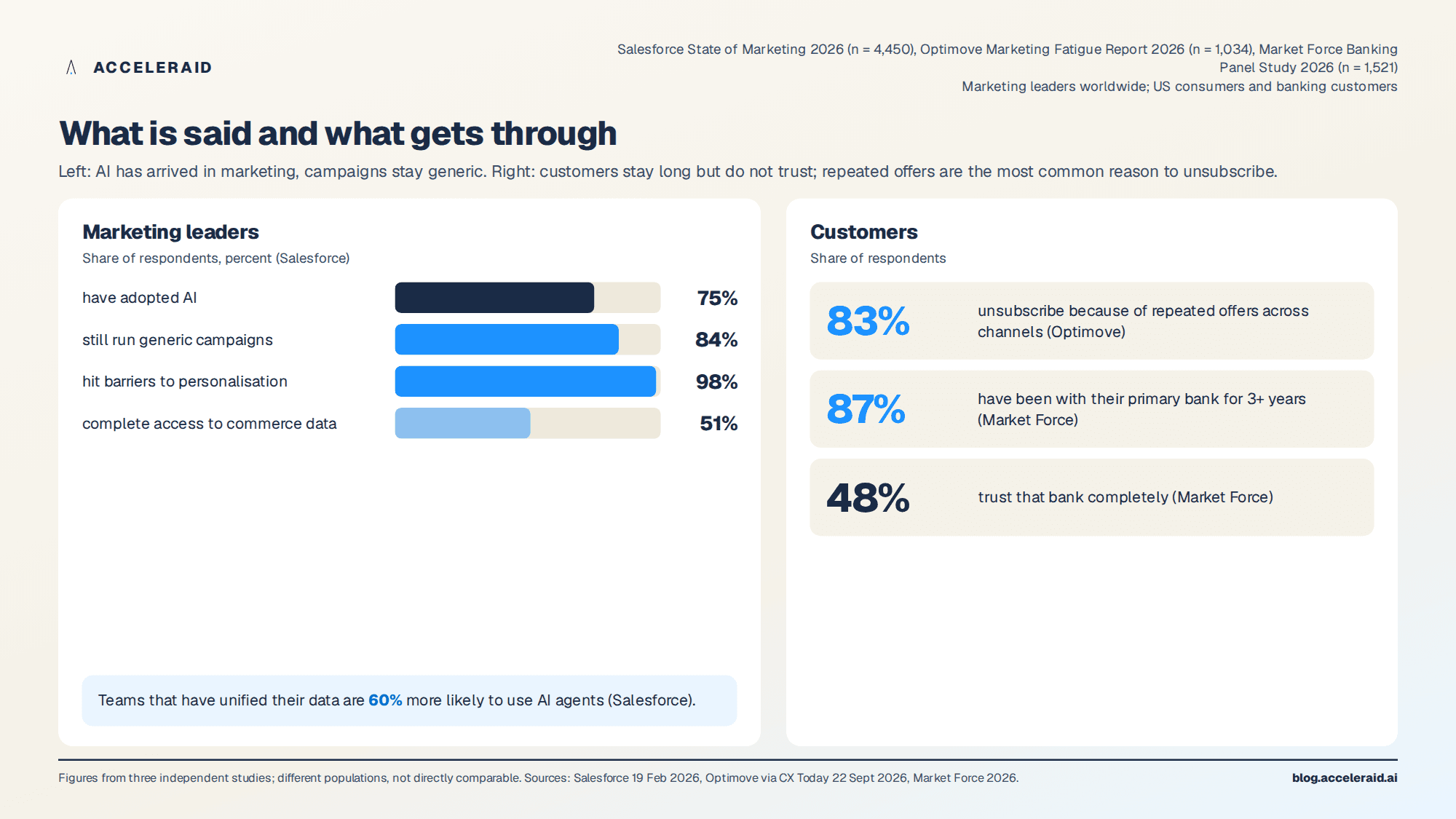
An honest stocktake is sobering. In The Financial Brand's State of Financial Marketing research, around two thirds of the definitions of personalisation come down to selecting an audience for a message. Zafin finds that two thirds of traditional financial institutions' offers are barely targeted; they ask nothing more of the customer than a sign-up. For its State of Marketing 2026, Salesforce surveyed 4,450 marketing leaders: 75 percent have adopted AI, 84 percent admit they still run generic campaigns, and 98 percent hit barriers to personalisation, mostly in the data. Only 58 percent have complete access to service data, 56 percent to sales data, 51 percent to commerce data.
In plain terms: what many institutions call personalisation is cross-selling with better audience selection. That is not a criticism of cross-selling. McKinsey shows in "At last, customers first" that 48 percent of European bank customers hold only one product with their bank, and that banks in the upper quartile of product penetration achieve 13 percent higher balances, 5 percent higher revenues and 22 percent more products per customer. More products per customer is a legitimate and necessary goal.
The problem is the sequence. When the offer is fixed first and the matching audience is sought afterwards, the result is exactly the experience that drives customers away. Optimove's Marketing Fatigue Report 2026 (1,034 US consumers) names repeated offers across several channels as the most common reason for unsubscribing: 83 percent. Customers read repetition as proof that the brand is not listening.
The consequence shows up in a figure Market Force calls the "loyalty paradox": in its 2026 Banking Panel Study of 1,521 banking consumers, 87 percent have been with their primary bank for more than three years, but only 48 percent trust it completely. Tenure is not loyalty. It is often just inertia, and inertia can be dissolved by a better offer from a competitor at any time.
Finding | Value | Source |
|---|---|---|
Definition of personalisation = audience selection | about 2 in 3 institutions | The Financial Brand 2026 |
Traditional institutions' offers without real targeting | 2 in 3 | Zafin State of Offers 2026 |
Marketing leaders with AI / still running generic campaigns | 75% / 84% | Salesforce State of Marketing 2026 (n = 4,450) |
Complete access to service, sales, commerce data | 58% / 56% / 51% | Salesforce State of Marketing 2026 |
Unsubscribes due to repeated offers across channels | 83% | Optimove Marketing Fatigue 2026 (n = 1,034) |
Customers 3+ years with primary bank / complete trust | 87% / 48% | Market Force 2026 (n = 1,521) |
Bank customers holding only one product | 48% | McKinsey/Finalta 2026 (112m relationships) |
What agents change
Up to this point the finding would be an organisational matter. AI agents turn it into a design matter, because they have one property people in marketing departments do not have: they do exactly what they are optimised for.
An agent whose objective is "offers accepted" will make offers. Many of them. It will learn that repetition across three channels raises acceptance in the short term, and it will do so until unsubscribes rise. An agent whose objective is customer lifetime value under constraints will decide differently: it will not approach a customer in week two with a loan offer, because the expected value of the relationship falls through the loss of trust. The objective that spent years as a slide in the organisation becomes configuration.
Practice is still far from this. In the Cornerstone Advisors study for Persado, 9 percent of US bank marketing teams use agents that act on their own within approved rules; 63 percent use AI for copy. In a BCG survey of 300 CMOs in June 2026, 42 percent use generative AI only for isolated tasks, and 8 percent run campaigns in which several agents operate autonomously. Salesforce reports that 81 percent of marketers would trust AI to respond to customers but are held back by disjointed or irrelevant data. Teams that have unified their data are 60 percent more likely to use agents.
The sequence this implies is the same as for the terms: data first, then the objective, then rules per lifecycle stage, then the agent. Those who procure the agent first get faster cross-selling.
An operating model in which the terms work together
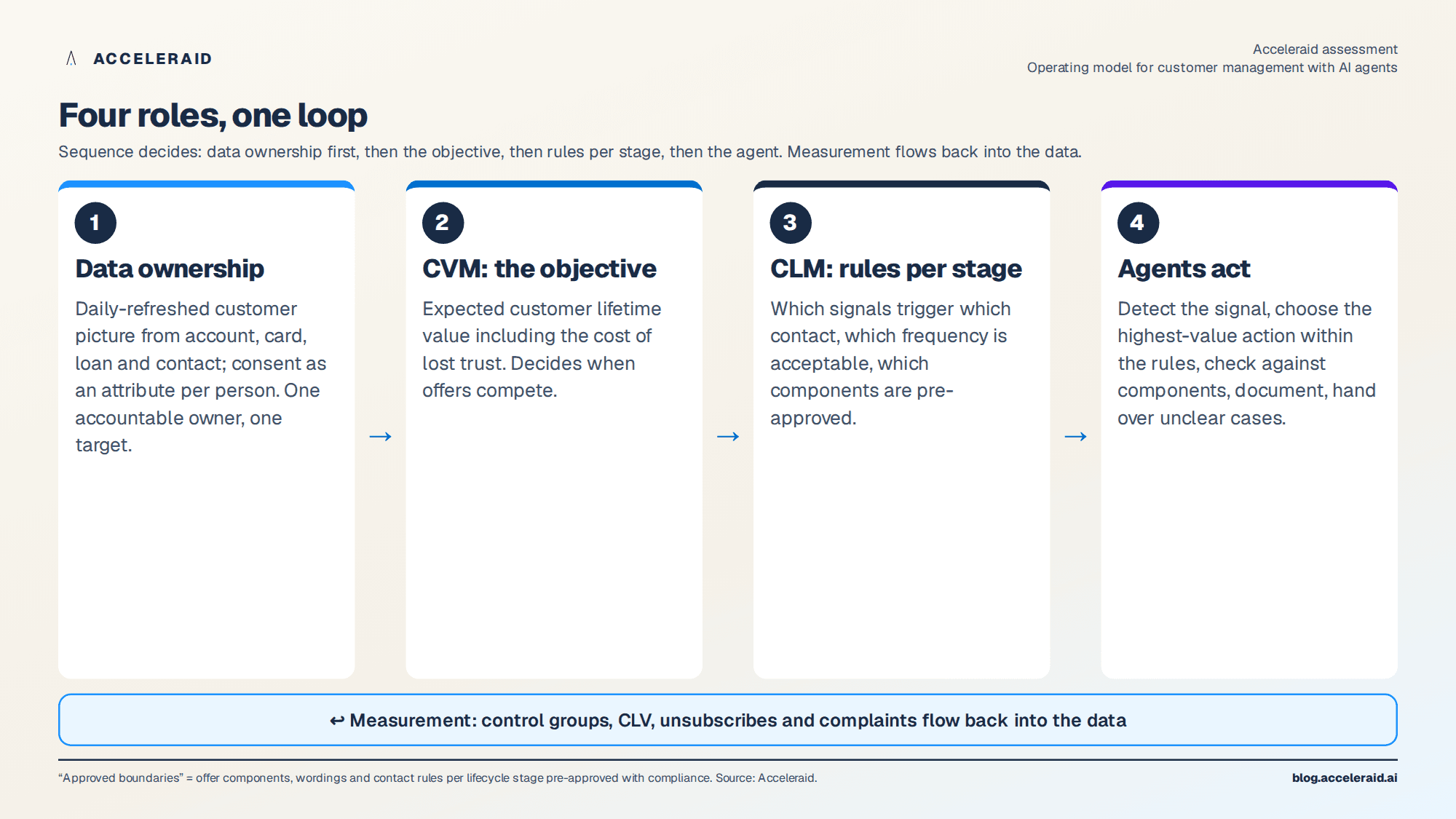
What does it look like when CLM, CVM, CLV and customer data are understood not as competing remits but as layers of one system? Four roles, one loop.
Data ownership provides a daily-refreshed picture of every customer from account, card, loan and contact behaviour, with consent and purpose limitation as attributes per person rather than a downstream check. One accountable person, one measurable target. This is the foundation without which the rest does not work.
CVM ownership defines the objective against which all actions are evaluated: expected customer lifetime value, including the cost of lost trust. It decides when offers compete, and it holds the budget for control groups, without which impact cannot be proven.
CLM ownership translates the objective into rules per stage: which signals trigger which contact, which contact frequency is acceptable in each stage, which offer components and wordings are pre-approved with compliance for which group. These rules are the "approved boundaries" within which an agent may later act.
The agents execute: they detect the signal, select within the rules the action with the highest expected customer value, check the draft against the approved components and document the decision. In deviations or unclear cases they hand over to a human. Every action flows back into the data with its outcome and improves the next decision.
Measurement closes the loop: control groups show whether the action changed behaviour; CLV shows whether value rose; unsubscribes and complaints show whether the contact rules are right.
What this means for the job advert
A bank that hires a CVM owner without having data ownership and an agreed objective will get a person who runs campaigns. That is not a reproach to the person; it is the only thing possible in that environment. Conversely, a CLM suite that promises personalisation but meets data that is two thirds scattered or batch-updated will select audiences and push offers. That is not the suite's fault either.
Three questions help check the sequence before the next hire or purchase. First: is there a daily-refreshed picture for any given customer that one person is accountable for? Second: is it agreed which objective actions are evaluated against, and does that objective include the cost of lost trust? Third: are there pre-approved rules per lifecycle stage within which an agent could act if it arrived tomorrow?
Anyone who answers all three with yes can happily mix up the terms. The organisation is already working towards the same goal.
Five takeaways
CLM describes the path, CVM steers, CLV measures, customer data carries everything; the four terms are layers of one system, not competing remits.
What is usually called personalisation today is cross-selling with audience selection: 84 percent of marketing leaders still run generic campaigns, 83 percent of consumers unsubscribe because of repeated offers.
Tenure is not loyalty: 87 percent stay with their primary bank for more than three years, but only 48 percent trust it completely.
Agents do exactly what they are optimised for; the objective moves from slide to configuration, and "offers accepted" is the wrong one.
Sequence decides: data ownership first, then the customer value objective, then rules per stage, then the agent. Those who buy the agent first get faster cross-selling.
Illustration: AI-generated. AI-assisted content: We use AI technologies and automated agents in the creation of our articles, including from Microsoft, Google, OpenAI, Anthropic and other providers. Topics, editorial direction and final approval remain with our team.
