CLM & CVM
Co-Brand Cards, Part 1: Direct or Indirect Monetization – Where the Money Is Really Made
Two P&Ls, bank and partner: interchange, fees, interest and royalties versus frequency, membership, second products and data.
•
acceleraid Redaktion
7 min read

Co-Brand Cards 2026 series · Part 1 of 5. The lead article maps the market and sets out the six questions this series answers.
Whether a co-brand card makes money directly or indirectly sounds like an accounting question. In fact it determines the design of the programme: anyone who wants to earn directly builds on fees, interest and partner payments; anyone who wants to earn indirectly builds on frequency, basket size, data and second products. Both models involve two profit-and-loss statements, the bank's and the partner's. This article lays them side by side and shows why the indirect case does not add up without customer lifecycle management.
The bank's direct case
The bank's income side has four lines. First, interchange, capped in the EU at 0.3 percent for consumer credit cards (EUR-Lex). Second, the annual fee: Deutsche Bank's Miles & More card costs €138 in Gold and €66 in Blue, while the entry-level Myflex is free and designed as a revolving card (Finanztip). Third, interest on revolving balances. Fourth, ancillary charges: Zinia's Amazon Visa charges 3.9 percent on cash withdrawals and a 1.5 percent foreign-currency fee (Stiftung Warentest).
How heavily banks depend on the third line is visible at American Express: co-brand portfolios accounted for around 26 percent of billed business at the end of 2025 but 36 percent of card loans; for Delta the ratio was 13 to 21 percent (View from the Wing, citing Amex disclosures). JPMorgan is taking on more than $20 billion in card loans with Apple Card (CNBC). The bank's direct case, in other words, is a lending case. Where customers do not revolve, as at Bilt with 15 to 25 percent instead of the expected 50 to 75 percent (Fintech Business Weekly), the largest line is missing.
On the cost side sit the payments to the partner, the sign-up bonus, the ongoing reward, credit provisions and operations. In the US, more than $28 billion flowed from banks to co-brand partners in 2022 (NerdWallet, citing CFPB).
The partner's direct case
For the partner, the card is often the highest-margin line in the accounts. Delta received $8.2 billion from American Express in 2025 (Delta); American Airlines took in $6.2 billion from card and other partners, roughly four times its adjusted operating income (Reuters). United receives around $3.2 billion from Chase (Platinum Flyer). Marriott's card royalty fees rose from $410 million in 2019 to $716 million in 2025, and 51 owners of nearly 1,000 hotels have since written to the company's leadership demanding a share (Hospitality Today).
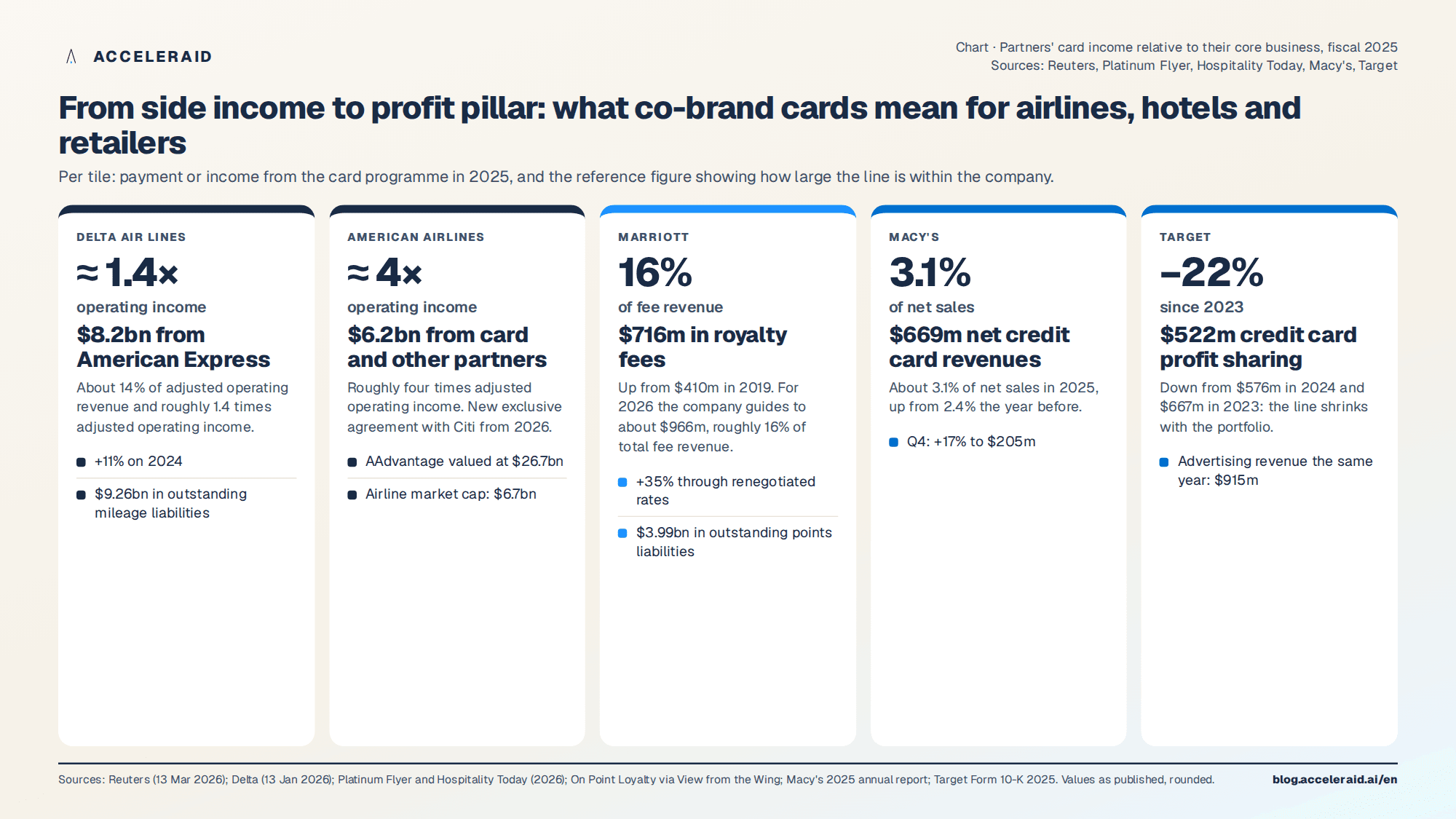
In retail the amounts are smaller but visible. Target reports credit card profit sharing of $522 million for 2025, after $576 million in 2024 and $667 million in 2023 (Target, Form 10-K 2025). Macy's booked net credit card revenues of $669 million in 2025, about 3.1 percent of net sales (Macy's, 2025 annual report). Tesco sold its banking business to Barclays for around £700 million and receives an annual royalty of about £50 million under a ten-year partnership (The Guardian). The underlying model is always the same: the partner brings the brand and customer access, the bank brings the balance sheet and the licence, and the contract splits the proceeds.
The indirect case
The indirect case begins where the card changes customer behaviour. Four effects can be documented.
Frequency and share of wallet. Researchers at the Kellogg School analysed a pilot by a Peruvian retail group that gave unbanked customers a co-brand card: their spending with the retailer roughly doubled within twelve months, and almost 70 percent of the increase came from higher shopping frequency (Kellogg Insight). In Deloitte's survey, 56 percent of loyalty members say they spend more because of the programme (Deloitte via WSJ).
Membership and retention. At Costco, the credit card requires a membership. Membership fees came to about $5.3 billion in fiscal 2025, roughly half of operating income, with a renewal rate of 92.3 percent in the US and Canada (Zacks via TradingView). The card does not earn on its own here; it stabilises the business model that does.
Second products. U.S. Bank intends to pitch further banking products to the 700,000 small-business owners it reaches through the Amazon cards (Banking Dive). Tesco serves around four million banking customers through its Barclays partnership (Tesco).
Data and media revenue. Kroger ties 96 percent of its transactions to the loyalty card and monetises data on 60 million households through its subsidiary 84.51° (84.51°). On the bank side, Chase launched Chase Media Solutions in 2024, an advertising business built on the transaction data of 80 million customers (Business Wire); the card-linked offers provider Cardlytics generated $233.3 million in revenue in 2025 (Cardlytics).
Why the indirect case fails without CLM
All four effects share one problem: they can only be measured as a difference. A customer who shops twice as often after applying for the card might have shopped more often without it. Deloitte notes that many partnership card portfolios are stagnant while the overall card market grows at about 6 percent a year (Deloitte). Without a comparison group, nobody knows whether the reward bought behaviour or merely rewarded it.
Customer lifecycle management solves this not with a year-end report but with an operating method: every measure, whether sign-up bonus, activation incentive or win-back offer, is presented to part of the target group and withheld from a comparable part. The difference is the incremental return. We described the data foundation this requires in Customer 360 is not yet a Customer Brain. Over time, these differences build a picture of which measure works for which type of customer, and engagement shifts to where the lever is greatest. We described this principle as a learning loop in our Customer Brain series (AI in banking: the Customer Brain roadmap).
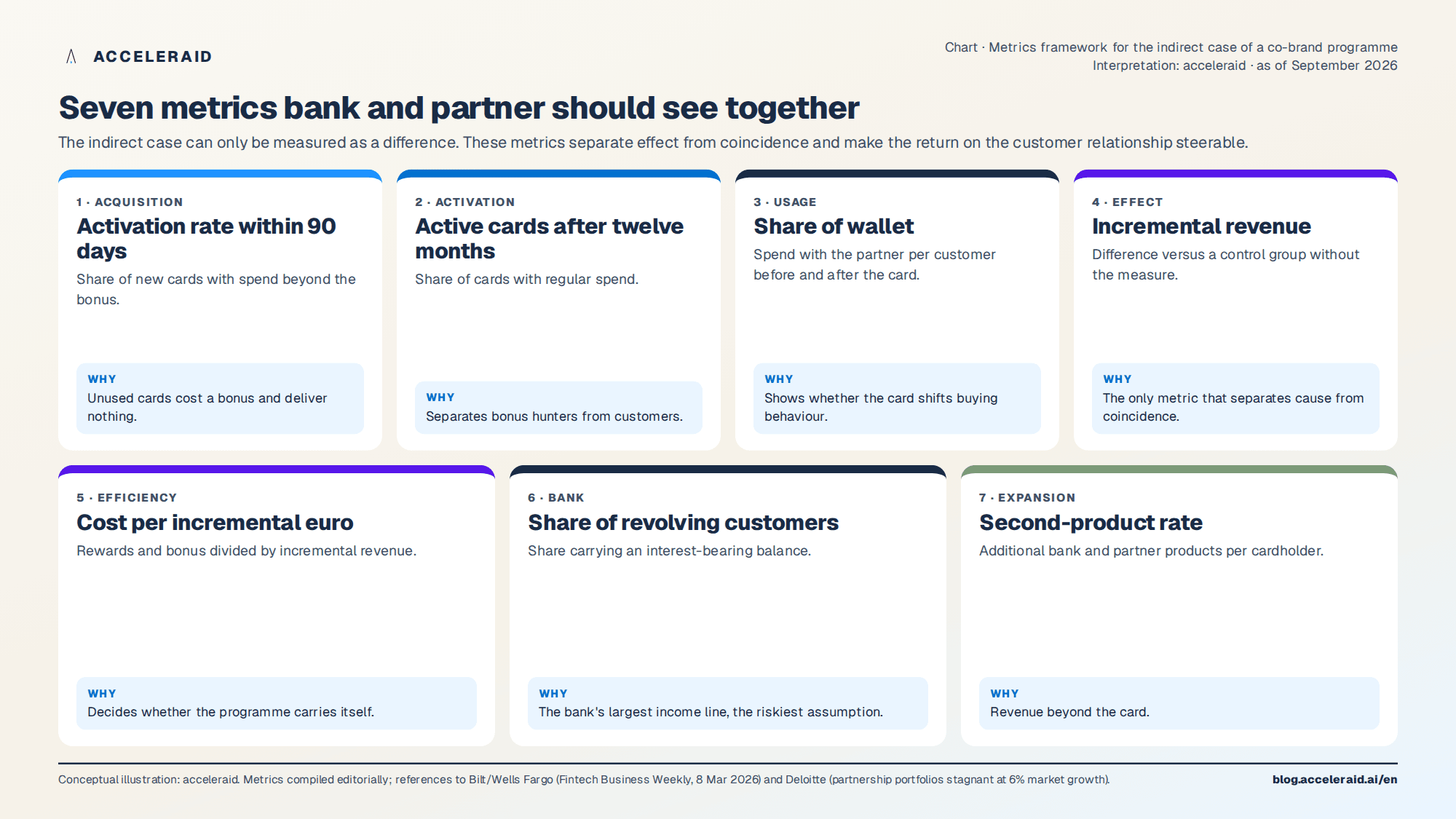
For a co-brand programme this means, in practical terms, that bank and partner need a shared set of metrics:
Metric | What it measures | Why it matters |
|---|---|---|
Activation rate within 90 days | Share of new cards with spend beyond the bonus | Unused cards cost a bonus and deliver nothing |
Active cards after twelve months | Share of cards with regular spend | Separates bonus hunters from customers |
Share of wallet | Spend with the partner per customer before and after the card | Shows whether the card shifts buying behaviour |
Incremental revenue | Difference versus the control group | The only metric that separates cause from coincidence |
Cost per incremental euro | Rewards and bonus divided by incremental revenue | Decides whether the programme carries itself |
Share of revolving customers | Share carrying an interest-bearing balance | The bank's largest income line and the riskiest assumption |
Second-product rate | Additional products per cardholder | Revenue beyond the card |
Assessment
Direct or indirect is not an either-or. In the US, partners monetise directly through royalties and banks through lending, which is why programmes there are so large and so fragile. In Europe, the interchange cap leaves both sides little direct income, so programmes either charge an annual fee or have to pay off indirectly. The card is worth it when both sides see the same metrics, run the same experiments and share the return where it arises: in the customer relationship.
Five takeaways
The bank's direct case is a lending case: at American Express, co-brand portfolios account for 26 percent of billings but 36 percent of card loans. Where customers do not revolve, the largest income line is missing.
For partners, the card is often the highest-margin revenue source: Delta $8.2 billion, American $6.2 billion, Marriott $716 million. In retail the figures range from 3 percent of sales at Macy's to $522 million at Target.
The indirect case rests on four documented effects: higher frequency, stickier membership, second products and data revenue.
Every indirect effect can only be measured as a difference against a control group. Without that measurement, a programme buys behaviour it would have received anyway.
In Europe, the indirect case is the only one that carries. It requires a shared metrics framework between bank and partner, from activation rate to cost per incremental euro.
Illustration: AI-generated. AI-assisted content: We use AI technologies and automated agents in the creation of our articles, including from Microsoft, Google, OpenAI, Anthropic and other providers. Topics, editorial direction and final approval remain with our team.
