Data & Technology
AI in Banking | Customer Brain 1/5: Customer 360 Is Not Enough
Why a complete customer view still cannot make controlled decisions, and which layers a Customer Brain needs beyond Customer 360.
•
acceleraid Redaktion
6 min read

AI in Banking · Customer Brain Series · Part 1 of 5
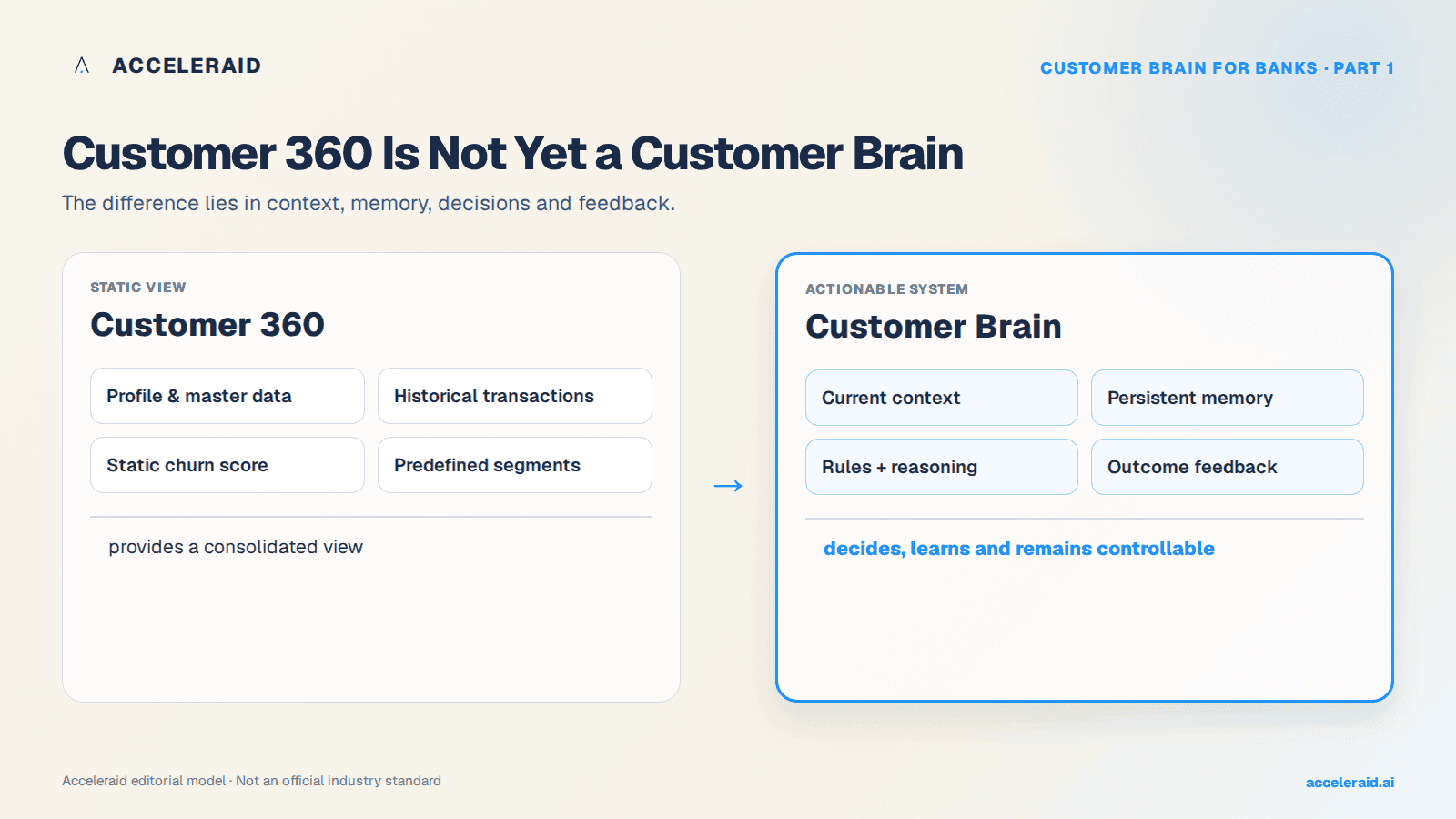
A Customer 360 view answers an important question: what do we know about this customer? A Customer Brain must answer a harder one: what matters in this situation, what may we infer from it, and which next action is appropriate? The gap between the two is not simply more AI. It is the shift from a data view to controlled decision-making.
Banks have spent years bringing customer data together. CRM records, transactions, service contacts, campaign responses and digital events now flow into data warehouses, lakehouses or customer data platforms. This is essential groundwork. But it does not yet create a system that retains context over time, understands relationships, applies policies and learns from outcomes. Customer 360 is a view. A Customer Brain is an architectural model for contextual and accountable decisions.
Customer 360 describes; a Customer Brain interprets
Customer 360 combines profiles, accounts, products, interactions and events. At its best, it provides a reliable and current basis for analysis and segmentation. That value is tangible: teams face fewer data silos and work from a more consistent record. Yet a complete view does not decide what should happen next.
Several capabilities are still missing. The system must determine which identities belong together, how events relate in time and business meaning, and which context is permitted for a given purpose. It must distinguish short-lived signals from durable knowledge. It also needs policies for consent, access, exclusions, escalation and approval. Only then can “the customer has product A and event B” become a reasoned recommendation.
This is why a language model alone is insufficient. An LLM can process language and formulate conclusions. It does not automatically know the authoritative customer identity, valid consent, current product eligibility or the bank policy governing a specific action. Those facts and constraints must come from controlled systems.
“The Customer Brain is no longer a distant vision. The necessary technical building blocks are available today. We are no longer facing a research problem, but an implementation and governance challenge. What matters is connecting data, models, memory and agents in a way that makes data protection, access rights, business rules and human control part of the architecture from the outset.” — Michael Altendorf, CEO of Acceleraid
Three situations reveal the difference
Churn: A Customer 360 view can display falling usage, declining balances, repeated service contacts or a lack of response. A Customer Brain would not translate those signals indiscriminately into a campaign. It would need to consider their sequence, open complaints, product status, contact preferences and exclusion rules. The appropriate action might be a service call, a restrained information message, an offer or deliberately no outreach. The important output is not only a score, but a justified choice among permitted options.
Onboarding: A dashboard shows which steps are complete. A Customer Brain would interpret where progress has stalled, which information has already been provided and whether a reminder would help or annoy. It could distinguish a technical drop-off from pending identity verification or limited product understanding. The next action would remain policy-bound, including permitted channels, time limits and the point at which a person takes over.
Complaint context: An isolated marketing process may detect a cross-sell opportunity while the service team knows that a complaint is open. A Customer Brain must connect the two and give the complaint priority. It should make previous commitments, case status and tone available without exposing more personal data than the task requires. The result is not necessarily an automated reply. It is first a safe context for the right person or process.
These examples expose the core principle: value does not come from the largest possible data pool. It comes from relevant context, explicit rules and a controllable action.
Memory does not mean unlimited retention
The word “Brain” can be misleading. It should not imply an all-knowing customer store. For banks, that would be neither operationally sound nor compatible with responsible data protection. European data protection authorities stress that AI models trained with personal data are not automatically anonymous; both anonymity and the legal basis require case-by-case assessment (EDPB Opinion 28/2024).
A robust Customer Brain therefore uses purpose-bound memory. It retains only the context required by a defined use case, separates roles and purposes, and records where information came from. Forgetting, deletion and correction matter as much as recall. Complaint history relevant to resolving a case, for example, should not automatically enter every sales decision.
Regulation also follows the specific function. The EU AI Act explicitly classifies creditworthiness assessment and credit scoring of natural persons as high-risk, while excluding fraud detection from that particular category (EU AI Act, Annex III). An information assistant, a churn recommendation and a credit decision should therefore not operate under one generic “AI” control model. Risk, data access and human oversight need to be set per use case.
Moving from visibility to action
The practical route does not start with an enterprise-wide Brain platform. It starts with a bounded decision problem. A bank can select one use case, specify permissible data sources, establish identity and context logic, and constrain the available actions. It can then measure outcomes, interventions and exceptions. Governance becomes part of the design rather than a review performed at the end.
At least five distinct layers are needed:
reliable data and identities,
business meaning and relationships,
purpose-bound memory,
decisioning and policy checks,
controlled action with feedback.
Keeping these layers separate prevents a generative model from becoming the data source, decision-maker and executor at the same time. It also creates auditable hand-offs between technology, business teams, data protection, information security and model risk management.
In this model, Acceleraid should not be presented as a Customer Brain delivered today. Its factual role is that of a controlled customer-activation layer: it makes customer and transaction signals usable for segmentation, predictive decisioning, triggers and personalised activation. This can support a bank’s move from a consolidated view to supervised action without replacing its data warehouse, lakehouse or CDP. The existing article on dynamic banking engagement platforms explains how such a layer can sit between core systems and customer dialogue.
Customer 360 therefore remains important. It is the data foundation, not the target architecture. A Customer Brain begins where identity, meaning, memory, policies and actions are connected into a controllable decision process. Part 2 of this series examines each architectural component in detail.
The complete Customer Brain series
Lead article: The Customer Brain roadmap · Part 1: Customer 360 is not enough · Part 2: Architecture · Part 3: Data and governance · Part 4: Retention loop · Part 5: Maturity model
Illustration: AI-generated. AI-assisted content: We use AI technologies and automated agents in the creation of our articles, including from Microsoft, Google, OpenAI, Anthropic and other providers. Topics, editorial direction and final approval remain with our team.
Further Insights
We use cookies 🍪
Strictly necessary cookies, such as for Pipedrive forms, remain active. With your consent, we also use Google Analytics for analysis and Leadfeeder for visitor identification. You can find further information in our privacy policy.
Decline
Accept all