Data & Technology
AI in Banking | Customer Brain 4/5: The Retention Loop
How banks can contextualise churn signals, select permissible interventions and feed outcomes into the next controlled cycle.
•
acceleraid Redaktion
7 min read

AI in Banking · Customer Brain Series · Part 4 of 5
A churn score usually answers a narrow question: how similar is this customer to earlier customers who later left? Retention requires more. A bank also needs to understand what is changing now, which reason is plausible, which response is permissible and whether that response actually helped. A periodic ranking must therefore become a controlled learning loop.
The objective is not a guaranteed extension of the customer lifecycle. It is a testable impact hypothesis: if relevant signals are placed into the right context faster, a bank may respond earlier, more appropriately and with greater restraint. Whether that produces renewed use, a resolved complaint or a more stable relationship must be measured as an outcome.
Why a static churn score lacks context
A conventional score may be calculated weekly or monthly. It compresses features such as usage frequency, spending trends, product holdings or response history into a probability. This can support prioritisation, but it has three limits.
First, the number rarely explains the current cause. Falling card use might indicate churn, but it could also reflect travel, a replacement card, seasonal spending or a temporary technical issue. Second, the score ages between calculations. A newly opened complaint can change the appropriate action within minutes. Third, risk does not equal permission to act. Consent, channel policies, contact frequency, open service cases and sensitive contexts may rule out an intervention.
A dynamic approach does not discard the model. It places the model’s output in a temporal and business context. Prediction, event and policy remain separate. “High risk” becomes a reviewable decision situation rather than an automatic campaign assignment.
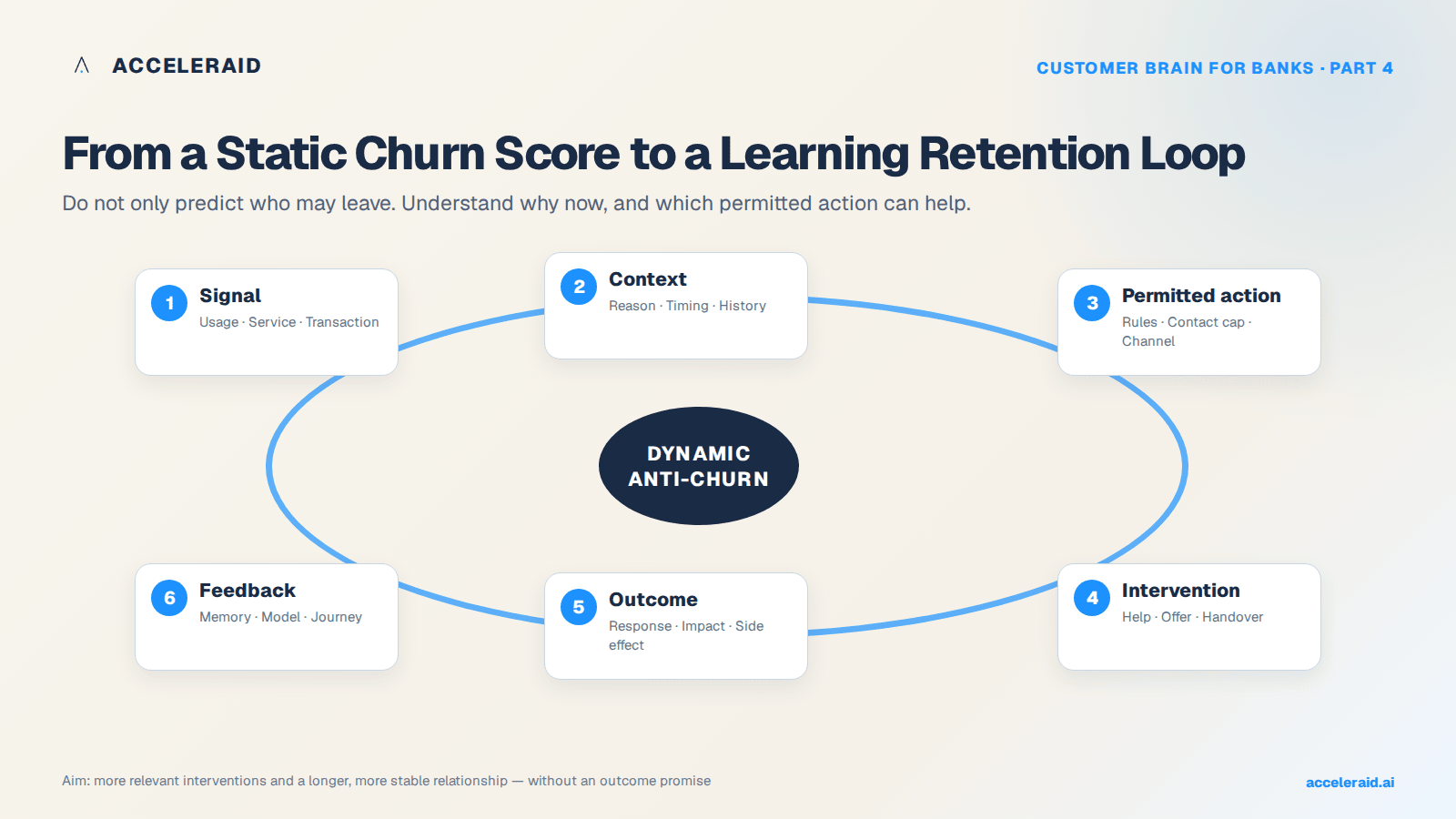
The loop: signal → context and reason → permissible action → intervention → outcome → feedback
1. Signal. The loop starts with an observable change: no card transaction within the expected period, an abandoned onboarding step, two contacts about the same service problem or withdrawn consent. A signal is not yet a diagnosis.
2. Context and reason. The system adds time sequence, product status, current service cases and known exclusions. It may rank possible reasons as hypotheses, but it must not present them as facts. “Card use is falling” is an observation; “the customer is using another bank” remains an assumption without reliable evidence.
3. Permissible action. Options are now checked against policy. Is outreach allowed? Which channel is approved? Is there a suppression? Must a person decide? Would no action be better? For personal data, even the choice of legal basis requires a concrete assessment. The European Data Protection Board describes a three-step test for legitimate interest and warns against treating a privacy notice as sufficient evidence of people’s reasonable expectations (EDPB Opinion 28/2024).
4. Personalised intervention. Only now is a message, service prompt, task or handover prepared. Personalisation does not mean maximising individualisation. It means limiting timing, tone, channel and content to the permitted context. Where risk is higher or confidence lower, a person retains approval.
5. Outcome. Measurement goes beyond a click. Depending on the use case, an outcome might be completion of an onboarding step, resumed normal card use, a resolved complaint, acceptance of service assistance, an opt-out or deliberately no change. Negative outcomes and complaints belong in the record as well.
6. Feedback. The result informs the next decision as an updated feature, adjusted policy, changed priority or new test hypothesis. Feedback does not automatically mean continuous model training. In regulated environments especially, model changes require versioning, testing and approval.
Five situations, five different responses
Card inactivity: A longer pause can be a useful signal. Before retention outreach, however, the bank should check card status, replacement-card processes, known technical issues, normal usage pattern and the permitted channel. The appropriate intervention may be a factual service message. A discount is not automatically the best response.
Onboarding drop-off: The last completed step provides more context than a general churn score. A technical failure may justify practical assistance; pending identity verification may call for clear process information; repeatedly ignored reminders may indicate that no further message is appropriate. The impact hypothesis is easier completion, not pressure.
Possible financial strain: Transaction patterns may suggest a difficult situation, but they do not prove it. Any such inference requires tightly limited purpose, restricted access and human review. It should not feed opportunistic cross-selling. A neutral service option or signpost to available support may be more appropriate. The bank must avoid asserting a sensitive condition that it has only inferred probabilistically.
Complaint recovery: An open or recently resolved complaint should override sales activity. The loop can determine that a confirmation, status update or personal handover must come first. Success here is not revenue. It is correct resolution and a sustainable reopening of the dialogue.
Service handover: When a digital process fails repeatedly, uncertainty is high or a person explicitly asks for support, ordered context should transfer to an employee. Nearly all German utilities covered in one industry review treated human handover as essential, reserving complex, sensitive and emotional matters as well as payment difficulty for human teams (ZFK). Although the sector differs, the operating principle is relevant to bank service: a handover is not a failure of the loop; it is a permissible action.
Learning means testing, not confirming the system’s assumptions
A retention loop needs an evaluation design. Each intervention should have a target metric, observation window, comparison group, exclusion criteria and defined potential harms. A higher open rate can coincide with more complaints. Card use can resume without any intervention. Without a comparison, correlation is easily mistaken for impact.
Control groups, holdouts or phased rollouts therefore belong in the architecture. Fairness and quality checks matter as well: are some customer groups contacted more frequently? Does a feature create unacceptable proxy effects? How often does service override a suggested action? How often does the system deliberately withhold intervention? The answers should improve policies and prioritisation, not only the model.
Michael Altendorf, CEO of Acceleraid, summarises the technical starting point: “The necessary technical building blocks are available today.” That does not mean implementation is complete. Data quality, accountability, access, approvals, evaluation design and governance determine whether those components become a dependable retention loop.
From predictive decisioning to controlled activation
Within this bounded process, Acceleraid can bring customer and transaction data together, apply predictive decisioning, generate triggers, prepare a next best action and support controlled activation. The defensible claim is a closed workflow of scoring, triggering, personalisation and optimisation. It does not imply a finished Customer Brain, a knowledge graph or persistent shared memory. Nor does it imply autonomous model training without business control.
A practical starting point is one portfolio, one well-defined situation and one target metric. Banks should first build a loop with a small set of permissible actions, observe impact and exceptions, and expand only afterwards. The existing article on the closed loop in customer lifecycle management explains the operating logic in more detail. The test remains simple: not whether the system acts more often, but whether it enables a permissible, explainable and demonstrably helpful intervention in the right context.
The complete Customer Brain series
Lead article: The Customer Brain roadmap · Part 1: Customer 360 is not enough · Part 2: Architecture · Part 3: Data and governance · Part 4: Retention loop · Part 5: Maturity model
Illustration: AI-generated. AI-assisted content: We use AI technologies and automated agents in the creation of our articles, including from Microsoft, Google, OpenAI, Anthropic and other providers. Topics, editorial direction and final approval remain with our team.
Further Insights
We use cookies 🍪
Strictly necessary cookies, such as for Pipedrive forms, remain active. With your consent, we also use Google Analytics for analysis and Leadfeeder for visitor identification. You can find further information in our privacy policy.
Decline
Accept all