CLM & CVM
Customers First, At Last: What McKinsey's Numbers on AI Personalization Mean for How Banks Manage Customers
48% of bank customers hold one product; banks contact them 3 to 5 times less often than fintechs. McKinsey's findings and what they mean for banks.
•
acceleraid Redaktion
6 min read

European banks have spent years investing in apps, data platforms and campaign tooling. Yet almost half of their customers hold a single product, and the number of banking relationships per customer keeps rising. In early September 2026, McKinsey published an analysis titled "At last, customers first" that puts numbers to this contradiction and outlines an AI-enabled model for customer value management (CVM). This article weighs the findings and draws out what they mean for how banks run the customer lifecycle.
The finding: plenty of digitisation, little depth in the relationship
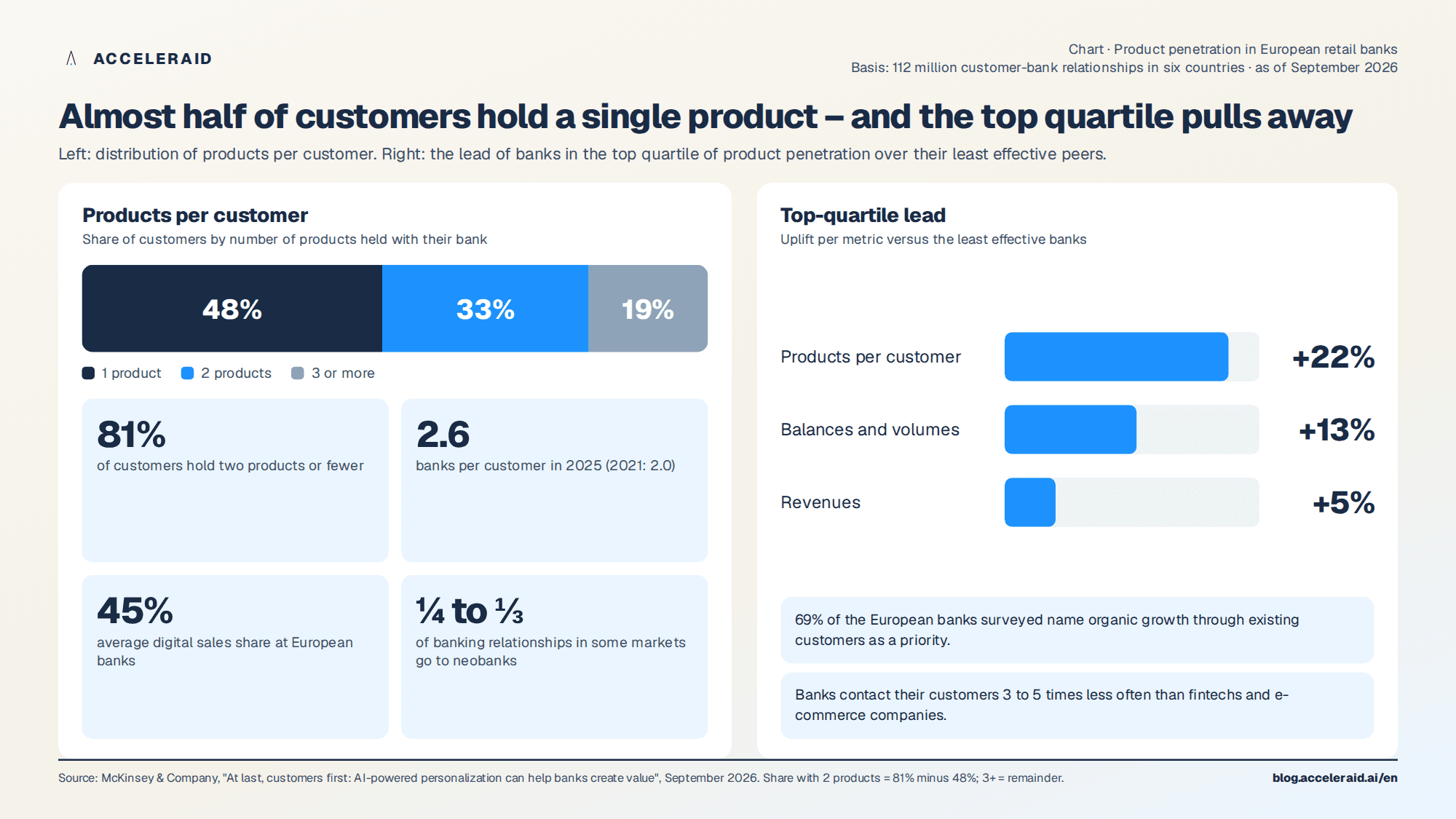
According to McKinsey, banks spend roughly 600 billion US dollars a year on technology worldwide. European banks now average 45 percent digital sales, and 99 percent of service interactions take place digitally. At the same time, competition for attention and share of wallet reached its highest level in 2025: across six European countries surveyed, customers held accounts at 2.6 banks on average in 2025, up from 2 in 2021. Digital-first neobanks attract a quarter to a third of banking relationships in some markets.
The real weakness lies in the depth of the relationship. McKinsey analysed 112 million customer-bank relationships across six European markets: 48 percent of customers hold only one product with their bank, and 81 percent hold two or fewer. Banks in the top quartile of product penetration achieve 13 percent higher balances, 5 percent higher revenues and 22 percent higher product ownership per customer than their least effective peers. Sixty-nine percent of the European banks surveyed name organic growth through existing customers as a priority. The lever is well known; execution lags the ambition.
Four components of AI-enabled customer value management
McKinsey describes the target state as a "hyperpersonalised" CVM model with four components: customer data and decisioning, personalised campaigns and journeys, measurement and marketing technology, and operating model and talent. None of this is a new architecture, but it is a clear order of priorities.
On data, the analysis explicitly advises against building all-encompassing pipelines first. It is more effective to start from specific use cases and connect only the data types those use cases need: digital activity, responses to earlier campaigns, transactions and interactions with staff. Most banks already run analytical models that suggest the next relevant offer, but these are too static and generate too few and too narrow occasions. They should be complemented by near-real-time triggers drawn from transactions and customer activity, for instance thresholds for changes in a current account balance that prompt savings or lending communication. All of it subject to privacy law and the customer consent framework.
Contact frequency: banks communicate three to five times less often
Perhaps the most important single finding concerns contact frequency. McKinsey's benchmarks show that banks communicate three to five times less frequently with customers than fintechs or e-commerce companies do. Leading institutions replace a handful of generic monthly mailings with regular, sometimes daily, personalised outreach and decide what to offer, when to reach out and through which channel. Based on observed implementations, frequency can rise to one message every one to two days before customers start opting out at a significant rate.
For banks this is a delicate statement. The headroom exists only when the content is relevant. Sending the same product message more often burns the trust that makes the number possible in the first place. Any increase in frequency therefore needs a robust contact rule per customer that weighs service notices, commercial impulses and regulatory communications against each other, plus real-time monitoring of opt-out rates. Equally notable is the finding that customers who receive a high volume of service-related alerts, such as suspicious-login warnings, new-payee notices or loan-payment reminders, generate 30 percent more sales. Service is not the opposite of sales; it is its precondition.
The order of personalisation and the value of the journey
A typical email contains up to 15 personalisable elements, McKinsey notes: the offer, images, wording, the call to action and more. The recommended sequence is fixed: personalise the product and its presentation first, then adjust channel and timing, and refine pricing last. In the projects cited, generative AI raised content production speed by 15 to 20 percent and improved click-to-lead conversion by up to 25 percent. Banks that sequence initial and follow-up contacts with discipline improved lead generation by up to 70 percent.
The step after the click matters just as much. One European bank increased the conversion rate of its mobile current-account opening journey fivefold, from below 2 percent to close to 10 percent, by removing obstacles in digital onboarding: easier identity verification, a clear explanation of why data is collected and how it will be used, less data entry and a layout adapted to each device. Personalisation does not end with the impulse; it runs through to the completed journey.
Measurement and operating model decide whether it scales
As the result of rigorous execution, McKinsey reports 20 to 30 percent higher customer engagement, 10 to 25 percent higher customer value and 15 to 25 percent better customer experience. Ranges like these can only be substantiated with end-to-end performance measurement: a dashboard across every channel, including branches and CRM (customer relationship management) systems, that shows which campaign led to which sale. The recommended order for technology is to define commercial objectives and use cases first and derive the tooling from them.
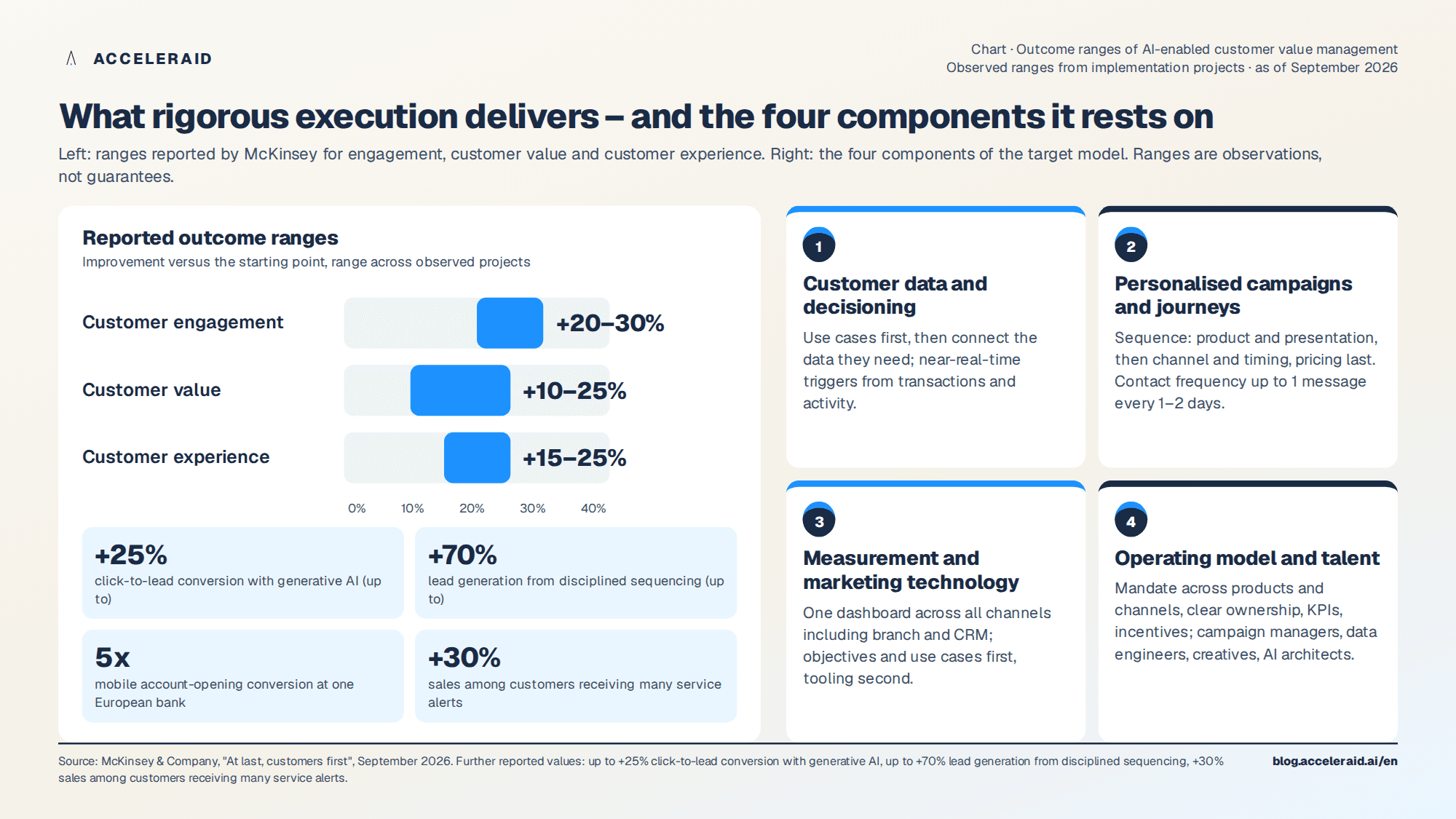
On the operating model, the analysis treats the move from product-led to customer-led campaigning as an organisational task: a mandate that cuts across products and channels, clear ownership for data collection, analytics, decisioning and execution, defined KPIs (key performance indicators) and incentives, and a structured governance process. The roles required are campaign managers and operators, data engineers and scientists, creative designers and AI platform architects. To get started, McKinsey recommends three steps: diagnose the biggest gap across the four components, pilot one or two commercial use cases such as cross-selling or usage growth, and only then scale across customers, products and channels.
What this means for running the customer lifecycle
Seen through a customer lifecycle management lens, the analysis confirms three things that many institutions have yet to put into practice. First, the bottleneck is not model quality but the number and breadth of occasions generated from events. Second, frequency is a control parameter, not a taboo, provided contact rules, consents and opt-out signals run alongside it. Third, without measurement that links event, decision and outcome across channels, every value claim remains an estimate. McKinsey's figures come from consulting engagements and benchmarks and carry no guarantee; they do, however, describe a direction that any institution can test against its own data.
Five takeaways
Forty-eight percent of bank customers in six European markets hold one product and 81 percent hold two or fewer; the top quartile achieves 22 percent more products per customer and 13 percent higher balances.
Banks reach out to customers three to five times less often than fintechs; up to one message every one to two days is feasible when relevance and outreach rules hold.
Service alerts are a precondition for sales: customers who receive many security and status notices generate 30 percent more sales.
Personalisation follows an order: product and presentation first, then channel and timing, pricing last; the journey after the click decides whether the sale closes.
Scaling requires cross-channel measurement and an operating model with a mandate across products; start with one or two piloted use cases rather than a full rebuild.
Illustration: AI-generated. AI-assisted content: We use AI technologies and automated agents in the creation of our articles, including from Microsoft, Google, OpenAI, Anthropic and other providers. Topics, editorial direction and final approval remain with our team.
