CLM & CVM
Co-Brand Cards, Part 3: Who Bears Which Costs? Bank, Partner and the Interchange Question
0.3 instead of 1.8 percent: what the interchange cap did to programmes, what Costco, Amazon, Apple and Bilt teach, and how the numbers can work in Europe.
•
acceleraid Redaktion
7 min read

Co-Brand Cards 2026 series · Part 3 of 5. The lead article maps the market; part 2 shows the card as the key to the golden record.
When Costco declined to renew its contract with American Express in 2015, Amex chief executive Kenneth Chenault explained the retreat in one sentence: "The numbers didn't add up." Costco had been paying Amex about 0.6 percent per purchase; Citi and Visa offered terms under which, according to people involved, Costco's card costs would be "virtually nothing". Ten percent of Amex's 112 million cards were Costco cards (Bloomberg). The case is the template for co-brand negotiations since: the partner knows what its customer access is worth, and the bank must decide whether it can pay the price. This article lays out the cost split and why it works out differently in Europe.
What the interchange cap changed
In the US, a co-brand programme is funded from three sources: interchange averaging around 1.8 percent, above 2 percent for premium cards, plus interest and annual fees (Head for Points). In the EU, the first source has been capped at 0.3 percent for consumer credit cards since 2015; commercial cards and three-party schemes, where issuer and network are the same company, are exempt (EUR-Lex, Regulation (EU) 2015/751). The editor of Head for Points summed up the consequence: if you earn 0.3 pence per pound, you cannot buy a mile from an airline for 0.5 to 1 pence. MBNA withdrew eight airline cards in 2017, including Miles & More, Emirates Skywards and United MileagePlus (This is Money).
The two exemptions explain how the remaining German programmes are built. The Payback credit card is an American Express card (American Express), a three-party product outside the cap. Deutsche Bank's Miles & More card charges €138 a year in Gold and €66 in Blue and awards one mile per two euros spent (Finanztip). Zinia's new Amazon Visa awards one point per euro at Amazon, in other words 1 percent, well below the discontinued Landesbank Berlin card (Stiftung Warentest). All three routes, exemption, fee or lower reward, are answers to the same gap.
Who pays for what
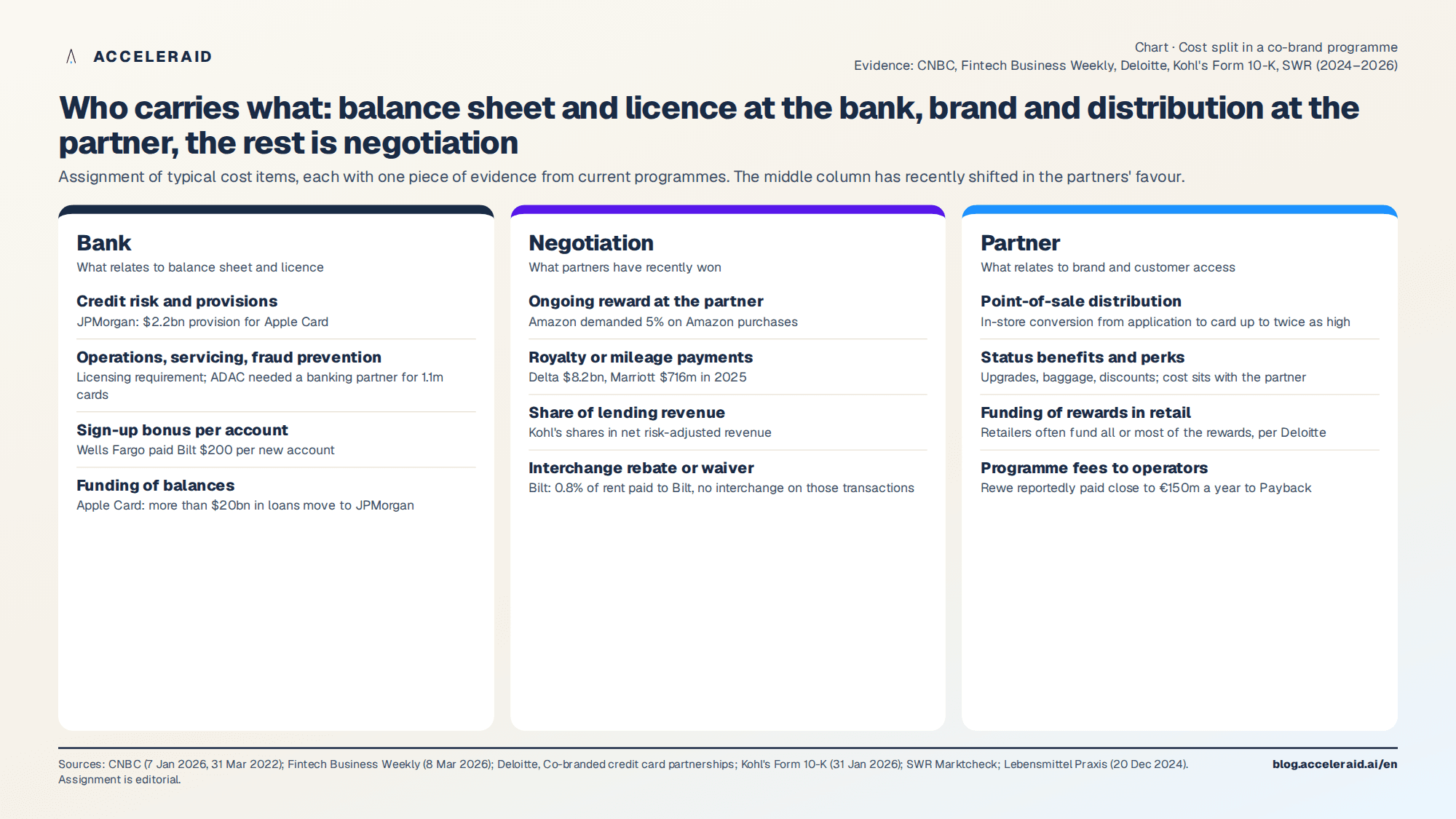
The cost split in a co-brand contract follows no standard, but it does follow a recognisable pattern. The bank carries what relates to balance sheet and licence; the partner carries what relates to brand and customer access; everything in between is negotiable.
Item | Typically borne by | Evidence |
|---|---|---|
Credit risk and provisions | Bank | JPMorgan books a $2.2 billion provision for Apple Card (CNBC) |
Operations, servicing, fraud prevention | Bank | Licensing requirement; ADAC needed a banking partner for 1.1 million cards (SWR) |
Sign-up bonus per account | Bank, partly partner | Wells Fargo paid Bilt $200 per new account (Fintech Business Weekly) |
Ongoing reward at the partner | Negotiable | Amazon demanded 5 percent on Amazon purchases; retailers often fund all or most of the rewards (CNBC, Deloitte) |
Royalty or mileage payments to the partner | Bank to partner | Delta $8.2 billion, Marriott $716 million in 2025 |
Share of lending revenue | Bank to partner | Kohl's shares in the portfolio's net risk-adjusted revenue (Kohl's, Form 10-K) |
Interchange rebate or waiver | Bank to partner | Bilt: 0.8 percent of rent paid to Bilt, with no interchange on those transactions (Fintech Business Weekly) |
Point-of-sale distribution, status benefits | Partner | In-store conversion from application to card up to twice as high (Deloitte) |
When the numbers do not add up: five cases
Amazon. When Amazon solicited bids for its Prime programme with an estimated 150 million US members in 2021, it demanded a permanent 5 percent reward, a share of loan revenue and an interchange rebate. American Express and Synchrony bid; Chase kept the programme after two decades (CNBC). The small-business cards are nonetheless moving from Amex to U.S. Bank in 2026 (Banking Dive).
Apple. Goldman Sachs lost more than $1 billion on Apple Card. American Express, Synchrony and Barclays dropped out of the bidding; JPMorgan is taking over more than $20 billion in loans and booking a $2.2 billion provision (CNBC).
Walmart. Capital One and Walmart ended their agreement early in 2024 after disputes (Reuters); since 2025 Walmart has issued its cards through OnePay and Synchrony (CNBC).
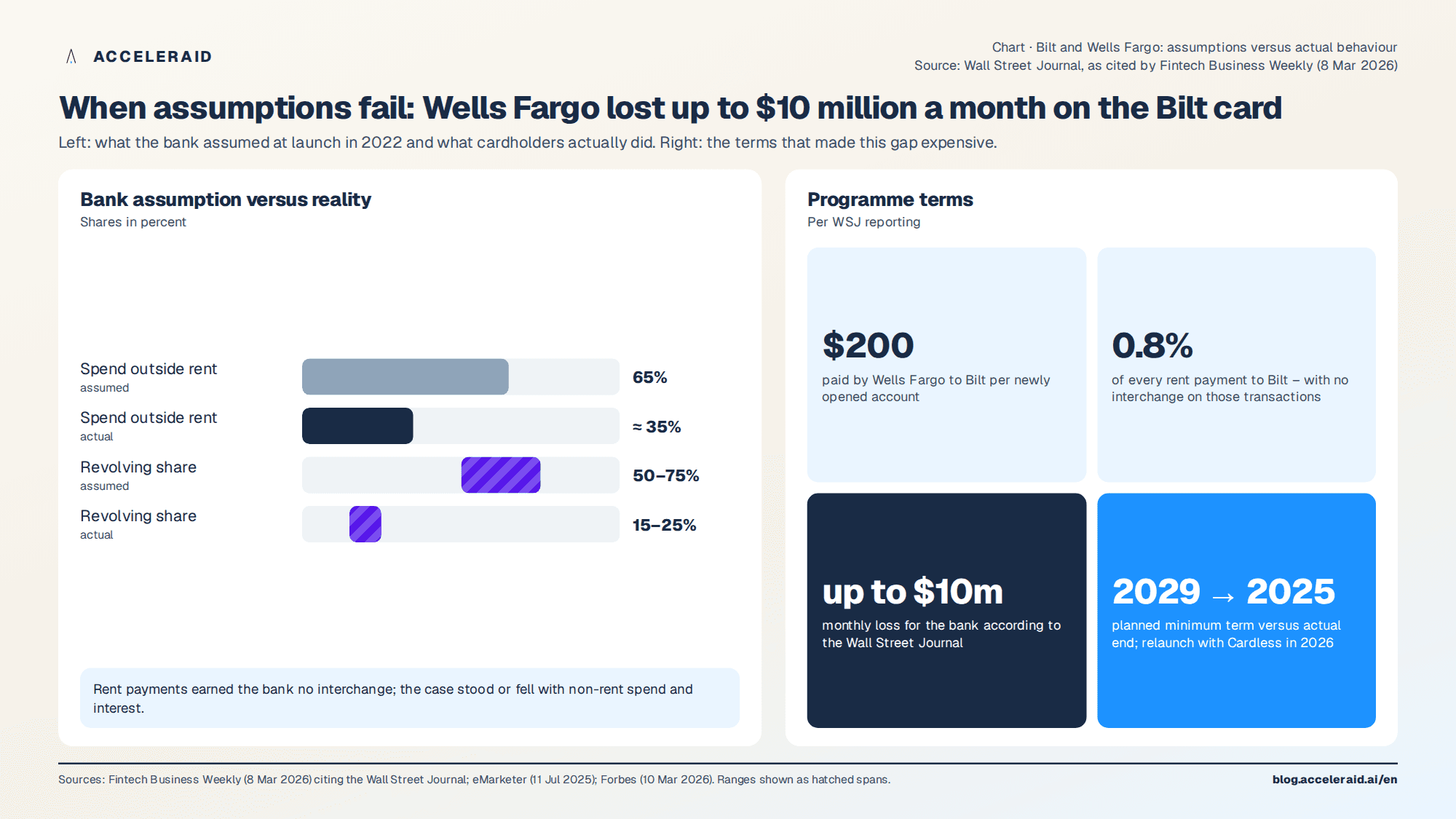
Bilt. Wells Fargo paid $200 per account and 0.8 percent of every rent payment without earning interchange on those transactions. The bank's assumptions missed: 65 percent of spend expected outside rent, 35 percent realised; 50 to 75 percent expected to revolve, 15 to 25 percent realised (Fintech Business Weekly, citing WSJ reporting).
Rewe. This case shows the partner's side: Rewe left Payback at the end of 2024 and is reported to save close to €150 million a year in fees (Lebensmittel Praxis). Partners, too, check whether the programme is worth its price.
How the numbers can work in Europe
A worked example, explicitly hypothetical: a customer spends €3,000 a year with the partner on the card. At a reward of 1 percent, that costs €30. At 0.3 percent interchange, the bank earns €9. Without an annual fee and without a revolving balance, €21 is missing before operations, risk and bonus are paid for. Only the partner can close that gap, and only if the card brings it more than €21 in additional margin.
This is the difference from the US model: in Europe the reward is not a by-product of payments but a marketing expense of the partner, and marketing expenses have to prove their effect. A programme that pays the reward evenly to all cardholders also pays for customers who would have bought anyway. A programme that steers the reward per customer can raise it where it changes behaviour and lower it where it does not. We described the metric for this in part 1: cost per incremental euro.
That has consequences for the contract. Bilt and Wells Fargo had agreed a term running to at least 2029 and locked in terms based on assumptions that proved wrong within months. A contract that provides for data sharing, shared metrics and adjustment mechanisms for reward and bonus is safer for both sides than one that guarantees fixed rates for ten years. We showed what such adjustment looks like in day-to-day operation using churn prevention as the example (From a static churn score to a learning retention loop). McKinsey's analysis of customer value management shows how large the lever is when banks align their engagement with actual customer value (McKinsey: AI personalisation in banks); in a co-brand programme that applies to both contracting parties.
Assessment
Is a programme still worth it on the bank's side? In Europe, yes, on three conditions. First, the card is a fee-based product or a deliberately revolving product whose lending income carries the case. Second, the card gives the bank access to customers it would otherwise not reach, with permission to offer them second products. Third, the reward is funded by the partner as a marketing expense and steered by effect. If any condition is missing, the programme ends the way Bilt, Apple Card or MBNA's airline cards did: the numbers do not add up.
Five takeaways
In the US, a co-brand programme is funded from interchange of around 1.8 percent, interest and fees. In the EU it is 0.3 percent, which is why the reward here has to be paid by the partner or the customer.
The Interchange Fee Regulation's exemptions for three-party schemes and commercial cards explain why the Payback credit card is an Amex and why Miles & More charges an annual fee.
The bank carries credit risk, operations and bonus; the partner carries brand, distribution and status benefits. Reward, royalty and revenue share are negotiable, and partners have recently won those negotiations.
Costco, Amazon, Apple, Walmart and Bilt show the same pattern: where the bank's assumptions about spend outside the partner and revolving usage fail to materialise, the programme ends.
In Europe the reward is a marketing expense of the partner. It pays off only when it is steered per customer by effect and the contract provides for data sharing, shared metrics and adjustment mechanisms.
Illustration: AI-generated. AI-assisted content: We use AI technologies and automated agents in the creation of our articles, including from Microsoft, Google, OpenAI, Anthropic and other providers. Topics, editorial direction and final approval remain with our team.
