CLM & CVM
Co-Brand Cards, Part 4: Points, Miles or Cash Back – Which Reward Actually Retains
68 percent prefer cash back, SkyMiles is worth $31.8 billion: what customers say, what balance sheets show and why the answer is per customer.
•
acceleraid Redaktion
6 min read

Co-Brand Cards 2026 series · Part 4 of 5. The lead article maps the market; part 3 covers the cost split between bank and partner.
At the end of 2025, Delta carried $9.26 billion in liabilities for miles not yet redeemed (Delta, full-year 2025 results), and Marriott $3.99 billion in outstanding Bonvoy points (Platinum Flyer). A proprietary currency is a loan that customers extend to its issuer, and at the same time the strongest retention tool a programme owns. Cash back, by contrast, is immediate, intelligible and closed on the balance sheet, but it retains only as long as it keeps flowing. Which reward is right depends on what the programme is meant to achieve and what it can afford.
What customers say
The surveys are unambiguous when customers are asked directly. In a PayPal and Reach3 study of 1,068 US adults, 68 percent prefer cash back for its simplicity and 32 percent prefer points; 81 percent say rewards influence their shopping and payment behaviour (Chief Marketer). The Wise Marketer Group reports from its survey of 1,000 US consumers that 90 percent are willing to switch brands, 23 percent frequently and 65 percent given the right incentive (The Wise Marketer). In Germany, 86 percent of respondents in an Ipsos study for Payback name saving money as their main motive (Payback, Ipsos study).
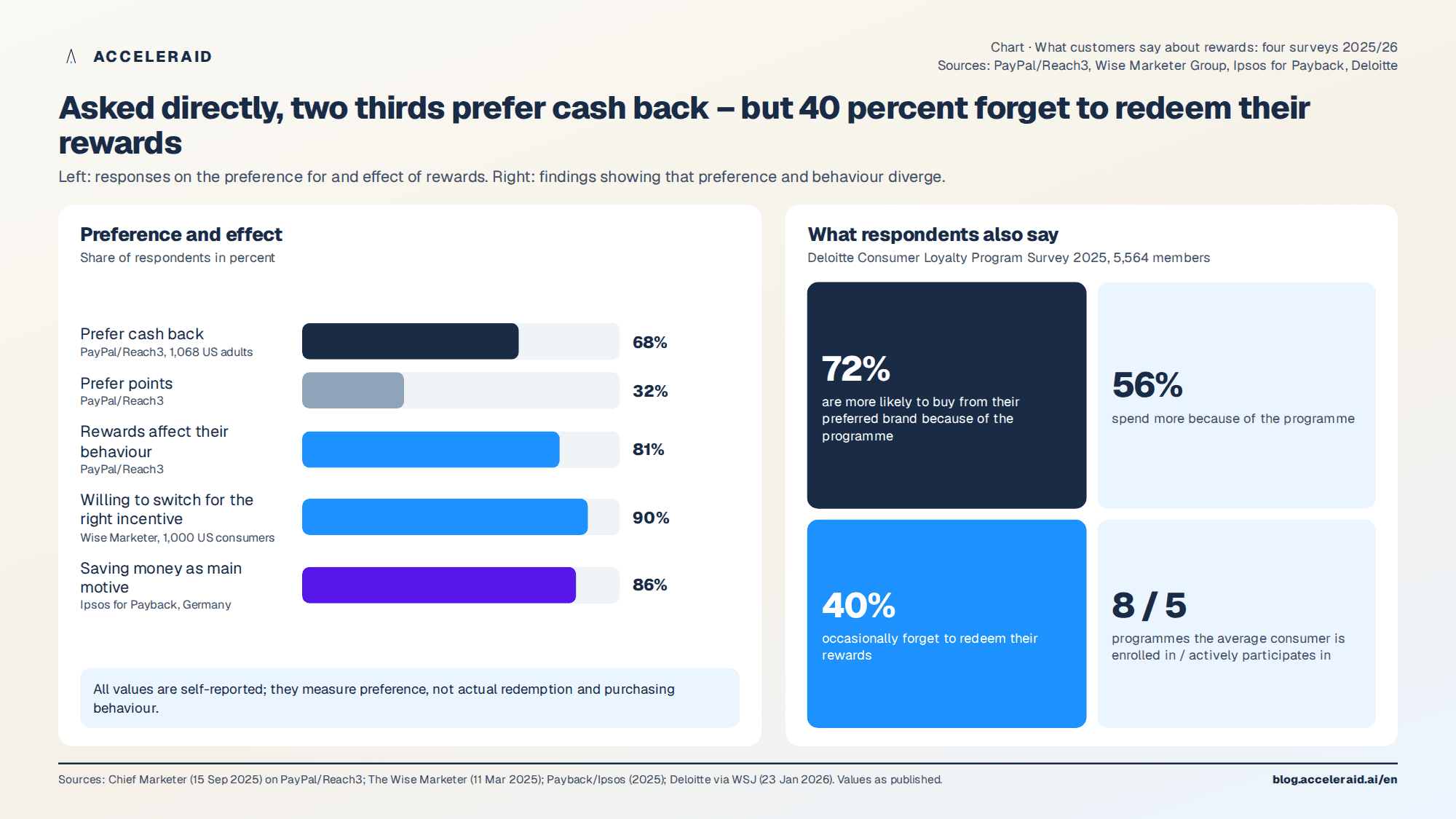
The surveys have one weakness, though: they measure preference, not behaviour. In the same survey in which 72 percent say programmes make them more likely to buy, Deloitte finds that 40 percent of members occasionally forget to redeem their rewards (Deloitte via WSJ). For the programme operator, that forgetting is a gain with points and a non-event with cash back.
What the programmes say
The balance sheets of the mileage programmes tell the other side. On Point Loyalty values Delta SkyMiles at $31.8 billion, American AAdvantage at $26.7 billion, United MileagePlus at $25.3 billion and IAG Avios at $10.3 billion; American Airlines' entire market capitalisation stood at $6.7 billion at the same time (View from the Wing, citing On Point Loyalty). These values arise because the programmes sell their currency to banks before customers redeem it, and because they set the value of the currency themselves.
That is exactly where the risk for the customer lies. IdeaWorks found that the payback of rewards in the US has fallen by about half since 2019, as airlines cut or eliminated mileage earning on the cheapest tickets. Since April 2026, United awards only three miles per dollar to members without a card and at least six to cardholders (Reuters). The currency is devalued, and the card becomes the condition for earning at full value at all.
In German retail the movement runs the other way. Rewe has left Payback and since 2025 has awarded euro credits instead of points: ten or twenty cents, sometimes a euro or more per promotional item, plus 10 percent off the first shop of the following month once monthly spend reaches €400 (Lebensmittel Praxis). Payback itself usually awards one point per two euros, or 0.5 percent; consumer advice centres put loyalty card discounts generally at 0.5 to 3 percent (Merkur). On Apple Card the reward is called Daily Cash and amounts to 1, 2 or 3 percent depending on the channel (PPC Land). Citi's Costco Anywhere Visa shows how finely cash back can be tiered: 5 percent on fuel at Costco, 4 percent on other fuel and EV charging up to $7,000 a year, 3 percent on restaurants and travel, 2 percent on all other Costco purchases and 1 percent elsewhere (Citi). The tiering steers spend to where the partner wants it without any need for a proprietary currency.

The decision as a table
Criterion | Proprietary currency (points, miles) | Cash back |
|---|---|---|
Intelligibility | Low; value depends on redemption | High; the value is the amount |
Cost to the operator | Controllable via redemption value, expiry and non-use | Fixed; every percentage point costs a percentage point |
Balance sheet | Liability until redemption | Expensed immediately |
Retention effect | High with status and goal saving; falls with devaluation | Low; works only while it flows |
Partner fit | High; the currency can be sold to banks and partners | Low; cash back is not tradeable |
Trust risk | Devaluations are perceived as broken promises | Minimal; a cut is visible but honest |
Data value | Redemption yields preference signals | Few additional signals |
The question is wrongly posed
Whether points or cash back retain better cannot be answered for a programme, only for a customer. A customer saving for a flight responds to miles; a customer paying for the weekly shop responds to euros; a customer who holds the card only for the sign-up bonus responds to nothing the programme should pay for permanently. A programme that pays everyone the same reward therefore pays everyone too much or too little.
This presupposes that customers trust the engagement; our review of the Deloitte survey shows where bank customers stand (Trust of bank customers in generative AI). Customer lifecycle management allows a different kind of steering: the base reward stays uniform and intelligible, but the additional incentives, whether bonus points for a category, a euro coupon for a repeat purchase or a status extension, are allocated per customer by expected effect and measured against a control group. It is the same mechanism we described for churn prevention as a learning loop (From a static churn score to a learning retention loop), only with the reward as the control variable. After a year the programme knows which segments respond to which reward, and the points-versus-cash-back debate becomes an allocation question with data rather than a matter of principle with opinions.
For bank and partner this has a practical consequence: a proprietary currency remains sensible where it has a target value the customer is working towards, that is, in travel, status and larger purchases. Cash back or euro credits are superior where purchases are frequent and amounts small. Both can be combined in one programme if the allocation is made by customer rather than by product.
Five takeaways
Asked directly, customers prefer cash back: 68 to 32 percent in the PayPal study, and 86 percent name saving money as their main motive at Payback. But surveys measure preference, not behaviour.
Proprietary currencies are assets for their issuers: SkyMiles is valued at $31.8 billion and AAdvantage at $26.7 billion, more than the airline's market capitalisation.
The price is devaluation: the payback of US rewards has halved since 2019, and the card is becoming the condition for earning. Rewe is going the opposite way with euro credits.
Points are controllable and stretched across the balance sheet; cash back is intelligible and honest. The choice is a trade-off between cost, retention and trust.
The question must be answered per customer, not per programme. With a uniform base reward and individually steered add-on incentives, measured against control groups, it becomes a data question.
Illustration: AI-generated. AI-assisted content: We use AI technologies and automated agents in the creation of our articles, including from Microsoft, Google, OpenAI, Anthropic and other providers. Topics, editorial direction and final approval remain with our team.
