CLM & CVM
Customer Lifecycle and Customer Value Management for Banks: Lead Article to the Five-Part Series
The lead article to the five-part series: Acquire, Activate, Engage, Retain and Reactivate as one operating system for retail banking.
•
acceleraid Editorial Team
6 min read

This article is part of a six-piece reading path comprising one lead article and five operating phases:
The CVM series at a glance
Customer Lifecycle Management for banks is not a new concept — what is new is the expectation to run it based on real-time signals and AI-powered decision logic instead of rigid campaign calendars. This article structures the field: What Customer Lifecycle Management for banks actually encompasses today, which phases, signals, and tech-stack building blocks belong to it — and why the business case behind it is better proven than the buzzword might suggest. For those who want to read about the individual phases in detail, you can find them in our five-part CLM Retail Banking Series ↗; this article provides the high-level overview.
What Customer Lifecycle Management means for banks
Customer Lifecycle Management (CLM) in banking refers to the systematic management of the customer relationship across successive phases — from acquisition and activation to growth, maturity, and retention — based on behavioral and transactional data instead of static segments. The difference from classic campaign management lies in the cadence: CLM responds to signals that change daily, not to quarterly plans. It is precisely this cadence that is increasingly becoming a competitive factor, because the underlying customer relationship itself has changed.
Global retail banking revenue exceeded $3.14 trillion in 2023, with growth accelerating from a 5.3% CAGR (2013–2020) to a 7.6% CAGR (2020–2023) (McKinsey, October 2024 ↗). At the same time, the banking relationship is diluting: The average number of banking relationships per US consumer rose from 2.6 (2021) to 3.2 (2023) (McKinsey, October 2024 ↗). Growth therefore no longer occurs automatically from the mere account relationship — it must be actively maintained and expanded. This is the economic foundation upon which Customer Lifecycle Management for banks is built.
Why primary customer status must be hard-won today
German customers interact with their bank an average of 134 times a year, 72 per cent of those interactions digitally. Yet only 41 per cent of sales are completed digitally; only 20 per cent of surveyed banks in Germany and Austria offer end-to-end in-app journeys, compared with 79 per cent of mobile-first leaders (McKinsey German Retail Banking Snapshot 2025 ↗).
Digital reach is also high: 86 per cent of people in Germany use online banking and 44 per cent say they never visit a branch (Bitkom 2025 ↗). Usage, completion and primary status are nevertheless different. CVM must make these transitions measurable rather than merging them into a generic engagement metric.
The counter-test is essential. BCG reports that under rigorous incrementality measurement, 20 to 40 per cent of active next-best-action programmes deliver only marginal or negative incremental lift. They redirect existing demand instead of creating new impact (BCG 2026 ↗). A CVM programme succeeds only when it creates additional, controlled and measured value.
The four lifecycle phases and their signals
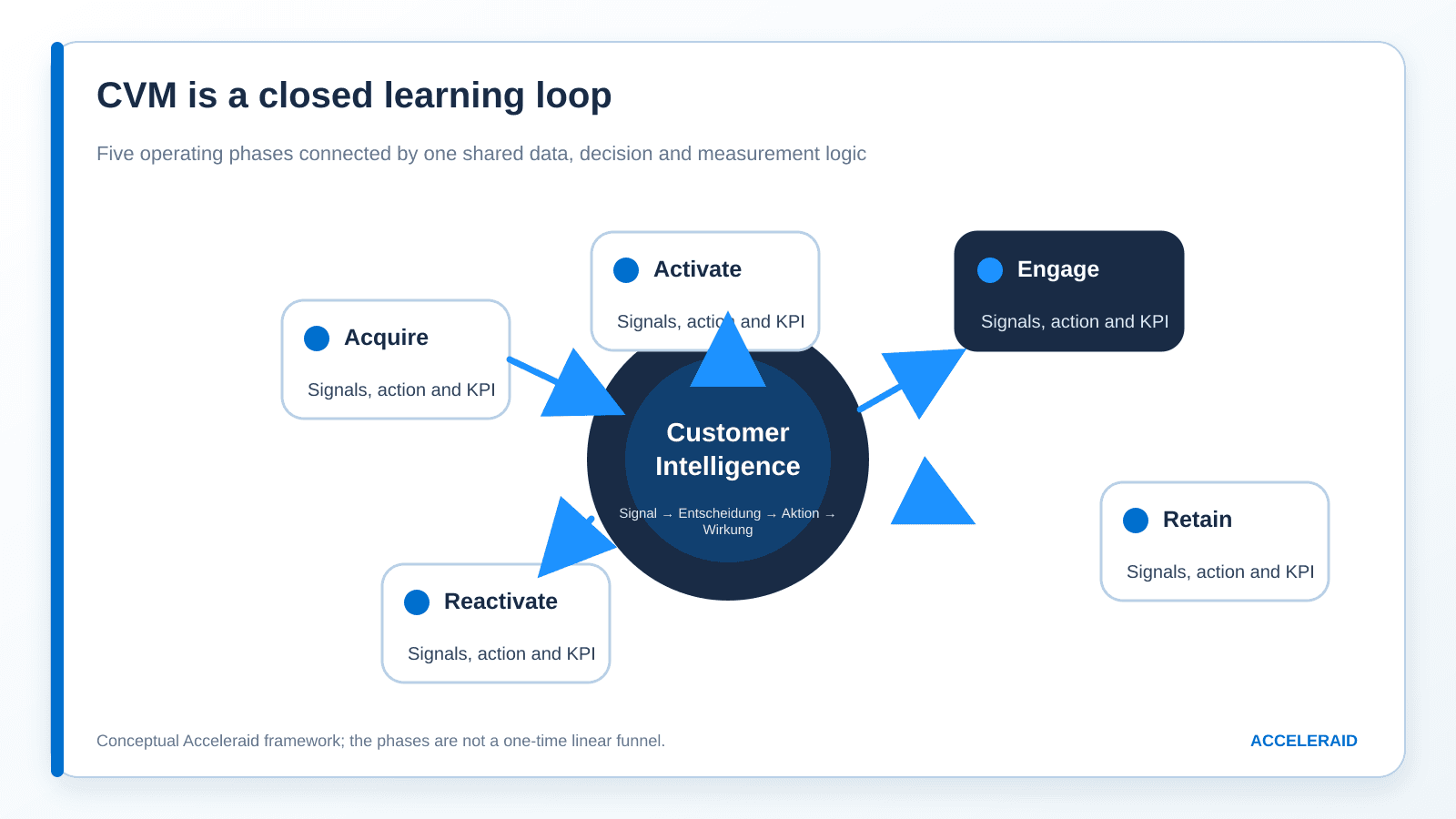
The operating model comprises five phases. Each has its own signals, decisions, actions and outcome metrics, yet together they form a closed learning loop.
Phase | Core question | Example signals | Primary measure |
|---|---|---|---|
Acquire | Which demand becomes a valuable relationship? | Source, context, completion quality | Qualified completion plus first activity |
Activate | Is the completed product actually used? | Login, funding, first and repeat usage | Product-specific activation |
Engage | When is an action relevant and permitted? | Transaction pattern, life event, channel preference | Incremental usage or advice |
Retain | Which risk is still actionable? | Declining usage, balance or engagement | Prevented attrition versus holdout |
Reactivate | Which dormancy deserves which treatment? | Inactivity duration, cause, historical value | Sustained incremental reactivation |
The phases are not a one-time sequence. A reactivated customer may re-enter Activate or Engage; measured outcomes then improve rules, thresholds and models.
Why detection alone is not enough — orchestration is key
Whether a bank "knows" its customers is no longer a soft question, but a measurable one: in 2023, Bain found an NPS gap of 123 points between customers who strongly agree with the statement "my bank interacts with me because it knows who I am" and those who strongly disagree (survey of 29,805 consumers in 11 countries) (Bain 2023 ↗). A proven example of the impact of such detection logic: users of the RBC assistant NOMI showed +50% digital interactions, +93% time spent in their financial accounts, and only 2% churn compared to 8% in the comparison group (Bain 2023 ↗). How churn can be detected early is covered in part 4 of our series on Churn Prediction 90 days in advance ↗.
Finally, advocacy is the economic endgame of a functioning lifecycle program: banks in the top advocacy quintile grow 1.7 times faster than the average globally (North America 2.6x, APAC 2.0x, Europe 1.7x, LatAm 1.3x); a +10 point advocacy score corresponds to +1% growth (Accenture 2025 ↗). Advocates also hold 17% more products at their primary bank (2.8 vs. 2.4) and a 5–30% higher share of wallet, depending on the product category (Accenture 2025 ↗).
The tech stack behind the framework
A lifecycle framework is only as good as the data infrastructure that feeds it with signals. Channel weighting today clearly follows digital usage: 152 app, 96 website, 52 ATM, and only 8 branch contacts per customer per year (2025); the number of branches fell by 40% in Europe and 24% in the US over the decade (Accenture 2025 ↗). This means: Lifecycle orchestration must be conceived primarily as digital, even if the branch remains relevant for critical moments. How this channel mix can be specifically managed is explored in depth in our series on Next Best Action in banking ↗.
The Acceleraid platform technically maps the complete lifecycle: A CDP with real-time connections to CRM, core banking system, and card processing forms the System of Record; a Prediction Engine generates explainable affinity, churn, propensity, and Next Best Action scores; the CLM/CVM orchestration translates these scores into concrete actions along the entire journey from acquisition to retention, taking contact frequency limits and channel preferences into account (Acceleraid Platform ↗). In a banking context, regulatory reporting and German hosting with GDPR-by-design are added — prerequisites without which no lifecycle program is scalable in a regulated industry (Acceleraid Banking ↗).
Conclusion: The framework is the beginning, not the destination
Today, Customer Lifecycle Management for banks is less of a campaign calendar and more of a data-driven operating model that treats acquisition, activation, growth, and retention as a coherent, signal-driven process. The numbers show: those who master this process grow faster, retain primary customers longer, and convert inertia into true connection. How a software decision-making framework is specifically derived from this — buy, build, or extend — is covered in the next part of this mini-series.
Five key takeaways
CVM is not a linear funnel but a closed learning loop.
The five operating phases need shared data, decision and measurement logic.
A score creates value only when it leads to a permitted action and measurable outcome.
Primary-customer status is created by real usage, not by contract completion alone.
Governance, contact rules and holdouts belong in the operating model, not in a downstream control step.
The complete Customer Lifecycle and Customer Value Management series
Lead article: The lifecycle and value management framework · 1/5: Acquire ↗ · 2/5: Activate ↗ · 3/5: Engage ↗ · 4/5: Retain ↗ · 5/5: Reactivate ↗
Illustration: AI-generated. AI-supported content: In the creation of our articles, we use AI technologies and automated agents, including those from Microsoft, Google, OpenAI, Anthropic, and other providers. Topics, professional alignment, and final approval remain with our team.
