CLM & CVM
Customer Lifecycle and Customer Value Management 1/5: Acquire
Part 1 of the five-part series: How banks optimise acquisition for qualified completion and later activation.
•
acceleraid Editorial Team
5 min read
This article is part of a six-piece reading path comprising one lead article and five operating phases:
The CVM series at a glance
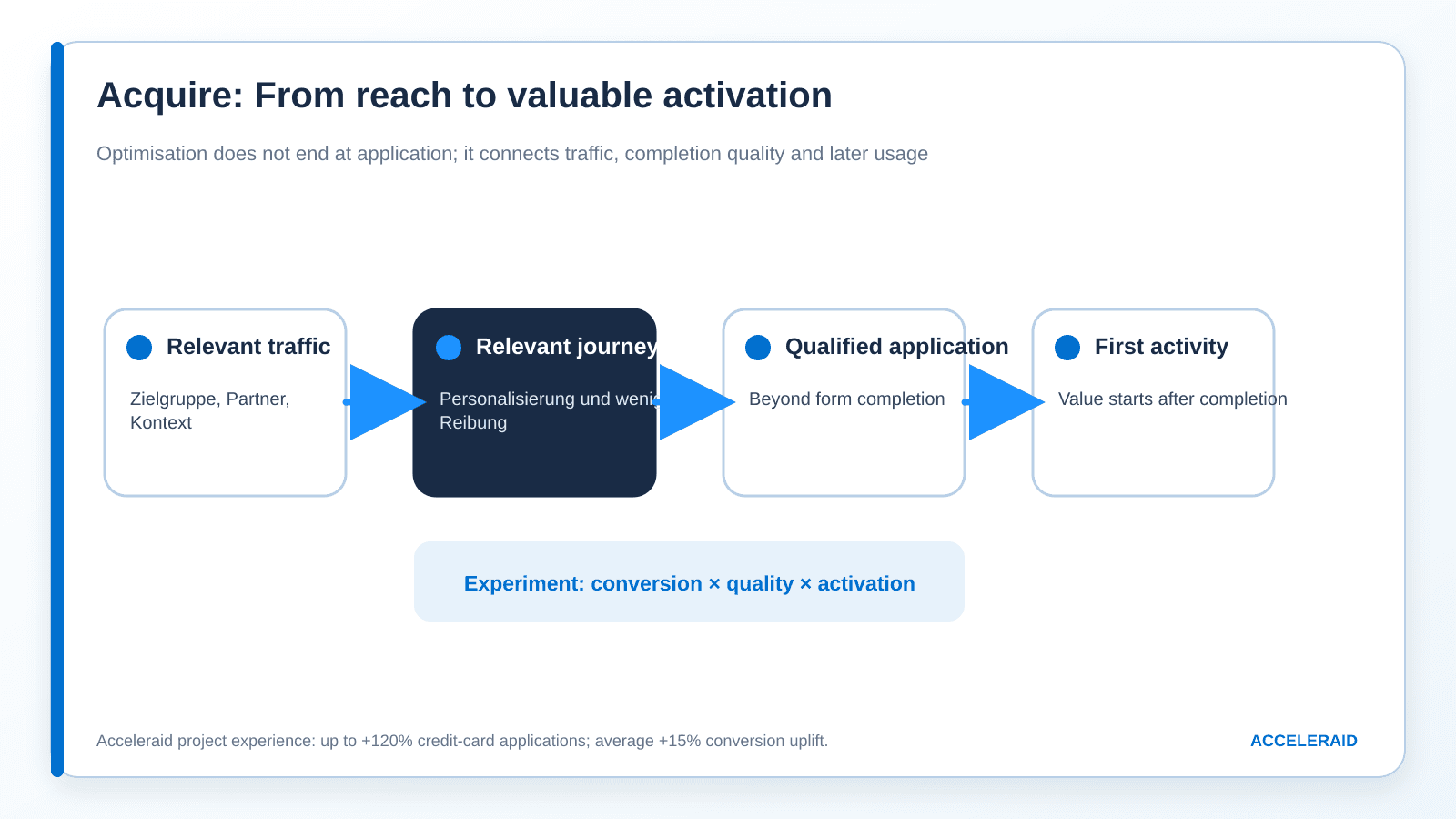
Digital account opening is no longer a specialist channel. The real problem is the gap between visit, application, approval and later usage. Capgemini's 2025 World Retail Banking Report says 47 per cent of surveyed digital-banking customers aged 18 to 45 across eleven markets abandon a card application midway; only three per cent of surveyed bank marketers call their onboarding seamless, one per cent in Europe (Capgemini 2025 ↗). The young urban sample is not a total-market benchmark, but it demonstrates operational friction.
Where the application funnel loses conversion
Digital opening has become a standard route in many markets. McKinsey's 2024 retail-banking report also describes marked differences in profitability and digital performance across institutions (McKinsey ↗). One form-conversion metric is therefore insufficient for steering.
Layer | Question | Example KPI |
|---|---|---|
Traffic | Do we reach the right audience in the right context? | Cost per qualified visit |
Journey | Which friction prevents completion? | Step-level abandonment rate |
Quality | Does the journey produce an eligible, suitable application? | Approval and completeness rate |
Value | Does real usage follow completion? | First activity and 90-day value |
Acceleraid project outcomes such as up to 120 per cent more credit-card applications and an average 15 per cent conversion uplift are project experience, not universal market benchmarks. They must be validated for each institution, product and baseline (Acceleraid Banking ↗).
Lever 1: Personalized application funnels instead of a one-size-fits-all form
The strongest evidence for removing specific friction is not an industry benchmark but a pre-registered experiment with 161,300 Bank of Ireland customers. A behaviourally redesigned savings-account journey increased openings by 27 per cent in the factorial test; among organic arrivals, the A/B uplift was 39.5 per cent (Z = 2.89; p = .004). Risk framing added a further 20 per cent effect (ESRI Working Paper 722 ↗).
The boundary matters: this was one product, one bank and customers with marketing consent. It increased account opening, not automatically later usage or deposit amounts. Acquisition optimisation therefore has to be measured into the Activate phase.
Lever 2: AI Traffic Allocation and Multi-Armed Bandit instead of rigid A/B testing
Classic A/B tests have a structural disadvantage: they distribute traffic evenly across variations throughout the entire test period — even when one variation has long been recognizable as superior. Multi-armed bandit methods solve this problem by dynamically shifting traffic to the best-performing variation, while keeping a small portion reserved for further exploration. As a practical guideline, it is recommended to permanently allocate 5–10% of traffic for exploration and 1–5% as a holdout group (Braze ↗).
For banks with high traffic volumes and many parallel landing page variations — such as across different co-brand partners — this is more than a technical detail: it significantly shortens the time to optimal delivery and reduces lost revenue during the testing phase. Acceleraid's Experience Optimization module combines this exact AI traffic allocation with personalized landing pages and application funnels, and is associated with an average conversion uplift of 15% according to the provider (Acceleraid ↗).
Lever 3: Email retargeting after application abandonment
An abandoned application is not a lost lead — provided the email address has already been captured and the retargeting is timely and behavior-based. The difference between automated, triggered emails and classic bulk campaigns is significant: open rates of 38–48% compared to 30.7%, click-through rates of 4.67–5.58% compared to 1.29–1.69% (a 332% increase), and a conversion rate of 1.49% compared to 0.08% — a 19-fold difference. The revenue per email sent for triggered emails is 22 times higher than that of bulk emails; it is also remarkable that 41% of all email revenue comes from just 5.3% of the send volume (Stripo Research ↗). For comparison: the industry benchmark for Business & Finance is an open rate of 31.35% and a click-through rate of 2.78% for regular campaigns (Mailchimp ↗) — a value that triggered application abandonment emails can significantly exceed.
An effective retargeting playbook for application abandoners typically follows a clear escalation logic: a first reminder within a few hours of abandonment, a second with specific help regarding the point of abandonment (e.g., missing documents), and, in the event of continued inactivity, a transition to a longer-term lead nurturing sequence. Since CAC in retail banking is around $561 per new customer, with significant differences depending on the channel — digital banks $290, paid search $590 (FirstPageSage ↗) —, every recovered application represents a direct efficiency gain in the marketing budget.
Lead Nurturing: The transition from abandonment to follow-up
Not every abandoned application can be reactivated immediately. A structured nurturing process categorizes leads by abandonment reason and likelihood of return, delivers relevant content (e.g., explanations of fees or security), and maintains contact across multiple channels. The connection with the traffic allocation from Lever 2 is crucial here: insights from nurturing — such as which segments respond to which content — should feed back into the ongoing optimization of the application funnel, rather than remaining isolated in a separate campaign tool.
According to Acceleraid, a card program with orchestrated lead nurturing led to 50% more qualified leads (Acceleraid ↗). This underscores that nurturing should not be a downstream process, but an integral part of the acquisition funnel.
From application to active customer relationship
An optimized funnel with personalized landing pages, dynamic traffic allocation, and consistent retargeting only solves the first half of the problem: the application itself. Whether an approved application actually becomes an active, value-generating customer is decided in the following weeks — a topic we will address in the next part of this series, where we will shed light on the activation gap and the role of prediction models in onboarding. The foundation for both phases is the same: a data architecture that makes signals from every touchpoint available in real time, as implemented in Acceleraid's CDP and Prediction Engine modules (Acceleraid Platform ↗).
Five key takeaways
Acquisition does not end with a completed form.
Traffic, completion quality and later activation must be optimised together.
Personalisation needs a reasoned hypothesis and controlled experimentation.
Retargeting should remove friction rather than simply increase contact pressure.
The most important handover is from Acquire to Activate.
Illustration: AI-generated. AI-supported content: In creating our articles, we use AI technologies and automated agents, including those from Microsoft, Google, OpenAI, Anthropic, and other providers. Topics, editorial direction, and final approval rest with our team.
