CLM & CVM
Customer Lifecycle and Customer Value Management 3/5: Engage
Part 3 of the five-part series: How banks translate transaction signals into advice with governance, timing and contact rules.
•
acceleraid Editorial Team
5 min read

This article is part of a six-piece reading path comprising one lead article and five operating phases:
The CVM series at a glance
Moving, birth or a new relationship can change financial needs. A bank does not reliably “detect” such events from payments. It can only predict an elevated probability and must incorporate uncertainty, consent and suitability into every subsequent decision.
The scientific proof: Transaction data beats aggregated data
De Caigny, Coussement and De Bock analysed roughly 60 million debit transactions from 132,703 customers and more than 1.5 million counterparties at one European bank. Over six months, base rates were 9.44 per cent for moving, 2.02 per cent for a new relationship, 1.64 per cent for birth and 1.61 per cent for an ended relationship (Decision Support Systems 130:113232, 2020 ↗).
Granular transaction variables improved prediction over aggregated data. This does not mean the event was identified with certainty: at low base rates, precision remains a constraint. A score may prioritise a next review or advisory step, but must not assert a sensitive fact without governance.
Prediction horizon | Event class | Base rate |
|---|---|---|
6 months | Moving | 9.44% |
6 months | New relationship | 2.02% |
6 months | Birth | 1.64% |
6 months | Ended relationship | 1.61% |
Trigger-based instead of batch marketing: Timing determines relevance
The value of behavioural steering can be demonstrated without sensitive life-event claims. A field study of 65,073 German bank customers examined activation of a transaction-categorisation tool. In matched groups, activation was followed by a €409.03 increase in monthly debit balance (p < .01) and a €268.52 increase in savings balance (p < .05); 2.2 per cent received a salary inflow for the first time (Becker 2017 ↗).
Tool activation was self-selected, so the result is not fully causal. It nevertheless shows why observable behaviour and concrete functionality are more defensible than generic email multiples from e-commerce datasets.
From signal to action: a decision framework
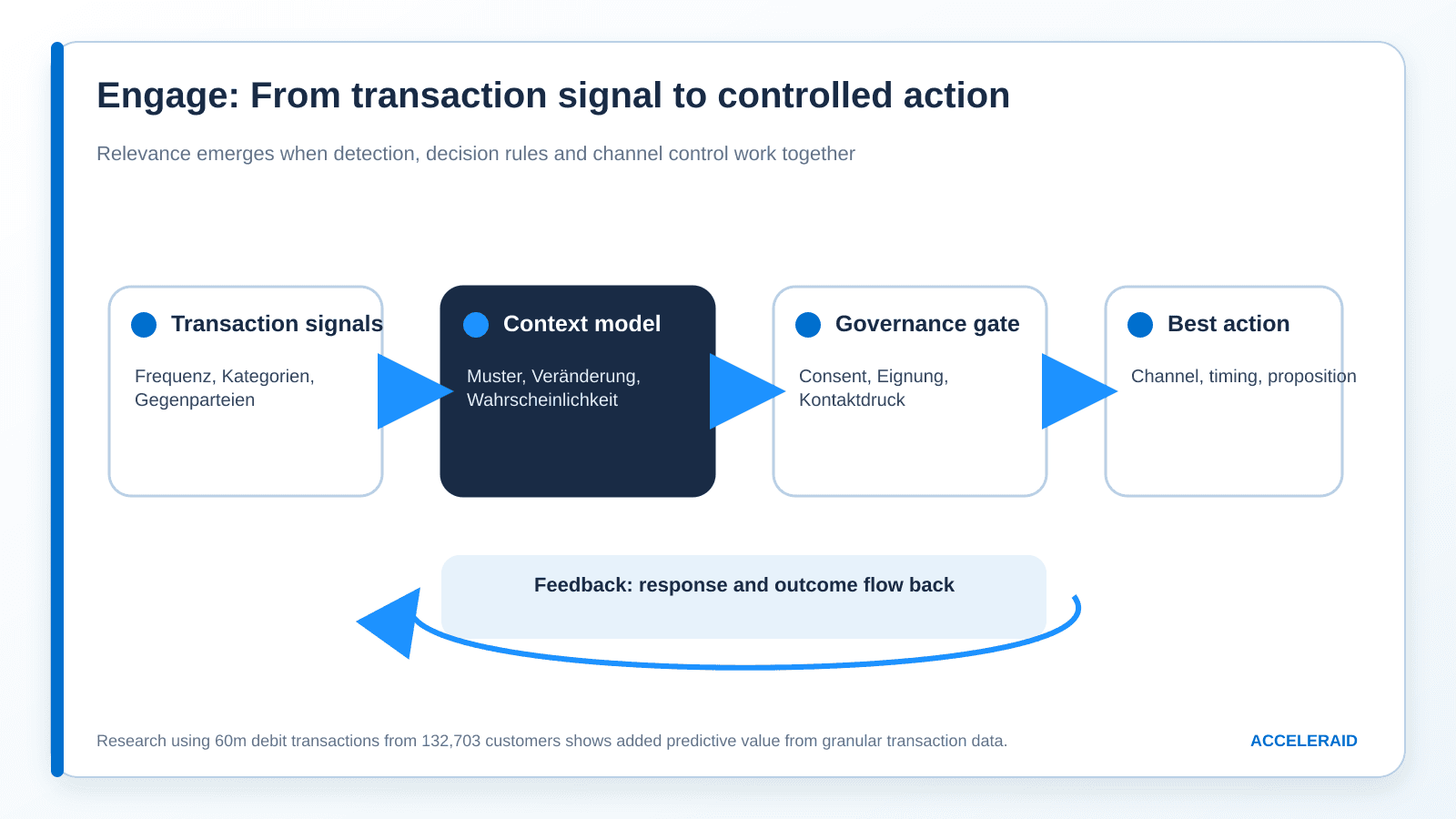
For practical implementation, a clearly structured playbook is recommended, which systematically combines probability scoring, prioritisation and channel selection:
Signal scoring: continuous scoring of transaction streams for patterns such as relocation (new standing orders, changed merchant categories), family growth (changed spending categories), or relationship status (account movements, joint vs. separate transactions).
Prioritization: matching the scored signal with confidence (AUC level of the respective model), business value of the potential offer, and regulatory requirements.
Channel selection: selecting the contact channel according to documented customer preference and contextual appropriateness — a sensitive event like the end of a relationship requires a different tone and potentially a more personal channel than a relocation notification.
Time window: playing out the offer within a defined response window, not in the next campaign cycle.
Frequency control: compliance with contact frequency limits so that an elevated life-event probability does not lead to a flood of offers across multiple channels simultaneously.
Multi-channel delivery without contact overload
The channel question is not a minor matter in the DACH context. In 2025, 89% of banking customers with checking account access use online banking, an increase of 8 percentage points compared to 2023 (Deutsche Bundesbank ↗); in Germany, parallel app or website usage is at 86%, with 44% of online banking users no longer visiting the branch at all (Bitkom ↗). At the same time, international comparison data shows that despite declining contact frequency (8 contacts/year compared to 152 for the app), the branch continues to have the highest retention power for complex issues — 64% of customers still rely on it for conflict resolution (Accenture Global Banking Consumer Study ↗). A life event such as real estate financing after a elevated relocation-probability signal can therefore be initiated digitally, but closed in an advisory meeting in the branch or via video consultation.
From 65,000 advisory appointments to systematic practice
The practical experience of Acceleraid shows that substantial demand for advice can indeed be generated from elevated life-event probabilities and transaction signals: According to the provider, the use of the CLM/CVM engine led to 65,000 generated advisory appointments (Acceleraid ↗). The platform combines explainable propensity and life-event signals from transaction data with orchestration that adheres to fixed contact frequency limits per channel — ensuring that a single elevated-probability signal does not lead to contradictory or overlapping communications via app, email, and branch CRM simultaneously (Acceleraid Platform ↗). The goal is to make an offer within 24 hours of signal scoring — close enough to the event to be relevant, and coordinated across channels to avoid being intrusive.
Why contact frequency limits are not a minor issue
Precisely because life events trigger strong, immediate impulses for action, there is a risk that multiple campaign engines running in parallel will react to the same signal — such as a relocation notification triggering an app push notification, an email, and a branch alert at the same time. Without a central orchestration logic with documented frequency limits per channel and customer, a positive signal can quickly turn into perceived intrusiveness. A robust CLM/CVM architecture must therefore not only recognize when an event takes place, but also bindingly define how often and via which channel a customer may be contacted within a certain period — regardless of how many individual signals are triggered in that period.
Outlook: From opportunity to risk
Life-event probability models addresses the positive side of engagement — the growth potential in the existing customer relationship. However, the same transaction database also provides the earliest warning signals for the opposite: creeping churn. How churn risk can be recognized up to 90 days in advance is the subject of the next part of this series.
Five key takeaways
Granular transaction data can provide additional predictive power.
A detected signal is neither consent nor a product recommendation.
Context model, governance gate and next best action must remain separately auditable.
Contact frequency and channel preference are part of the decision.
Response and outcome must flow back into the system.
Illustration: AI-generated. AI-supported content: In creating our posts, we use AI technologies and automated agents, including those from Microsoft, Google, OpenAI, Anthropic, and other providers. Topics, technical direction, and final approval lie with our team.
