CLM & CVM
Customer Lifecycle and Customer Value Management 2/5: Activate
Part 2 of the five-part series: How observable progress, lifecycle scoring and event-based journeys steer the first 90 days.
•
acceleraid Editorial Team
5 min read

This article is part of a six-piece reading path comprising one lead article and five operating phases:
The CVM series at a glance
An approved application is not yet an active customer relationship. BCG illustrates activation as three to four transactions per month measured at 90 and 180 days and attaches a rate of 30 to 40 per cent. Because BCG does not disclose the sample, geography or method for this figure, we treat it not as a market benchmark but only as an illustration that opening and usage require separate measurement (BCG ↗).
The activation gap in numbers
The available primary evidence does not support a robust cross-bank claim that only 30 to 40 per cent of all digitally acquired banking customers activate. Activation varies too much by product, market, definition and observation window. Each bank should therefore define activation before building the model.
Product | Observable progress | Possible activation definition |
|---|---|---|
Current account | Funding, payment, repeat usage | Defined real usage days in the measurement window |
Credit card | Enablement, first payment, repetition | First and repeat transaction |
Savings | First deposit, recurring contribution | Funding plus balance after the measurement window |
BCG frames activation as building a primary-bank relationship through relevant usage and personalisation, but does not provide a universally transferable activation benchmark (BCG ↗). The operational answer is a bank-specific baseline with a clear cohort and definition.
Why the first 90 days decide everything
The first 90 days are not a natural law but a practical observation and steering window. Each product class requires its own expected progress: technical functionality, funding, first usage, repetition and, where relevant, primary status.
The Bank of Ireland experiment makes the boundary between completion and activation particularly clear. The redesigned journey increased account openings but did not automatically produce a significant increase in deposit amounts (ESRI Working Paper 722 ↗). A funnel that stops at “opened” can therefore overstate economic success.
Fenergo reports from 600 senior decision makers in the UK, US and Singapore that 70 per cent of their institutions had lost clients because of slow onboarding, while the reported abandonment rate was around ten per cent (Fenergo 2025 ↗). This is self-report rather than behavioural measurement, but it reinforces the need for a bank-specific baseline.
Lifecycle phase scoring as a steering tool
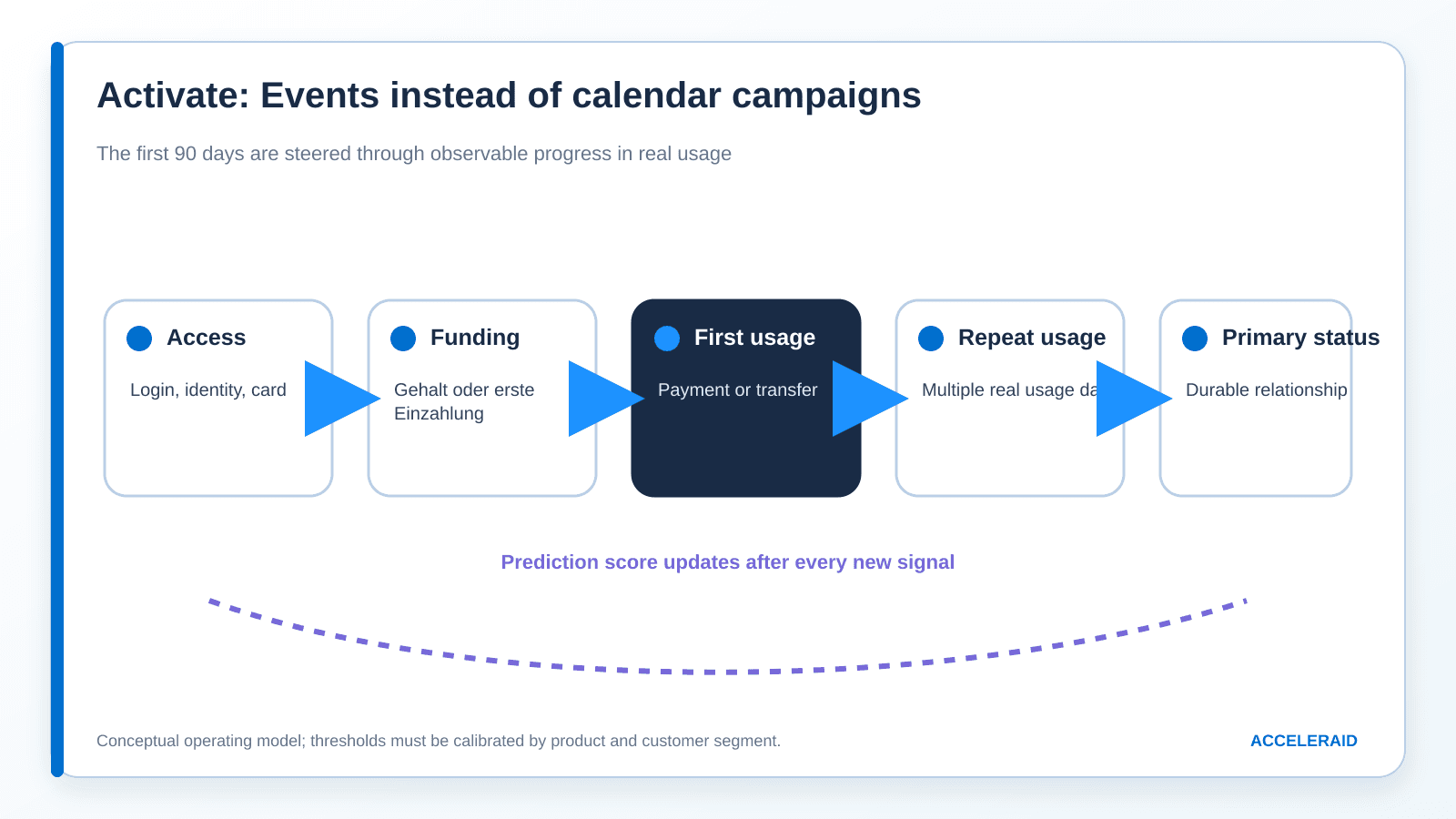
This is where lifecycle phase scoring comes in: instead of targeting all new customers with the same onboarding sequence across the board, a scoring model continuously assigns each customer to a lifecycle phase — such as acquisition, growth, maturity, or retention — and derives the next appropriate action from it. The key is that this scoring is not statically done on the day of account opening, but updates with every new behavioral signal.
A simple phase model for the first 90 days can be structured as follows:
Days 0–7 (Onboarding Window): Focus on functionality — first login, card or app activation, complete verification. Every hurdle here disproportionately lowers the probability of later activation.
Days 8–30 (First Use): Initiating the first transactions, for example through salary deposits or standing orders; here it becomes clear whether an account becomes the primary bank relationship.
Days 31–90 (Consolidation): Cross-selling impulses only where transaction patterns reveal a real need — not as a generic offer.
After Day 90: Transition to regular lifecycle management; customers with no activation signals are moved to a separate reactivation logic.
Transaction-based intent signals instead of calendar logic
The difference between a calendar trigger ("send an email 90 days after account opening") and a behavior-based trigger is significant. Transaction-based signals — such as missing salary deposits, lack of card usage, or unusually low transaction frequency — provide indications of activation risk much earlier than a pure time window. This is precisely where Acceleraid's Prediction Engine comes in: it generates explainable propensity and lifecycle phase scores from real-time transaction data and makes them usable for orchestrating onboarding measures (Acceleraid ↗).
Orchestration: From score to the right action in the right channel
A score alone changes nothing — the key is orchestrating the derived action via the customer's preferred channel. This means: lifecycle phase, channel preference, and regulatory requirements must flow together into a single decision logic that deploys in real time via online banking, app, email, or branch CRM. According to the provider, this precise interlocking of Prediction Engine and CLM/CVM orchestration — with built-in contact frequency limits so customers are not overloaded with impulses — forms the core of Acceleraid's platform approach (Acceleraid Platform ↗).
For marketing and digital executives, this results in a clear priority: activation is not a downstream onboarding issue, but a steering problem of the first 90 days that deserves the same analytical discipline as acquisition itself.
Why calendar campaigns fail at this task
Many institutions try to close the activation gap using classic campaign tools: a welcome email on day one, a reminder after two weeks, a cross-sell offer after one month — regardless of whether the customer has even made a first transaction. This calendar-driven logic treats all new customers the same, even though their actual activation behavior differs from day one. A customer who sets up a salary redirection in the first week needs different impulses than one whose account does not show a single booking after 30 days.
The consequence of calendar-driven communication is directly reflected in the silent attrition numbers: a customer who never opens an app push notification or reads an email is simply not reached by rigid campaign schedules, even though their transaction behavior has long indicated a lack of engagement. A score- and event-based approach, on the other hand, recognizes this pattern early on and can adjust communication accordingly — for example, by changing channels or initiating a more personal contact via the branch before the customer becomes completely inactive.
Outlook: From active customer to predictive offer
Once the activation hurdle is cleared, the task shifts: over time, signals become visible from an active customer that point to upcoming life events — a move, starting a family, a job change. How such events can be recognized from transaction flows and translated into concrete, timely advisory offers is the subject of the third part of this series.
Five key takeaways
An approved application is not yet an active customer relationship.
Activation must be defined by product-specific observable behaviour.
Events are more informative for steering than rigid calendar dates.
Scores require reasons, permitted actions and channel logic.
The first 90 days are a steering window, not a universal success benchmark.
Illustration: AI-generated. AI-supported content: We use AI technologies and automated agents in the creation of our articles, including from Microsoft, Google, OpenAI, Anthropic, and other providers. Topics, technical direction, and final approval lie with our team.
