CLM & CVM
Customer Lifecycle Management for Banks: The Complete 2026 Framework
Customer lifecycle management for banks: phases, signals, orchestration and tech stack in the complete 2026 framework.
•
acceleraid Redaktion
6 min read
01
Acquire
Signale erkennen
02
Onboard
Aktivierung steuern
03
Grow
Next Best Action
04
Retain
Churn reduzieren
05
Reactivate
Potenziale zurückholen
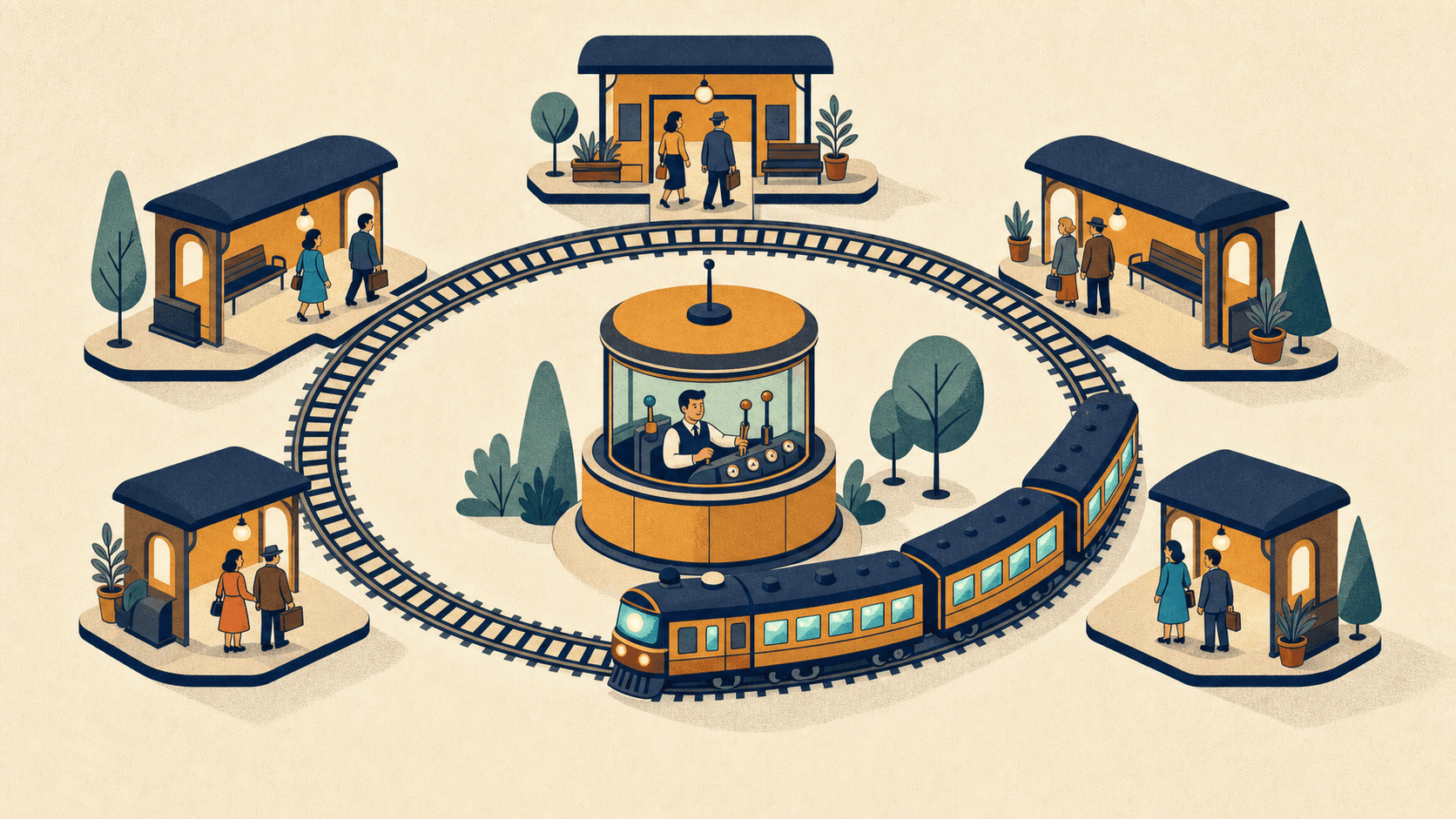
Customer lifecycle management for banks is not a new idea — what is new is the ambition to run it on real-time signals and AI-driven decisioning instead of rigid campaign calendars. This article maps the field: what customer lifecycle management for banks actually covers today, which phases, signals and tech-stack building blocks belong to it, and why the economics behind it are better documented than the buzzword suggests. Readers who want the phase-by-phase detail should see our five-part CLM retail banking series; this article gives the altitude view above it.
What customer lifecycle management means for banks
Customer lifecycle management (CLM) in banking is the systematic orchestration of the customer relationship across sequential phases — acquisition, activation, growth, maturity and retention — driven by behavioural and transaction data rather than static segments. The difference from classic campaign management is cadence: CLM reacts to signals that change daily, not to quarterly plans. That cadence is becoming a genuine competitive factor because the underlying customer relationship itself has changed.
Global retail banking revenue exceeded $3.14 trillion in 2023, with growth accelerating from a 5.3% CAGR (2013–2020) to 7.6% CAGR (2020–2023) (McKinsey, October 2024. At the same time, the relationship itself is diluting: the average number of banking relationships per US consumer rose from 2.6 (2021) to 3.2 (2023) (McKinsey, October 2024. Growth no longer follows automatically from simply holding the account — it has to be actively earned and expanded. That is the economic foundation customer lifecycle management for banks builds on.
Why primary-bank status now has to be fought for
Primary customers are the economic core of any retail bank: they hold the bulk of their deposits at their main bank, generate high-ROE fee income, lower funding costs, and stay longer. Optimising distribution strategy alone can lift deposit volumes by 10–15% (McKinsey, October 2024. Yet primary-bank status is no longer a given: roughly three-quarters of customers hold at least one competing banking relationship, a third use digital challengers as their primary or secondary bank, and 10% treat a challenger as their main institution (Accenture Global Banking Consumer Study 2025).
The "lazy loyalty" finding is particularly telling: 61% of customers have stayed with their bank for over seven years, 60% want relationship-based rewards, but only 45% are actually satisfied — a 15-point gap. Fewer than 15% of banks offer relationship-based rewards at all (Accenture 2025). Long tenure, in other words, is not proof of loyalty — it is often simply inertia, and inertia is easier for new entrants to break than genuine attachment. This is exactly where customer lifecycle management for banks comes in: it turns passive tenure into actively managed relationships.
The four lifecycle phases and their signals
BCG structures personalization in banking across the phases of prospecting, engagement and retention, built on a stack of customer DNA, a personalized curriculum, and an analytics engine with recursive learning (BCG, "What Does Personalization in Banking Really Mean?", 2019). Customer DNA itself, per BCG, is assembled from base profile, marketing responses, product holdings, transaction history, credit and risk activity, and external data, yielding household composition, wallet size, financial behaviour, offer sensitivity and channel preference (BCG, "The Power of Personalization", May 2018).
In practice, this model condenses into four operating phases — acquisition, activation/growth, maturity and retention — each with its own signals and intervention logic.
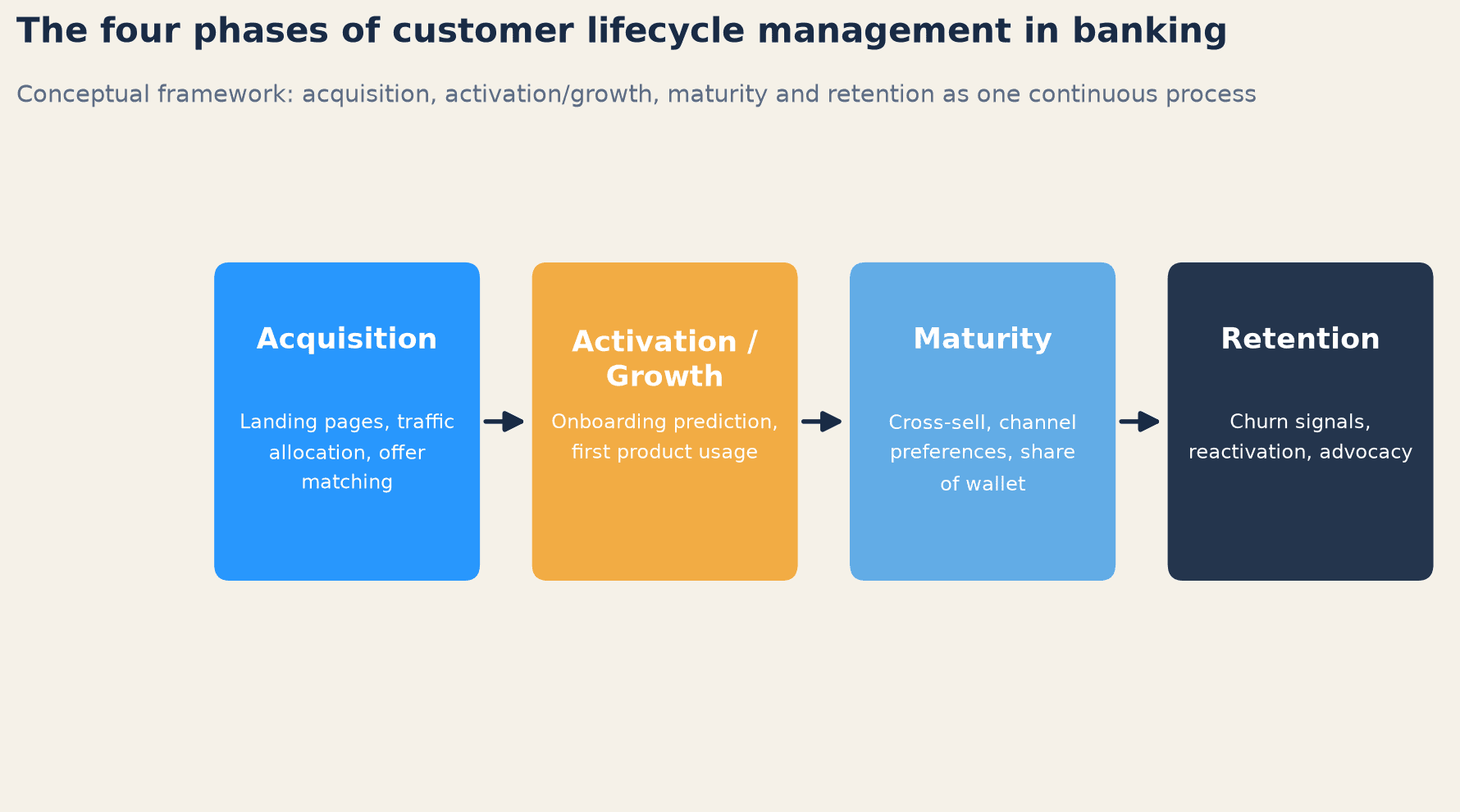
Onboarding is the hardest of these phases: the gap between a successful first-attempt digital account opening and a failed attempt that drives a switch to another bank is 103 NPS points. In the UK and Hong Kong, only about two-thirds of customers completed digital account opening on the first attempt in 2023, while Revolut, Starling and Monzo achieve failure rates below 1–2% (Bain, "Customer Behavior and Loyalty in Banking: Global Edition 2023"). For how to orchestrate this activation phase in practice, see part 2 of our series on onboarding prediction models.
Why detection alone is not enough — orchestration is what decides
Whether a bank actually "knows" its customers is no longer a soft question — it is measurable. Bain found a 123-point NPS gap in 2023 between customers who strongly agree that "my bank interacts with me because it knows who I am" and those who strongly disagree (survey of 29,805 consumers across 11 countries) (Bain 2023). One documented example of the payoff from this kind of recognition logic: users of RBC's NOMI assistant showed +50% digital interactions, +93% time spent in their financial accounts, and only 2% churn versus 8% in the comparison group (Bain 2023). For how to detect attrition early, see part 4 of our series on churn prediction 90 days ahead.
Advocacy is the economic endpoint of a working lifecycle program: banks in the top advocacy quintile grow globally 1.7 times faster than average (North America 2.6x, APAC 2.0x, Europe 1.7x, LatAm 1.3x); a +10-point advocacy score corresponds to +1% growth (Accenture 2025). Advocates hold 17% more products at their main bank (2.8 vs. 2.4) and a 5–30% higher share of wallet depending on category (Accenture 2025).
The tech stack behind the framework
A lifecycle framework is only as good as the data infrastructure feeding it signals. Channel weighting now clearly follows digital usage: 152 app, 96 website, 52 ATM and just 8 branch contacts per customer per year (2025); branch counts fell 40% in Europe and 24% in the US over the decade (Accenture 2025). That means lifecycle orchestration has to be designed digital-first, even as the branch remains relevant for critical moments. For how to manage this channel mix in practice, see our series on next best action in banking.
The Acceleraid platform maps this full lifecycle technically: a CDP with real-time connections to CRM, core banking and card processing forms the system of record; a prediction engine generates explainable affinity, churn, propensity and next-best-action scores; CLM/CVM orchestration translates these scores — respecting contact-frequency limits and channel preferences — into concrete actions across the entire journey from acquisition to retention (Acceleraid Platform). In banking specifically, regulatory reporting and German-hosted, GDPR-by-design infrastructure round this out — prerequisites without which no lifecycle program in a regulated industry can scale (Acceleraid Banking).
Bottom line: the framework is the start, not the destination
Customer lifecycle management for banks today is less a campaign calendar than a data-driven operating model that treats acquisition, activation, growth and retention as one continuous, signal-driven process. The numbers are clear: banks that master this process grow faster, retain primary customers longer, and convert inertia into genuine loyalty. How this translates into a concrete software decision framework — build, buy or extend — is the subject of the next article in this mini-series.
Illustration: AI-generated. AI-assisted content: We use AI technologies and automated agents in the creation of our articles, including from Microsoft, Google, OpenAI, Anthropic and other providers. Topics, editorial direction and final approval remain with our team.
We use Cookies 🍪
Strictly necessary cookies (e.g. Pipedrive forms) remain active. With your consent we also use Google Analytics (analytics) and Leadfeeder (visitor identification). More in our Privacy Policy.