CLM & CVM
Wero in Banking: Why Rollout Starts with Activation and Lifecycle Measurement
Why Wero needs onboarding, activation, fraud prevention, service and lifecycle measurement to become a manageable customer experience.
•
acceleraid Redaktion
7 min read
01
Acquire
Signale erkennen
02
Onboard
Aktivierung steuern
03
Grow
Next Best Action
04
Retain
Churn reduzieren
05
Reactivate
Potenziale zurückholen

acceleraid Redaktion · 20 August 2026
Wero is reaching more banking customers in Germany: norisbank made the service available to its customers on 6 August, while N26 launched it directly in its app on 11 August. Eligible N26 customers in Germany and France can send and receive money using a phone number or email address; at norisbank, Wero is linked directly to the current account. Strategically, however, the important question is not simply whether a new payment method is available. It is whether customers understand it in a relevant situation, activate it, use it safely and return to it. norisbank/EPI N26
Rollout starts before the first payment
A payment method is not an isolated app feature. It changes a recurring everyday decision: which route does someone choose when sending money to friends, paying online or, later, paying at a physical point of sale? Wero already supports person-to-person payments. It has been live for retail payments in Germany since the end of 2025, while recurring payments and point-of-sale payments are among the planned extensions. Wero at norisbank/EPI
That is why launch should be designed as a lifecycle responsibility. A bank should not only track technical availability. It should own the full sequence: reach, explanation, consent, first successful use, repeat use, service and, where an activation is abandoned, re-engagement. It is a conceptual operating model for launch management.
N26 illustrates the importance of the point of embedding. Wero sits in the app’s native transfer flow, and the recipient can be outside the N26 ecosystem. This removes an app switch and presents the value at the moment of sending. norisbank, in turn, links Wero directly to the current account, without a prior top-up. These are not merely interface choices. They determine whether a customer experiences the capability as extra effort or as an extension of the account they already use. N26/EPI norisbank/EPI
Onboarding needs a moment of need, not a feature list
Initial onboarding should explain the moment of use rather than enumerate every option. For P2P, the relevant moment may be sending or receiving money from family and friends. Wero removes the need to enter an IBAN or BIC; at N26, a phone number or email address can be used. norisbank/EPI N26
Effective onboarding therefore separates three questions. First, is the service available to this customer and what eligibility condition applies? Second, what problem does it solve in this moment? Third, what happens next and how will the customer know that the action is complete? The answers should be consistent across the app, help content and service. They should also distinguish where Wero can be used: in a P2P transfer, at participating online merchants or, when available, in further contexts. A payment method’s reach is not established by one explanation; it is built through repeatable clarity at these transitions.
Activation is more than registration. It includes a deliberately initiated, correctly completed and clearly confirmed first payment or receipt. If a contact cannot be found, a status is unclear or the process stops, that is not simply a technical edge case. It is a lifecycle signal that can trigger concise help, better explanation or a review of the process step. It does help prevent avoidable uncertainty from becoming either perceived risk or permanent non-use.
P2P and merchant use need different explanations
P2P is a social context. Its value depends not only on the sender but also on whether the recipient is reachable and knows the method. N26 explicitly extends the experience to recipients outside its own customer base. Lifecycle management should therefore not address only the sender. It should consider the recipient situation too: clear information about receipt, confirmation and possible next actions. N26
Merchant use has a different context. Wero can be used with participating online merchants. For pan-European solutions at the point of interaction, the Eurosystem identifies five relevant objectives: pan-European reach and customer experience, convenience and low cost, safety and efficiency, European brand and governance, and eventually global acceptance. This does not make a quality claim about any individual checkout. It does provide a useful review framework: acceptance points, the payment flow, post-payment confirmation and support following an interruption need to be managed as one journey. ECB
Banks should therefore not use the same message for P2P and merchant contexts. When sending money, the simple addressing of a contact is central. When buying online, acceptance, unambiguous authorisation, confirmation and help after an interruption take priority. what was initiated, which amount and payee are involved, how can the status be checked and where can a person obtain human support?
Fraud prevention belongs in the journey design
Fast payments increase the importance of an understandable and safe decision before execution. Parliament and Council reached a political agreement on the PSR and PSD3 at the end of 2025. In Parliament’s account, the agreed text includes matching a payee’s name and unique identifier, strong customer authentication, risk assessments, spending limits and blocking measures. Formal adoption by Parliament and Council was still pending in the cited material. European Parliament
For a new payment method, this cannot be a compliance layer added after launch. Risk notices, payee verification, confirmation and escalation need to appear at the point where the customer makes a decision. Too many unexplained interruptions can weaken activation; too little context can damage trust. Good design connects the two: comprehensible checks, clear language, proportionate friction and a visible route to service.
Service is also part of prevention. The European Parliament’s account of the agreed framework refers to access to human customer support, not only chatbots. For banks, this implies a practical requirement: the handover from self-service to qualified assistance needs to be defined for cases such as unclear payee details, suspicious activity or blocked payments. European Parliament
Lifecycle measurement: connect the stages, not just volume
A conceptual measurement model does not require invented targets. It connects events with accountability: who was informed about the capability, who began activation, who reached a successful first use, and in which context—P2P or merchant—did that occur? Where did a process stop, what help was used and did later use follow? These are not performance claims. They structure the signals a bank needs in order to manage rollout.
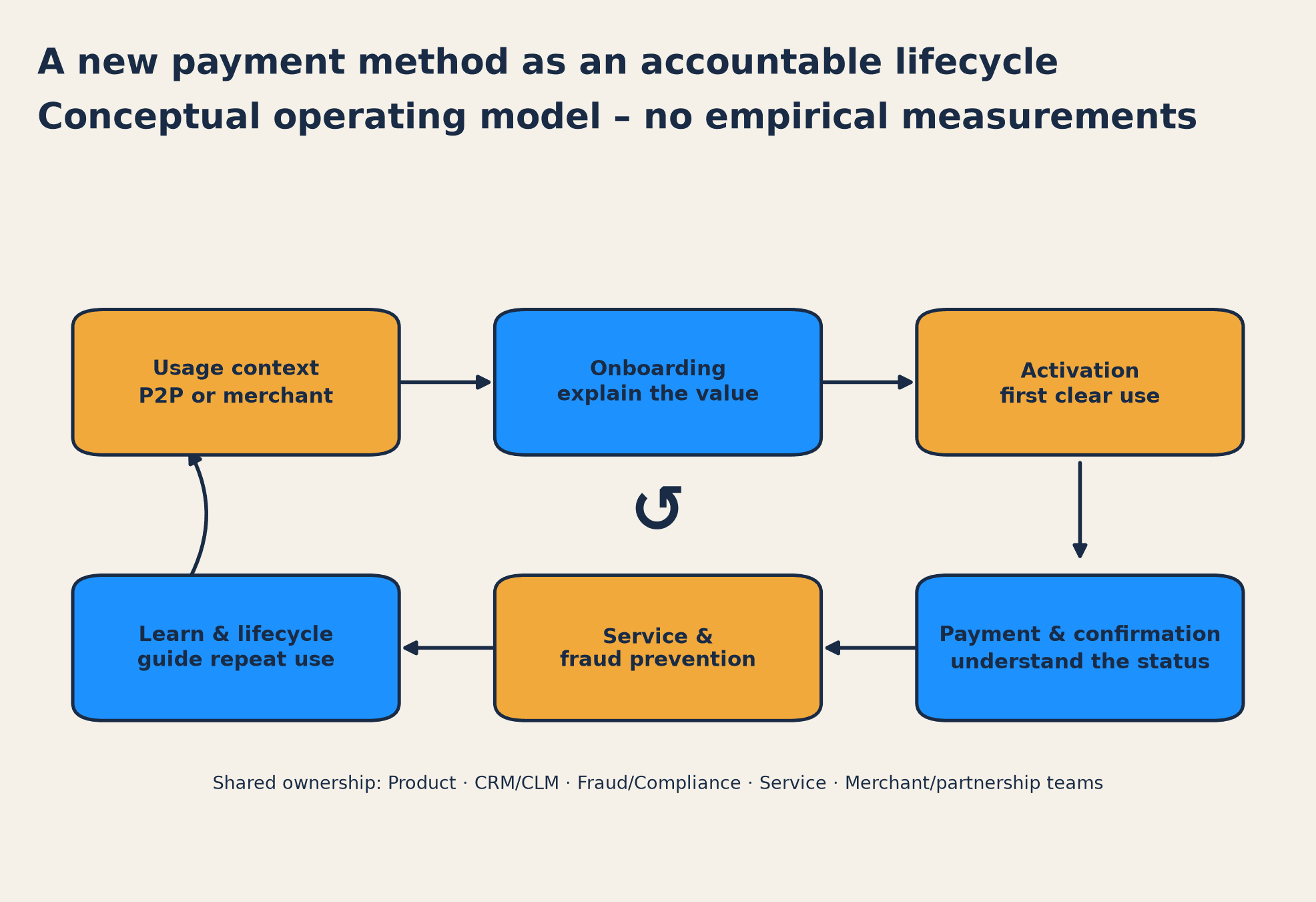
The model should also make ownership visible. Product owns the flow; CRM or lifecycle management owns communication and re-engagement; fraud and compliance own protection logic; operations and service own exception handling; merchant and partnership teams own acceptance contexts. A shared view helps prevent each function from optimising only its own segment.
The European Commission describes an efficient European market for retail payment services as one that provides clear payment information, fast and instant payments, consumer protection and choice. It also notes that payment service providers in the euro area must now enable clients to send instant euro payments and verify the intended beneficiary. Those requirements show why activation, transparency and prevention belong together. European Commission
The strategic measure is reliable repeat use
With N26 and norisbank, Wero extends its potential reach in the German banking landscape. The strategic value of such a rollout emerges only when availability is translated into understandable, safe and repeatable use. Infrastructure and the payment flow are prerequisites. Onboarding, activation, service, fraud prevention, P2P and merchant context, and lifecycle measurement turn them into a manageable customer experience.
For banking teams, the central question is therefore not, “Is the feature live?” It is, “In which situations does it demonstrably help customers, how do we protect those situations and how do we learn from every transition?” Teams that manage that connection operationally treat a payment method not as a one-time release but as a product relationship with a long, accountable lifecycle.
Illustration: AI-generated. AI-assisted content: We use AI technologies and automated agents in the creation of our articles, including from Microsoft, Google, OpenAI, Anthropic and other providers. Topics, editorial direction and final approval remain with our team.
We use Cookies 🍪
Strictly necessary cookies (e.g. Pipedrive forms) remain active. With your consent we also use Google Analytics (analytics) and Leadfeeder (visitor identification). More in our Privacy Policy.