CLM & CVM
Customer Journey Analytics in Banking: From Mature Analytics to Lifecycle Decisioning
How customer journey analytics connects signals, friction and rules to accountable lifecycle decisioning in banking.
•
acceleraid Redaktion
7 min read
01
Acquire
Signale erkennen
02
Onboard
Aktivierung steuern
03
Grow
Next Best Action
04
Retain
Churn reduzieren
05
Reactivate
Potenziale zurückholen

Author: acceleraid Redaktion | 17 August 2026
From an analytical view to a managed customer relationship
Customer journey analytics (CJA) in banking is no longer just a way to review how a digital journey performed. Used well, it connects signals from sales, service, digital channels and transactions with explicit decision rules. It turns observation of a journey into the capability to manage the next appropriate step in a customer relationship.
That is not an argument for more outreach. It is the opposite. Lifecycle decisioning should prevent unnecessary contacts, expose breaks between channels and offer timely help in important situations. The measure is not how many actions are delivered, but whether a person can complete their task reliably and with a clear understanding of what happens next.
The discussion of CJA’s maturity makes the distinction timely. CSGI, discussing Gartner’s 2026 Hype Cycle, reports that banking CJA moved from “early mainstream” to “mature mainstream” and describes it as a cross-channel view of friction and context. (CSGI’s Gartner discussion) Maturity, however, does not mean that every bank has already turned insight into consistent, accountable decisions.
Four terms, four different jobs
A journey map describes an idealised or research-led path: goals, stages, touchpoints, expectations and pain points. It is useful for creating a shared language and designing a service. It does not reliably tell a bank whether a particular customer is stuck today, or what assistance would be appropriate.
A dashboard makes measures visible. It may show abandonment in account opening, handling times or contact reasons. That supports management and prioritisation. But unless a rule translates an observation into an owned action, a dashboard remains focused on what has happened.
Campaign attribution assesses which contacts preceded, or contributed to, a measurable response. It matters when evaluating marketing investment and channel choices. Attribution usually looks at an intervention and its outcome. It is not designed to understand the full path of a customer task, suppress conflicting contacts or select the best service response at a sensitive moment.
CJA connects those layers. It reconstructs real paths from events, relates them to a person or case, and examines where patterns, delays, hand-offs and repetitions occur. The difference matters: analysis does not end with a visualisation; it provides verifiable context for a decision. CSGI characterises CJA as analysing interactions across human, automated and physical touchpoints. (CSGI’s Gartner discussion)
Turning signals into usable context
A sound CJA implementation starts with a precise question, not with a model. For example: why do people move from mobile to phone during a card application, and what must happen so that they can finish the task without repeating themselves?
The bank then combines signals that are necessary and permitted for that question: application steps, error messages, interrupted identification, scheduled callbacks, service contacts, consent, channel preferences and, where relevant, transaction patterns. A single event rarely explains much. Sequence and known status create the context.
Transaction data can provide useful cues, but it should never be treated as certainty about a personal event. The ABA Banking Journal describes how cleaned and categorised transaction data can become behavioural signals, for example to identify changes in usage or outflows; its article is sponsored content, so it is best treated as a practical prompt rather than an independent effectiveness study. (ABA Banking Journal)
The operational rule is straightforward: a signal is a reason to review, not a diagnosis. Repeated login failures may indicate a usability issue. A call after an interrupted process may point to a lack of clarity. A change in money movement can have many causes. CJA should bring such context together, not assign a premature meaning to it.
Finding friction across channels
Cross-channel friction often emerges at the hand-off, not inside a single system. A customer starts an address change in the app, receives a generic email, calls about a follow-up question and must explain the same situation again. Every system may have behaved correctly in isolation. The journey is still incomplete.
CJA makes these patterns observable by linking events along a business-defined journey: start, progress, interruption, contact, decision, completion and follow-up. Shared event semantics are essential. “Application submitted” cannot mean a click in one system and a successfully validated record in another.
Negative signals deserve as much attention as conversion. Repeated document requests, a long pause after an error page, repeated authentication or a switch to service can all indicate friction. The response should not automatically be a sales message. It may be a clearer explanation, a callback offer, a resumed process or a technical fix.
In its Banking Top Trends 2026, Accenture recommends starting with one or two complete journeys in which mobile and the contact centre share a customer context of identity, consent, history and intent. (Accenture Banking Top Trends 2026) That is a useful boundary: a contained journey forces the organisation to make data, ownership and action limits explicit.
Insight becomes decision rules
Lifecycle decisioning starts when a bank deliberately constructs the bridge from recognition to action. That bridge is made of rules, not a broad promise of personalisation.
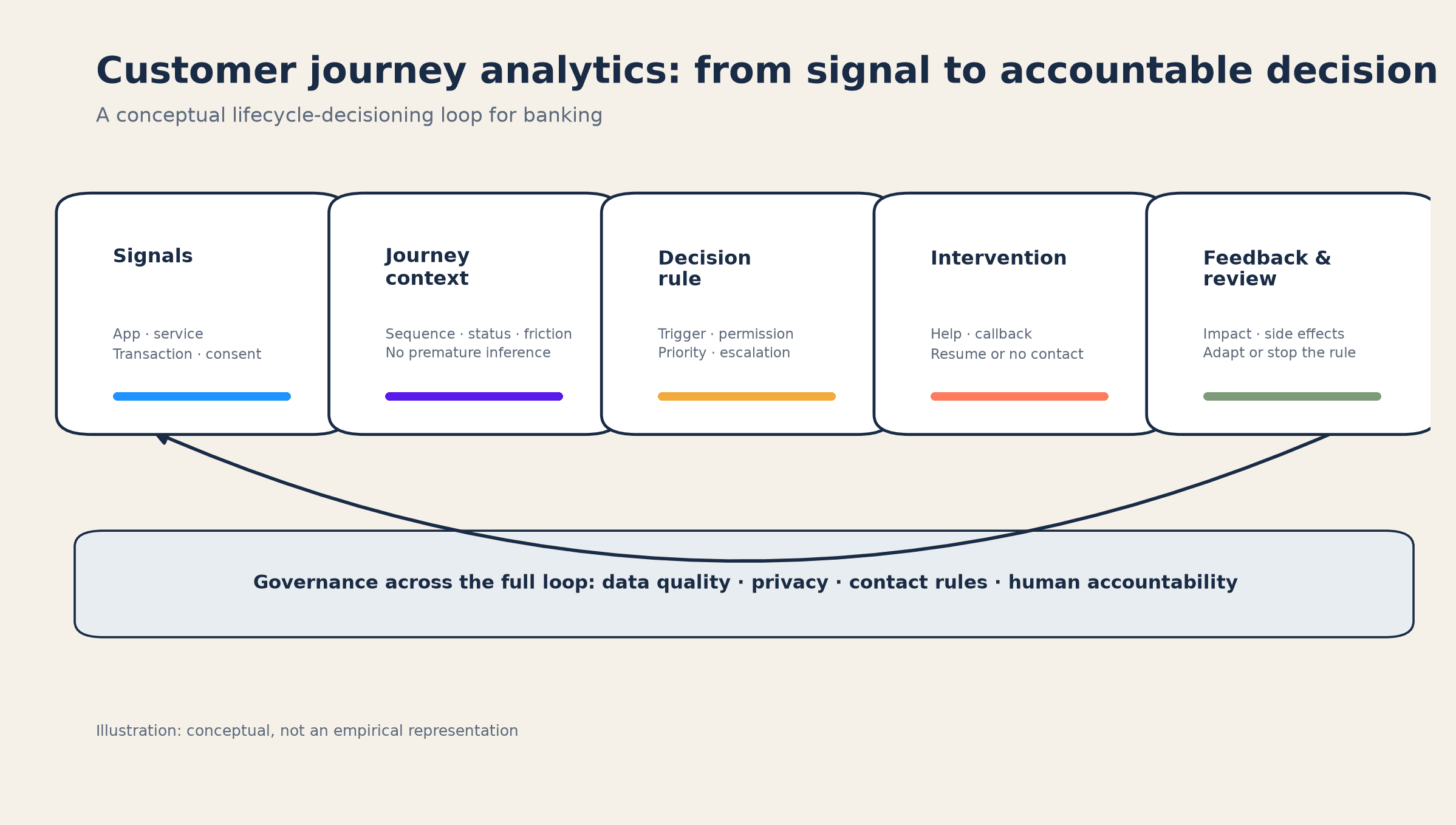
Every rule needs at least five components:
Trigger: What event pattern prompts a review?
Context: What further information must be present to understand the situation?
Permission: Are consent, contact-frequency and business-eligibility conditions met?
Intervention: What help or next step is intended for this situation?
Stop and measurement: When should the bank not act, when should a case be escalated, and how will the effect be assessed?
Consider a hypothetical case. Someone begins an online application, leaves after an error message and contacts service shortly afterwards. A rule can present the adviser with the known step and the error. It can suppress generic marketing. It should not infer a credit decision or assume a sensitive reason. The intervention improves continuity without bypassing the role of a person or the formal process.
To avoid becoming an uncontrolled contact engine, a bank needs contact rules that work across journey boundaries. These include priorities between service, risk and sales; cooling-off periods after complaints; frequency limits; and a clear owner for each decision. Without such rules, a campaign that looks sensible locally can be damaging globally.
Governance keeps accountability human
The closer a decision is to financial consequences, vulnerability or a complex life situation, the more clearly human accountability and escalation routes need to be defined. A model can provide a probability; it cannot replace professional judgement, a business rationale or accountability.
In practice, CJA governance needs a data owner for definitions and quality, a journey owner for customer experience and business purpose, privacy and compliance leads for permitted use, and business owners for each intervention. Product, service and technology teams should jointly decide which interventions can be automated, which require review and which are excluded.
Internal transparency is also essential. Employees need understandable information about why a case was suggested, which categories of data were involved and what they can override. Accenture calls for clear guardrails and options to opt out, pause, overrule and reconsider in AI-enabled interactions. (Accenture Banking Top Trends 2026) The same principles are useful for rules-based lifecycle decisions.
Close the loop rather than merely deliver an action
An intervention is not the end of a journey. After each action, the bank should ask whether it helped, whether it created new friction and whether the rule was unsuitable for particular situations. Success is not just a click or a completed sale. Depending on the journey, fewer repeat contacts, faster resolution, fewer escalations or greater clarity may be the more relevant result.
That requires controlled tests, documented hypotheses and a willingness to withdraw a rule. Optimising only for short-term response ignores the cost of lost trust and extra service demand. Bringing feedback from customer interactions, complaints, process data and business review back into the journey creates a learning, controlled loop instead.
CJA is therefore not another report in the marketing technology stack. It is the analytical foundation for accountable lifecycle decisioning: signals become context, context becomes explainable rules, rules become appropriate interventions, and the outcomes inform better design. Technology can accelerate that loop. Responsibility for purpose, limits and customer impact remains with the bank.
Illustration: AI-generated. AI-assisted content: We use AI technologies and automated agents in the creation of our articles, including from Microsoft, Google, OpenAI, Anthropic and other providers. Topics, editorial direction and final approval remain with our team.
We use Cookies 🍪
Strictly necessary cookies (e.g. Pipedrive forms) remain active. With your consent we also use Google Analytics (analytics) and Leadfeeder (visitor identification). More in our Privacy Policy.