CLM & CVM
Activate: From Application to Active Customer — Onboarding with Prediction Models
Only 30-40% ever activate: how lifecycle-phase scoring and prediction models manage the critical first 90 days.
•
acceleraid Redaktion
5 min read
01
Acquire
Signale erkennen
02
Onboard
Aktivierung steuern
03
Grow
Next Best Action
04
Retain
Churn reduzieren
05
Reactivate
Potenziale zurückholen

Part 2 of 5 in our series on Customer Lifecycle Management in Retail Banking. Part one covered personalized application journeys and email retargeting in the acquisition phase. This part looks at what determines whether an approved application turns into an active customer relationship.
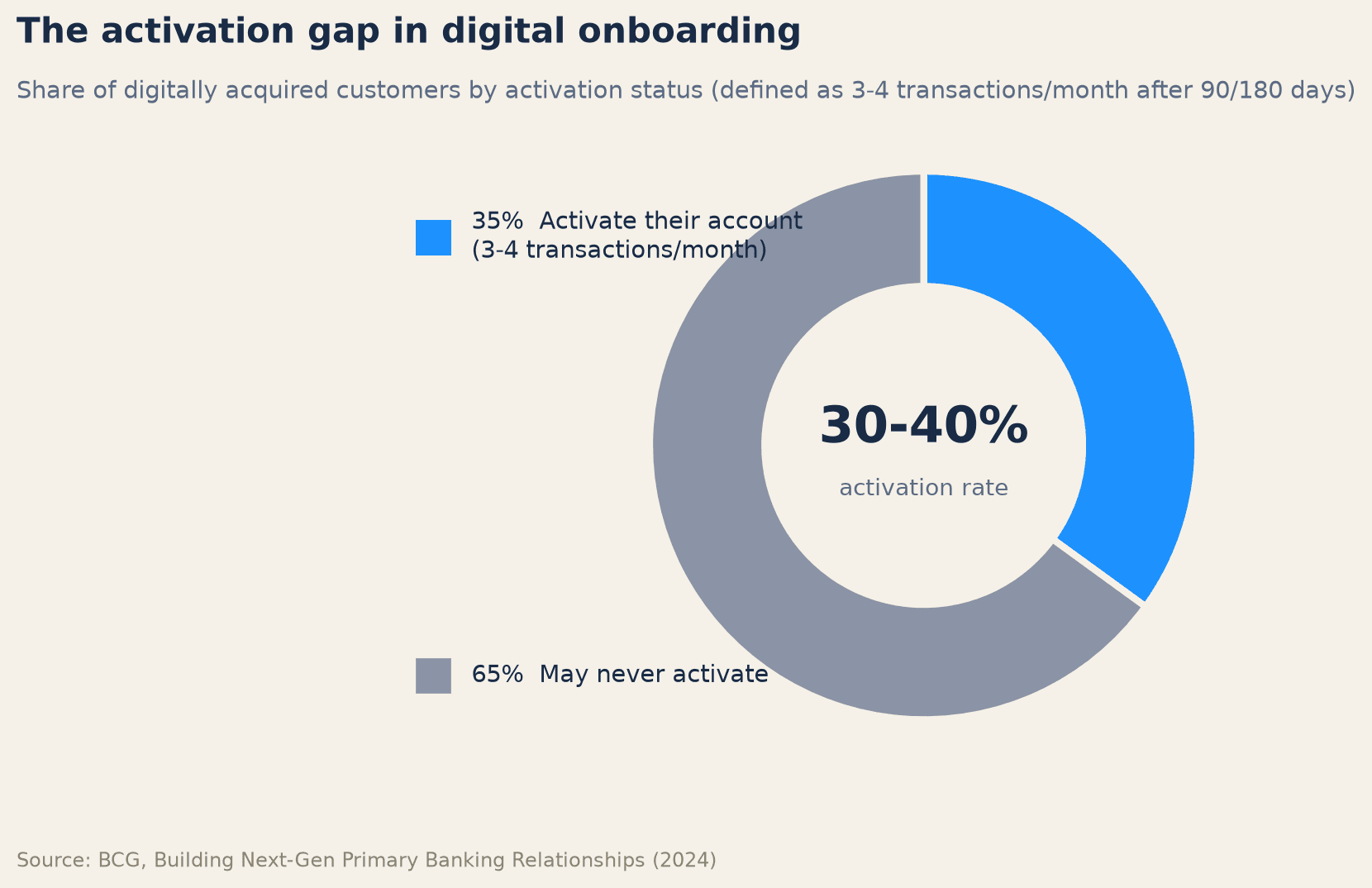
An approved application is not yet a customer. That sober observation sums up one of the costliest blind spots in retail banking: only 30–40% of digitally acquired customers ever activate their account — defined as at least three to four transactions per month after 90 or 180 days. The remaining 60–70% may never activate at all (BCG). Banks pour substantial effort into acquisition, only to lose most of that value immediately afterward.
The activation gap, visualized
This gap is not a fringe phenomenon. Around 11% of newly acquired checking accounts remain entirely inactive, and 20% of new households say a full bank switch feels like too much effort — a pattern the underlying study calls "silent attrition" (The Financial Brand, citing Javelin Strategy & Research). Delays in onboarding make the problem worse: a drawn-out process pushes abandonment to 40–70%, and churn among new retail accounts runs two to three times higher than the existing base (Guidehouse). Current market data confirms the trend: in 2025, 70% of banks lost customers due to slow onboarding, up from 67% the year before (FinTech Global, citing Fenergo).
Metric | Value | Source |
|---|---|---|
Activation rate of digitally acquired customers | 30–40% | |
Abandonment rate with drawn-out onboarding | 40–70% | |
Banks losing customers to slow onboarding (2025) | 70% | |
New accounts with elevated churn propensity in first 90 days | roughly 3x higher |
Why the first 90 days decide everything
The first 90 days after account opening are not just a ramp-up period — they are the moment that shapes the entire relationship going forward: most product decisions happen in the first year, often within the first few months (The Financial Brand / Marquis). Citing J.D. Power, new customers show nearly three times higher churn propensity during this window; at the same time, satisfaction and cross-selling improve markedly when customers are contacted four to seven times within the first 90 days — a figure the same report attributes to The Financial Brand (Epsilon). Missing the right contact at the right moment in this window often means losing the activation opportunity for good.
A significant part of the problem is self-inflicted: 86% of banks that lose customers to KYC and onboarding problems cite poor data management as the cause (Fenergo). The implication: activation cannot be solved with more communication alone — it requires systems that recognize which customer needs which nudge at which stage.
Lifecycle-phase scoring as a control mechanism
This is where lifecycle-phase scoring comes in: instead of running every new customer through the same generic onboarding sequence, a scoring model continuously assigns each customer to a lifecycle stage — acquisition, growth, maturity, or retention — and derives the appropriate next action from it. Crucially, this scoring is not fixed at the moment of account opening; it updates with every new behavioral signal.
A simple phase model for the first 90 days can be structured as follows:
Days 0–7 (onboarding window): focus on functional readiness — first login, card or app activation, completing verification. Any friction here disproportionately reduces the likelihood of later activation.
Days 8–30 (first use): trigger the first transactions, for example through salary redirection or standing orders; this is where an account either becomes the primary bank relationship or doesn't.
Days 31–90 (consolidation): cross-sell prompts only where transaction patterns indicate genuine need — not as blanket offers.
After day 90: transition into regular lifecycle management; customers without activation signals move into a dedicated reactivation track.
Transaction-based intent signals instead of calendar logic
The difference between a calendar trigger ("send an email 90 days after account opening") and a behavior-based trigger is substantial. Transaction-based signals — missing salary deposits, absent card usage, or unusually low transaction frequency — surface activation risk far earlier than a fixed time window ever could. This is exactly where Acceleraid's Prediction Engine operates: it generates explainable propensity and lifecycle-phase scores from real-time transaction data and makes them usable for orchestrating onboarding actions (Acceleraid).
Orchestration: turning a score into the right action on the right channel
A score alone changes nothing — what matters is orchestrating the resulting action through the customer's preferred channel. That means lifecycle phase, channel preference, and regulatory requirements must feed into a single decision logic that delivers in real time across online banking, app, email, or branch CRM. According to the vendor, this integration of the Prediction Engine with CLM/CVM orchestration — including built-in contact-frequency limits so customers aren't overwhelmed with prompts — is the core of Acceleraid's platform approach (Acceleraid Platform).
For marketing and digital leaders, the priority is clear: activation is not a downstream onboarding topic but a control problem for the first 90 days that deserves the same analytical rigor as acquisition itself.
Why calendar campaigns fail at this task
Many institutions try to close the activation gap with classic campaign tools: a welcome email on day one, a reminder after two weeks, a cross-sell offer after a month — regardless of whether the customer has even completed a first transaction. This calendar-driven logic treats all new customers alike, even though their actual activation behavior diverges from day one. A customer who sets up salary redirection in the first week needs different prompts than one whose account shows zero postings after 30 days.
The consequence of calendar-driven outreach shows up directly in silent-attrition numbers: a customer who never opens a push notification or reads an email simply isn't reached by a fixed campaign schedule, even though their transaction behavior already signals disengagement. A score- and event-based approach catches this pattern early and can adapt outreach accordingly — through a channel switch or a more personal branch contact, for instance — before the customer goes fully dormant.
Looking ahead: from active customer to anticipatory offer
Once the activation hurdle is cleared, the task shifts: over time, an active customer generates signals that point to upcoming life events — a move, a growing family, a job change. How to detect such events from transaction streams and translate them into concrete, timely advisory outreach is the subject of part three of this series.
Illustration: AI-generated. AI-assisted content: We use AI technologies and automated agents in the creation of our articles, including from Microsoft, Google, OpenAI, Anthropic and other providers. Topics, editorial direction and final approval remain with our team.
We use Cookies 🍪
Strictly necessary cookies (e.g. Pipedrive forms) remain active. With your consent we also use Google Analytics (analytics) and Leadfeeder (visitor identification). More in our Privacy Policy.