CLM & CVM
Retain: Spotting Churn 90+ Days Ahead — How a Prediction Engine Forecasts Attrition
41% leave their bank without ever closing the account. How churn propensity scores detect attrition 90+ days ahead and trigger retention.
•
acceleraid Redaktion
6 min read
01
Acquire
Signale erkennen
02
Onboard
Aktivierung steuern
03
Grow
Next Best Action
04
Retain
Churn reduzieren
05
Reactivate
Potenziale zurückholen

Part 4 of 5 in our series on customer lifecycle management in retail banking. Previously: Part 1 – Acquire, Part 2 – Activate and Part 3 – Engage. This part covers the fourth phase: Retain.
The customers nobody sees leaving
Attrition in retail banking rarely looks like a cancellation. In a survey of more than 227,000 bank customers by Rivel Banking Research, 41 percent of switchers had left their bank without ever formally closing the account — they simply let it go dormant while their primary relationship had already moved elsewhere (The Financial Brand / Rivel). High-income millennial households are particularly exposed: the same study flags 37 percent of them as at risk of churning. The report describes this pattern aptly as "quiet disengagement, not mass exodus" — and that is precisely why classic churn metrics, which are built around account closures, fail to catch it.
The scale of the problem is significant. Depending on the source, 15 to 25 percent of customers leave their financial services provider every year, with some retail segments running as high as 30 percent (Bank Director). Average retention in banking sits around 75 percent — roughly one in four customers eventually leaves (Experian). Capgemini's World Retail Banking Report adds further context: 74 percent of banking customers are either indifferent or dissatisfied with their bank (The Financial Brand on Capgemini) — fertile ground for exactly the kind of inertia that makes silent attrition possible in the first place.
Why retention carries so much economic weight
The economics of retention have been documented for over a decade, yet they are routinely underweighted in day-to-day operations. Frederick Reichheld's widely cited Harvard Business Review analysis found that acquiring a new customer costs five to 25 times more than retaining an existing one — and that a five-percentage-point improvement in retention can lift profit by 25 to 95 percent (Harvard Business Review, "The Value of Keeping the Right Customers"). A behavioral-data study puts the cost gap even higher: a new customer can cost up to 16 times as much as retaining an existing one, while a five-percentage-point reduction in churn can boost profit by 25 to 125 percent — against a backdrop of 1.6 trillion US dollars in switching costs across the US market alone (Kaya, Dong, Suhara et al., EPJ Data Science). Timing compounds the problem: accounts under six months old churn at three times the rate of established relationships, according to Bank Director (Bank Director).
These figures explain why retention is not a marketing side project but one of the most economically powerful levers available in retail banking. The issue is rarely a lack of awareness — it's a lack of lead time. By the time a customer files a cancellation or actually closes an account, the window for meaningful intervention has usually already closed.
What a churn propensity score actually measures
Attrition is predictable from behavioral data long before it becomes visible. That's exactly what a churn propensity score is designed to capture: the probability that a customer will leave, or sharply reduce engagement, within a defined time window. It doesn't come from a single red flag but from the interplay of several behavioral dimensions:
Transaction frequency. A drop in monthly transactions — especially recurring items like salary deposits or standing orders — is one of the most reliable early indicators of fading engagement.
Balance trends. Systematically declining average balances, or a gradual shift of funds toward external accounts, often signal that the primary banking relationship is quietly moving elsewhere.
Digital engagement. Falling login frequency in the app or online banking, fewer features used, no response to messages — digital activity correlates closely with overall customer commitment.
Product usage and cross-channel signals. Cards not renewed, unused credit lines, or expected follow-on products that never materialize round out the picture.
Recent modeling studies confirm that behavioral data genuinely works for churn prediction: an XGBoost-based churn model achieved 97 percent across accuracy, precision, recall, F1 score, and AUC on a dataset of roughly 10,000 customers (Li & Yan, Data Science in Finance and Economics). That level of model performance isn't an end in itself — it's the precondition for a score to be trustworthy enough to trigger automated action in production.
Thresholds and the 90-day window
A score by itself changes nothing — what matters is how early it gets translated into clearly defined action thresholds. In practice, several escalation stages emerge: a baseline phase where a customer behaves unremarkably; an early-signal stage where individual indicators start to weaken without a clear pattern yet; an escalation stage where several signals deteriorate simultaneously; and a critical stage shortly before actual churn, where many classic reactivation measures already arrive too late.
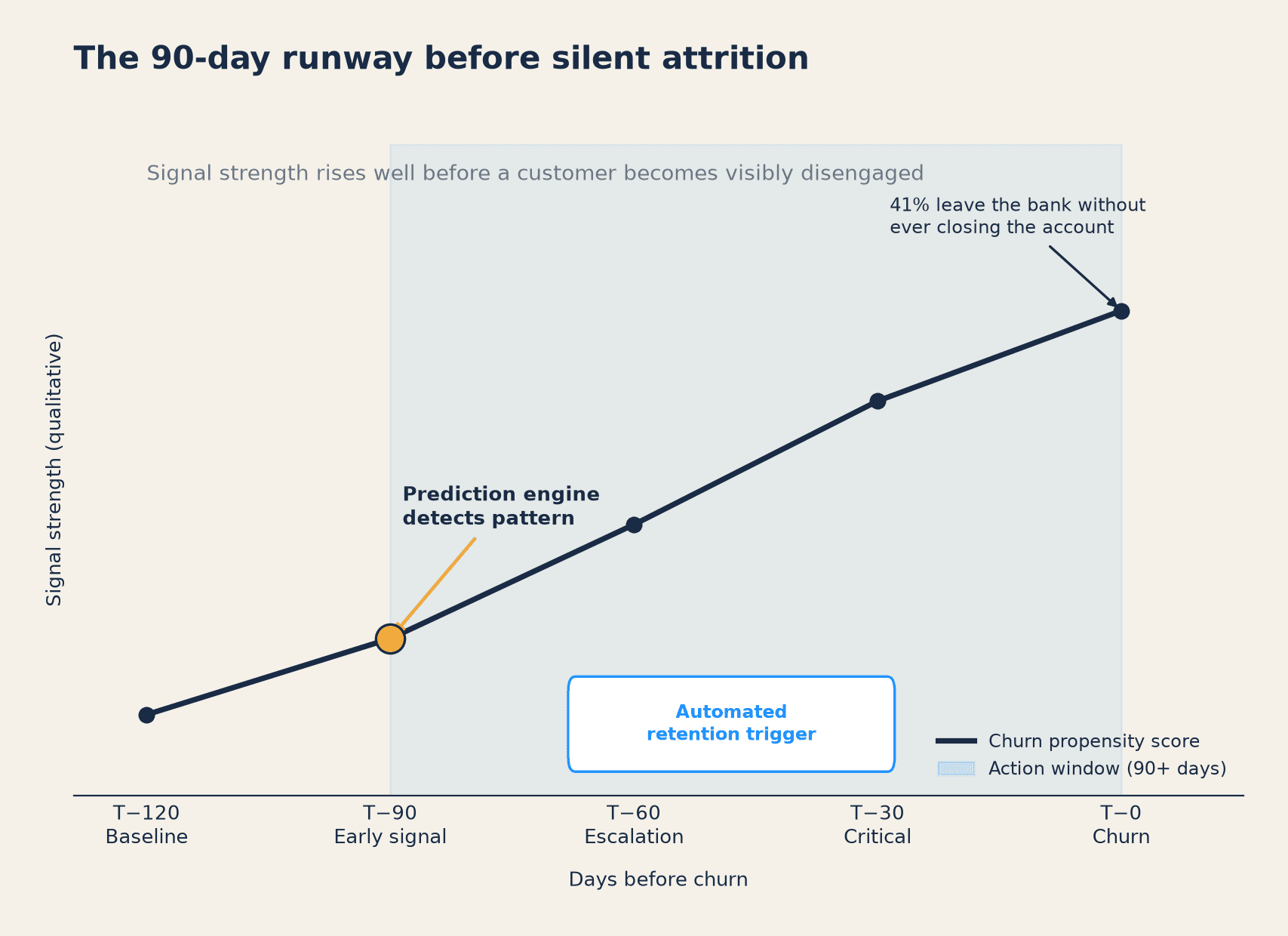
The earlier a score gets translated into an actionable threshold, the larger the remaining window for intervention. Acceleraid's prediction engine is built to detect churn risk up to 90 days in advance — enough lead time to plan and deploy targeted retention measures instead of reacting after the decision has already been made (Acceleraid Platform). The scores themselves are built to be explainable and auditable — a requirement that carries growing weight given tightening supervisory expectations for automated models in banking.
From detection to automated retention campaigns
A forecast is only as good as the action it triggers. Acceleraid's CLM/CVM orchestration layer combines churn propensity scores with a customer's lifecycle phase, known channel preferences, and commercial and regulatory constraints to derive the next best action — delivered in real time across online banking, the app, email, or branch CRM (Acceleraid Banking). That's what separates an operationally useful churn score from a purely descriptive reporting metric: once a customer crosses a defined risk threshold, a matching campaign can fire automatically — a personalized offer, a proactive advisory invitation, or a targeted nudge toward an unused product — all governed by contact-frequency limits so customers aren't overwhelmed by conflicting or excessive outreach.
The table below maps the four escalation stages to typical signal patterns and response options:
Stage | Time horizon | Typical signal | Response option |
|---|---|---|---|
Baseline | ongoing | Stable transaction frequency, stable balance | Standard monitoring |
Early signal | T−90 days | First declines in logins/transactions | Prediction engine flags elevated risk |
Escalation | T−60 days | Multiple signals deteriorate simultaneously | Automated retention trigger |
Critical | T−30 days | Balance outflow, minimal digital activity | Personal advisory outreach, targeted offer |
Conclusion: retention starts before the cancellation
Silent attrition shows that most churn in retail banking never surfaces as a cancellation — it surfaces as a slow withdrawal, and classic retention triggers that only fire on account closure arrive systematically too late. The economic case for retention is well established; what's usually missing isn't awareness of the problem but the ability to translate early signals within a 90-day window into concrete, cross-channel action. How this retention phase fits into a complete lifecycle orchestration — including reactivating dormant customers who haven't churned at all — is the subject of the closing Part 5 of this series.
Illustration: AI-generated. AI-assisted content: We use AI technologies and automated agents in the creation of our articles, including from Microsoft, Google, OpenAI, Anthropic and other providers. Topics, editorial direction and final approval remain with our team.
We use Cookies 🍪
Strictly necessary cookies (e.g. Pipedrive forms) remain active. With your consent we also use Google Analytics (analytics) and Leadfeeder (visitor identification). More in our Privacy Policy.