CLM & CVM
Acquire: Hyper-Personalized Landing Pages, Email Retargeting, and Lead Nurturing
How personalized application journeys, AI traffic allocation, and email retargeting lift conversion in customer acquisition.
•
acceleraid Redaktion
5 min read
01
Acquire
Signale erkennen
02
Onboard
Aktivierung steuern
03
Grow
Next Best Action
04
Retain
Churn reduzieren
05
Reactivate
Potenziale zurückholen

Part 1 of 5 in our series on Customer Lifecycle Management in Retail Banking. Over the coming weeks, we examine how banks manage the full customer lifecycle — from acquisition through activation and engagement to retention — using data-driven methods.
Digital account opening has become a bottleneck for many banks: more applications are started than ever, yet most never convert into a new customer. In the US, 21% of new checking accounts were opened digitally in 2024, rising to 27% a year later — with an average of 3.36 abandoned applications for every completed one (The Financial Brand). In Europe, roughly half of new checking accounts are now opened digitally (McKinsey). The question is no longer whether customers arrive online — it's how many actually finish the application.
Where the application funnel loses conversion
The numbers reveal a wide performance gap between institutions. In online account opening, top performers reach 30–40% overall conversion — built from 55% application completion and a 65% approval rate — while weaker providers stay below 10% (MANTL). A single friction point can carry outsized weight: requesting ID documents mid-process alone cuts conversion by 29% (MANTL).
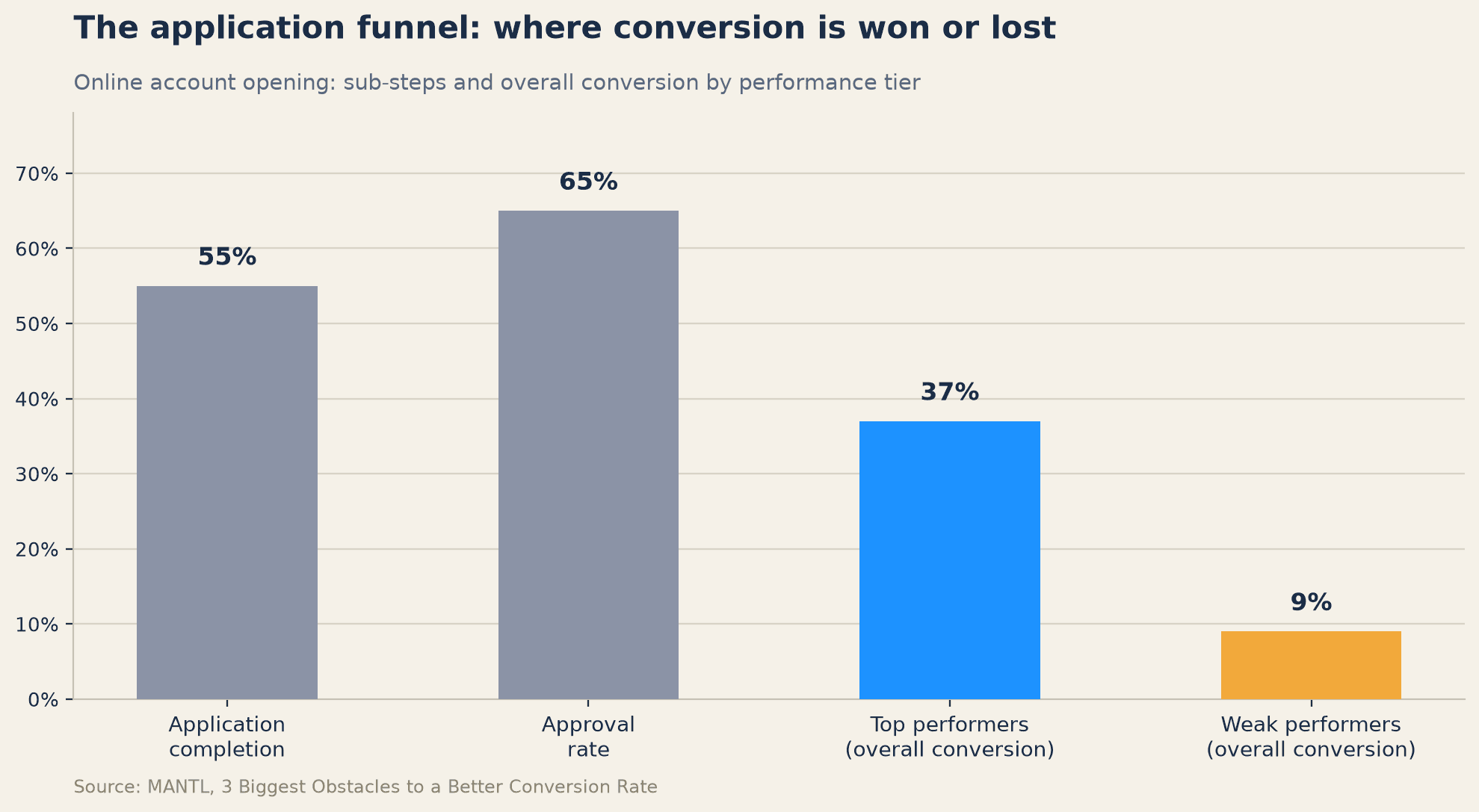
Metric | Top performers | Weak performers |
|---|---|---|
Application completion | 55% | significantly lower |
Approval rate | 65% | significantly lower |
Overall conversion | 30–40% | below 10% |
Source: MANTL
This gap is not random — it results from systematic differences in three areas: personalization of the application journey itself, intelligent allocation of traffic across variants, and disciplined follow-up on abandoned applications. Together, these three levers form the backbone of a robust acquisition framework.
Lever 1: Personalized application journeys instead of one-size-fits-all forms
Personalization is no longer a nice-to-have in retail banking — it's a measurable conversion lever. According to McKinsey, AI-driven personalization lifts conversion by a factor of three to five, with leading institutions running campaign cycles under four weeks (McKinsey). One European bank running around 200 personalization use cases saw conversion improve by a factor of nine, while personalization in campaigns delivers 5–15% higher revenue industry-wide (McKinsey). Customer expectations reinforce the point: 71% expect personalized interactions, and 76% are frustrated when they don't get them (McKinsey).
For co-brand and partner programs — credit cards issued jointly with retail partners or distribution networks, for instance — this means every landing page should reflect the context of its channel, campaign, and user profile rather than relying on one generic application flow for every entry point. According to Acceleraid, a card program using personalized, AI-optimized application journeys drove a 120% increase in credit card applications, deployed across more than 150 co-brand card pages (Acceleraid).
Lever 2: AI traffic allocation and multi-armed bandits instead of static A/B tests
Classic A/B tests carry a structural drawback: they split traffic evenly across variants for the full test duration — even once one variant is clearly outperforming. Multi-armed bandit methods solve this by dynamically shifting traffic toward the best-performing variant while still reserving a small share for ongoing exploration. A practical rule of thumb is to permanently allocate 5–10% of traffic to exploration and 1–5% as a holdout group (Braze).
For banks running high traffic volumes across many parallel landing page variants — across different co-brand partners, for example — this is more than a technical nuance: it materially shortens the time to optimal delivery and reduces revenue lost during testing. Acceleraid's Experience Optimisation module combines exactly this kind of AI traffic allocation with personalized landing pages and application journeys, and is associated by the vendor with an average conversion uplift of 15% (Acceleraid).
Lever 3: Email retargeting after application abandonment
An abandoned application is not a lost lead — provided the email address was already captured and retargeting happens promptly and based on behavior. The difference between automated, triggered emails and classic bulk campaigns is substantial: open rates of 38–48% versus 30.7%, click-through rates of 4.67–5.58% versus 1.29–1.69% (a 332% increase), and conversion of 1.49% versus 0.08% — a 19x difference. Revenue per email sent is 22 times higher for triggered emails than for bulk sends, and notably, 41% of total email revenue comes from just 5.3% of send volume (Stripo Research). For comparison, the industry benchmark for business and finance sits at a 31.35% open rate and 2.78% click rate for regular campaigns (Mailchimp) — a bar that triggered abandonment emails can clear by a wide margin.
An effective retargeting playbook for application abandoners typically follows a clear escalation logic: an initial reminder within a few hours of abandonment, a second message offering concrete help at the point of drop-off (missing documents, for example), and, if inactivity continues, a transition into a longer-term lead-nurturing sequence. Given that customer acquisition cost in retail banking runs around $561 per new customer — with sharp variation by channel, from $290 for digital banks to $590 for paid search (FirstPageSage) — every recovered application is a direct efficiency gain on the marketing budget.
Lead nurturing: bridging abandonment and re-engagement
Not every abandoned application can be recovered immediately. A structured nurturing process segments leads by reason for abandonment and likelihood of return, serves relevant content (explaining fees or security, for example), and maintains contact across multiple channels. The critical design choice is linking this back to lever 2: insights from nurturing — which segments respond to which content — should feed back into the ongoing optimization of the application journey rather than sitting in a separate campaign tool.
According to Acceleraid, a card program using orchestrated lead nurturing generated 50% more qualified leads (Acceleraid). That underscores that nurturing should be an integral part of the acquisition journey, not a downstream afterthought.
From application to active customer relationship
An optimized funnel with personalized landing pages, dynamic traffic allocation, and disciplined retargeting solves only half the problem: the application itself. Whether an approved application actually becomes an active, value-generating customer is decided in the following weeks — the subject of the next part of this series, where we look at the activation gap and the role of prediction models in onboarding. Both phases rest on the same foundation: a data architecture that makes signals from every touchpoint available in real time, as implemented in Acceleraid's CDP and Prediction Engine modules (Acceleraid Platform).
Illustration: AI-generated. AI-assisted content: We use AI technologies and automated agents in the creation of our articles, including from Microsoft, Google, OpenAI, Anthropic and other providers. Topics, editorial direction and final approval remain with our team.
We use Cookies 🍪
Strictly necessary cookies (e.g. Pipedrive forms) remain active. With your consent we also use Google Analytics (analytics) and Leadfeeder (visitor identification). More in our Privacy Policy.