CLM & CVM
Engage: Detecting Life Events from Transaction Streams and Turning Them into Advice
How relocation, childbirth, or separation can be predicted from transaction data — and turned into offers within 24 hours.
•
acceleraid Redaktion
5 min read
01
Acquire
Signale erkennen
02
Onboard
Aktivierung steuern
03
Grow
Next Best Action
04
Retain
Churn reduzieren
05
Reactivate
Potenziale zurückholen
Part 3 of 5 in our series on Customer Lifecycle Management in Retail Banking. Part two covered the activation phase. This part turns to active customers — and how to detect life events from their transaction behavior and translate them into concrete advisory outreach.
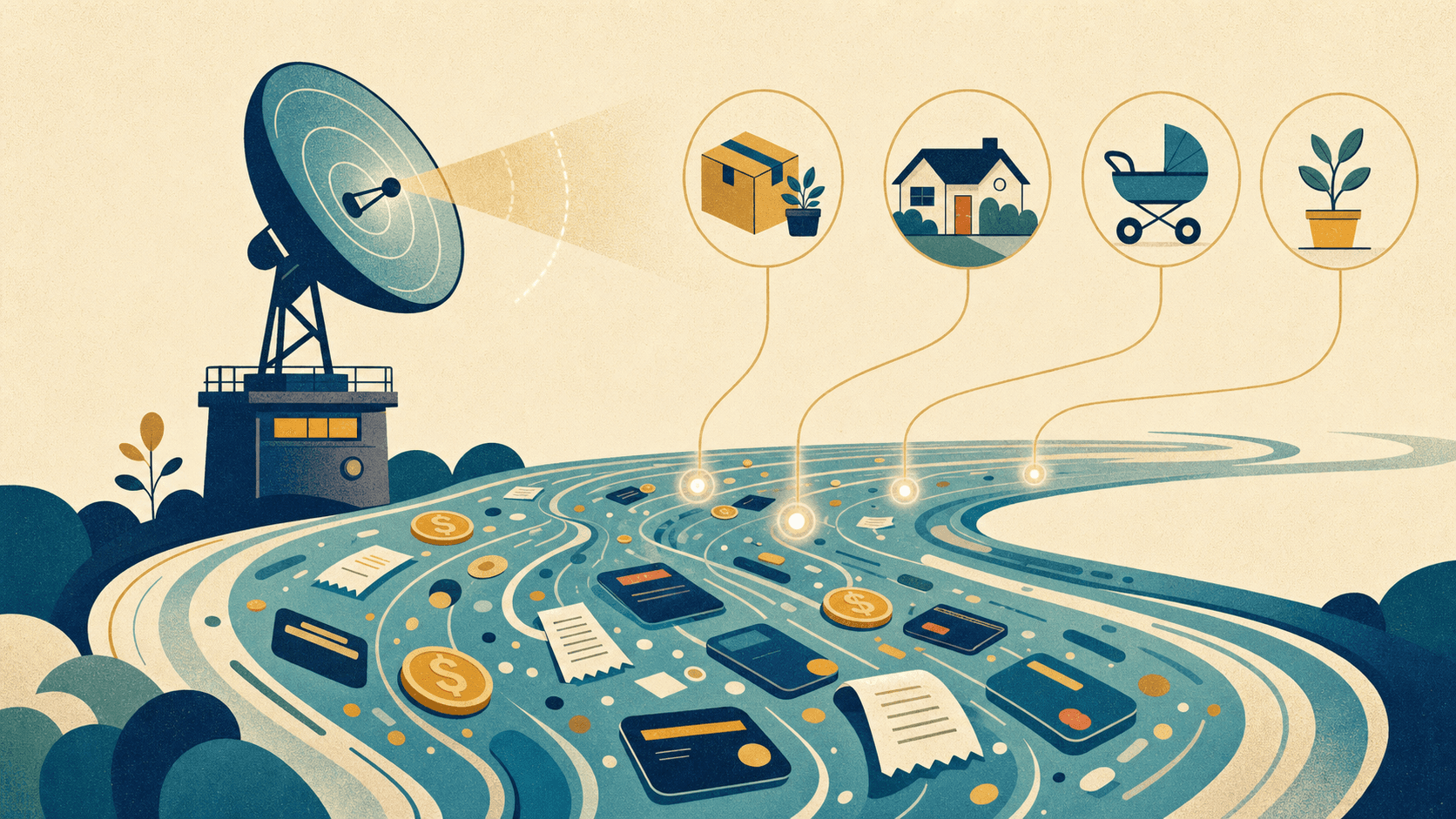
A move, a birth, the start or end of a relationship — life events change a person's financial needs abruptly and profoundly. For banks, they are among the most valuable moments in the entire customer lifecycle: 25% of consumers considering switching their checking account do so because of a life event (MANTL). The critical question is: how does a bank know such an event is happening — before the customer acts on it, or switches to a competitor?
The evidence: transaction data beats aggregated data
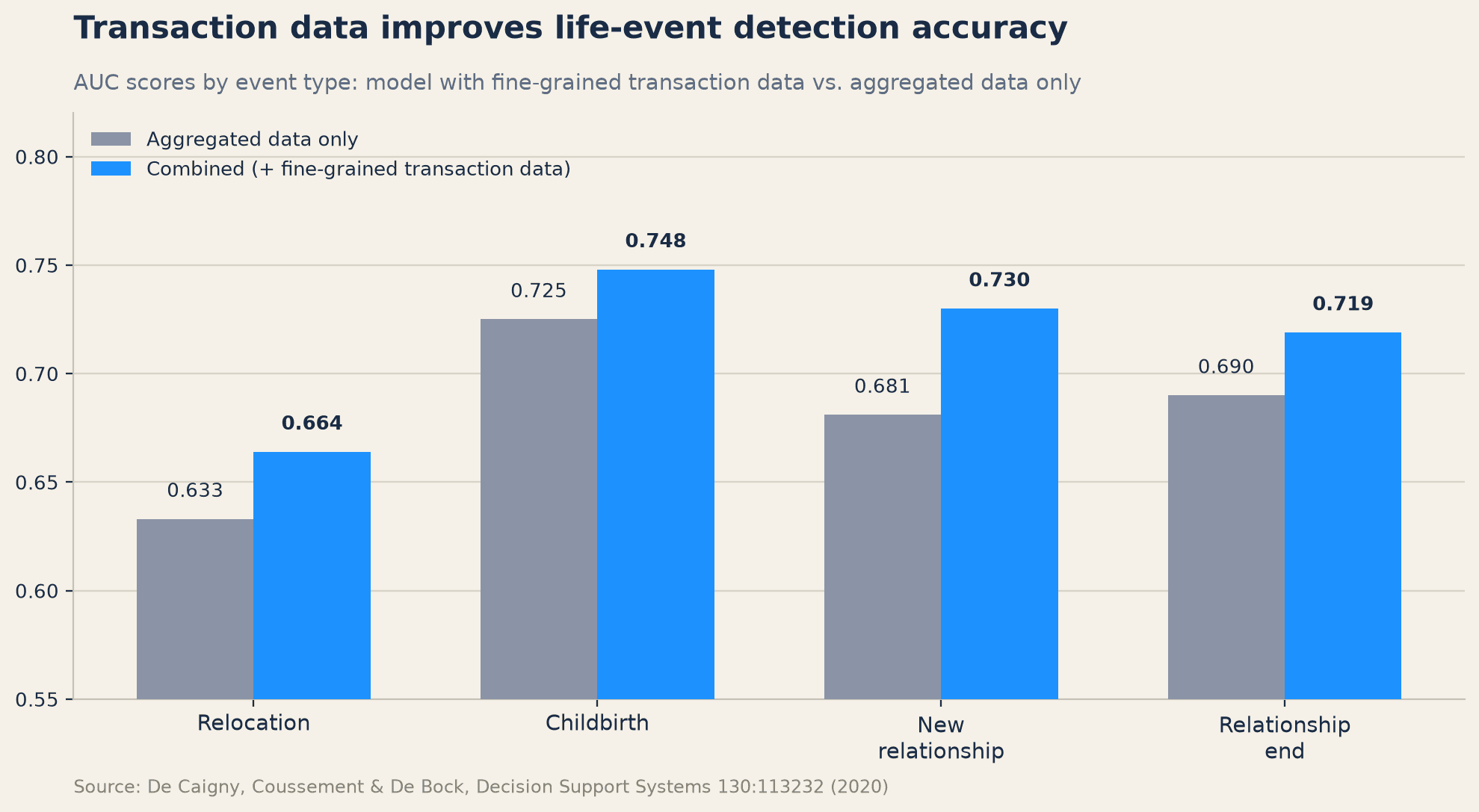
One of the most methodologically rigorous answers comes from a study analyzing roughly 60 million debit transactions from 132,703 customers and more than 1.5 million counterparties over a six-month forecast horizon. Event frequencies observed: relocation 9.44%, childbirth 1.64%, new relationship 2.02%, relationship end 1.61% (De Caigny, Coussement & De Bock, Decision Support Systems). The key finding is the model comparison: a model combining fine-grained RFM transaction data with aggregated data achieves a higher AUC in every single category than a model relying on aggregated data alone.
Event | AUC, aggregated data only | AUC, combined (+ transaction data) |
|---|---|---|
Relocation | 0.633 | 0.664 |
Childbirth | 0.725 | 0.748 |
New relationship | 0.681 | 0.730 |
Relationship end | 0.690 | 0.719 |
Source: De Caigny, Coussement & De Bock, Decision Support Systems 130:113232 (2020)
The gain in predictive power is consistent across all four event types — the study finds that fine-grained transaction data contributes the most to model performance. The practical implication: banks that try to infer life events from demographics or coarse account balances alone are systematically leaving predictive power on the table that already exists in their own transaction data.
Trigger, not batch marketing: timing determines relevance
A detection model is of little use if the resulting action lands in a mass email campaign weeks later. The benchmark data draws a sharp line between event-triggered and calendar-driven campaigns: triggered lifecycle journeys achieve 1.49% conversion versus 0.08% for classic campaigns — a 19x difference — alongside a 332% higher click-through rate. Notably, 41% of total email revenue comes from just 5.3% of send volume; a comparable Omnisend dataset shows a similar pattern, with 37% of revenue from 2% of volume (Stripo Research). In the BFSI sector, behavioral emails also achieve the highest open rate of any industry at 42.36%, with journey-based conversion at 29.15% versus 26.15% for purely behavioral emails without journey logic (MediaPost, analyzing MoEngage data).
Real-world examples confirm the effect: Affinity FCU reversed deposit outflows within nine months by tying campaigns directly to certificate-of-deposit maturity dates, while Deluxe alerts banks within minutes of a customer's external credit inquiry (The Financial Brand). These examples illustrate a simple truth: the value of a signal decays with every hour of delay.
From signal to action: a decision framework
Turning this into practice calls for a clearly staged playbook that systematically connects detection, prioritization, and channel selection:
Signal detection: continuous scoring of transaction streams for patterns such as relocation (new standing orders, changed merchant categories), a growing family (shifted spending categories), or relationship status (account activity, joint versus separate transactions).
Prioritization: weighing the detected signal against confidence (the AUC level of the underlying model), the business value of the potential offer, and regulatory constraints.
Channel selection: choosing the contact channel based on documented customer preference and contextual appropriateness — a sensitive event like a relationship ending calls for a different tone and possibly a more personal channel than a relocation notification.
Timing window: delivering the offer within a defined response window, not in the next campaign cycle.
Frequency control: respecting contact-frequency limits so a single detected event doesn't trigger a flood of offers across multiple channels at once.
Multi-channel delivery without contact overload
The channel question is far from a side issue in the DACH region. In 2025, 89% of checking-account holders in Germany used online banking, up 8 percentage points from 2023 (Deutsche Bundesbank); app or website usage in Germany simultaneously stands at 86%, with 44% of online banking users no longer visiting a branch at all (Bitkom). At the same time, international comparison data shows that despite far lower contact frequency (8 contacts/year versus 152 for the app), the branch retains the highest trust for complex matters — 64% of customers still rely on it for conflict resolution (Accenture Global Banking Consumer Study). A life event like a mortgage need triggered by a detected relocation signal might therefore be initiated digitally but closed through a branch consultation or video advisory session.
From 65,000 advisory appointments to systematic practice
That detected life events and transaction signals can generate substantial advisory demand in practice is illustrated by Acceleraid's experience: according to the vendor, deploying its CLM/CVM engine generated 65,000 advisory appointments (Acceleraid). The platform combines explainable propensity and life-event signals from transaction data with orchestration that enforces fixed contact-frequency limits per channel — so a single detected event does not trigger conflicting or overlapping outreach across app, email, and branch CRM simultaneously (Acceleraid Platform). The goal is an offer within 24 hours of signal detection — close enough to the event to stay relevant, and coordinated across channels to avoid feeling intrusive.
Why contact-frequency limits are not a side detail
Because life events trigger strong, immediate action impulses, there is a real risk that several parallel campaign engines react to the same signal — a relocation notice, for instance, simultaneously firing an app push notification, an email, and a branch flag. Without central orchestration logic that enforces documented frequency limits per channel and customer, an otherwise positive signal can quickly tip into perceived intrusiveness. A sound CLM/CVM architecture must therefore not only detect when an event occurs, but also define, in a binding way, how often and through which channel a customer may be contacted within a given period — regardless of how many individual signals fire during that window.
Looking ahead: from opportunity to risk
Life-event detection addresses the positive side of engagement — the growth potential within an existing customer relationship. But the same transaction data foundation also provides the earliest warning signs of the opposite: quiet, gradual churn. How to detect churn risk up to 90 days in advance is the subject of the next part of this series.
Illustration: AI-generated. AI-assisted content: We use AI technologies and automated agents in the creation of our articles, including from Microsoft, Google, OpenAI, Anthropic and other providers. Topics, editorial direction and final approval remain with our team.
We use Cookies 🍪
Strictly necessary cookies (e.g. Pipedrive forms) remain active. With your consent we also use Google Analytics (analytics) and Leadfeeder (visitor identification). More in our Privacy Policy.