CLM & CVM
Trust Is the Currency: What Bank Customers Will and Will Not Let Generative AI Do
Deloitte survey: 79% trust the bank's website, 49% generative AI, 83% reject agents acting without approval. What it means for customer-facing AI.
•
acceleraid Redaktion
4 min read

Bank customers already use generative AI to find out about accounts, loans and cards. But they trust it considerably less than their bank's website, and they do not want it to act without asking. That is the core of a survey of almost 2,600 banking customers in the United States published by the Deloitte Center for Financial Services on 27 August 2026 (Deloitte). The figures come from the US market; the patterns behind them will look familiar to European banks. Here is what the findings mean for customer-facing AI.
Research yes, sharing data no
Usage is already broad. 58 percent of surveyed generative AI users have used the tools to research banking products, although search engines still lead at 84 percent. The generational gap is marked: 65 percent of Gen Z respondents have used AI tools for banking research, compared with 45 percent of baby boomers. More than half of respondents find generative AI more useful than search engines, and more than 40 percent find its information more useful than that of the bank's website or banking app.
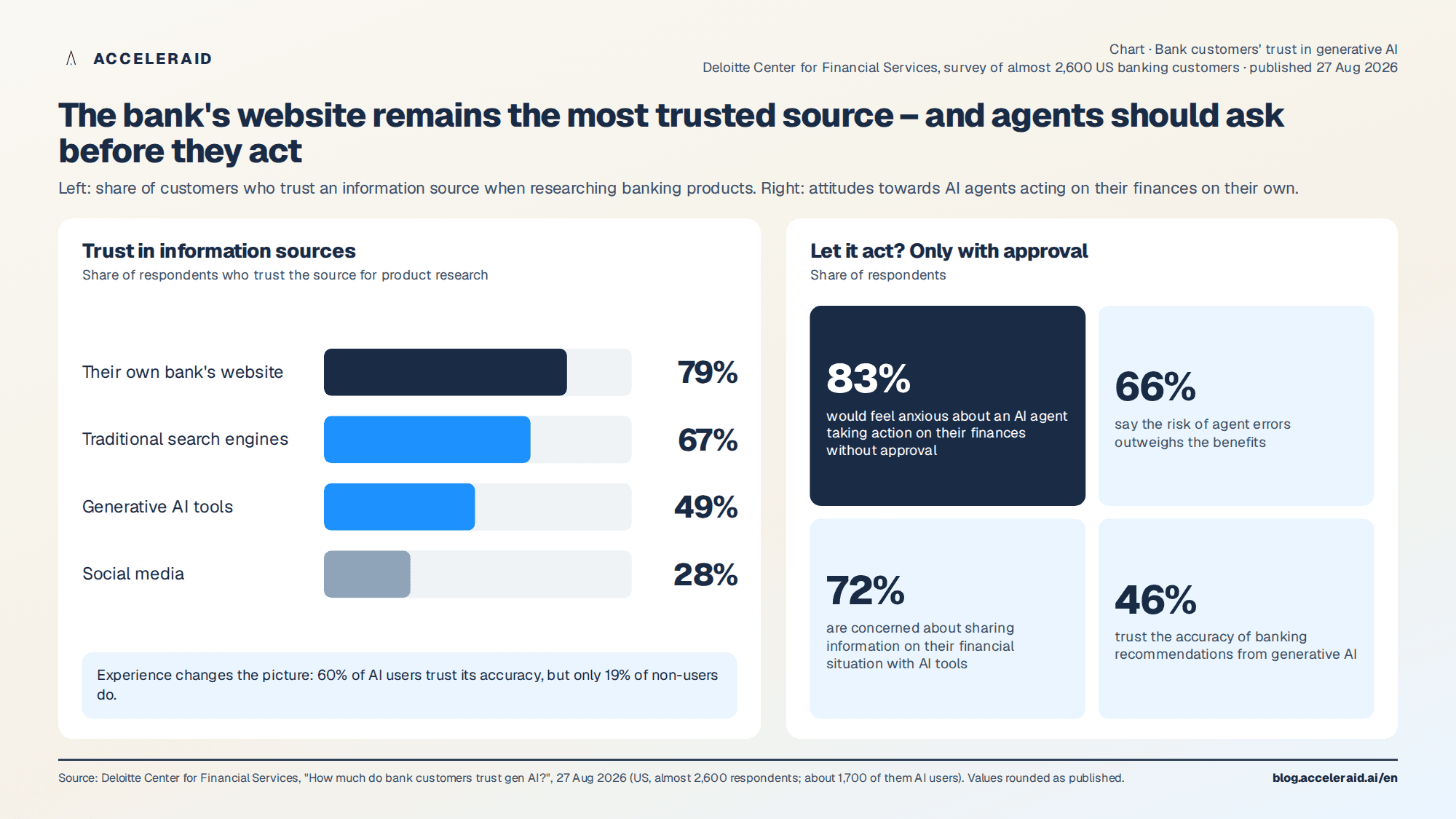
Usefulness meets reluctance. 72 percent of consumers, across age, gender and income, are concerned about sharing information about their financial situation with AI tools. 64 percent worry about hidden biases, and only 46 percent trust the accuracy of banking recommendations from generative AI.
What stands out is how strongly experience changes trust. Among the roughly 1,700 respondents who have already used AI tools, 60 percent trust their accuracy. Among those who have not, the figure is 19 percent. Trust is built in use, not in announcements.
The bank's website remains the most trusted source
Asked how much they trust information sources for product research, respondents put their bank's website first at 79 percent, followed by traditional search engines at 67 percent. Generative AI reaches 49 percent, social media 28 percent. Deloitte attributes the gap to the trust banks have built over years through regulation and customer experience, but warns at the same time that this lead can erode if customers come to see AI tools as more neutral than the bank itself.
For banks, this creates a double task. Their own website remains the place where trust is redeemed. At the same time, it becomes the source for the AI systems customers consult beforehand. Deloitte therefore recommends making product descriptions, rates, fees and disclosures structured and machine-readable, and aligning content with the questions customers actually ask. What an AI says about a bank increasingly depends on what the bank itself publishes in verifiable form.
Let it act? Only with consent
Customers' attitude is clearest on the question of whether AI may act on its own. 83 percent would feel anxious about an AI agent taking action on their finances without their approval. 66 percent believe the risk of errors outweighs the benefits. More than 40 percent name costly errors, privacy and a lack of human oversight as specific concerns.
This is not a rejection of agents but a condition. Deloitte advises banks to design AI tools that explain, compare, recommend and prepare actions, with execution only after the customer has approved. In addition, customers should see which data was used, which assumptions were made and why a recommendation was given. How card networks and banks are currently settling the technical side of that consent is the subject of our article on know your agent.
What follows for managing customers
The survey offers three pointers for banks that use or plan to use AI in customer contact.
First, AI's influence on purchase decisions can and should be measured. Deloitte recommends tracking the bank's presence in AI-generated shortlists, the accuracy of the descriptions, customer trust and customers' willingness to act on AI-assisted information. That is a new metric alongside search visibility and channel reach.
Second, trust depends on the segment. 55 percent of millennials trust AI recommendations, compared with 34 percent of baby boomers. A bank rolling out AI-assisted advice should calibrate the expected level of explanation and human reassurance by customer group, not across the board.
Third, the confirmation step is not friction; it is the moment trust is created. A clear preview of the action, the data used and a visible way to revoke are the conditions under which customers are prepared to delegate more. This connects with the finding from McKinsey's personalisation analysis that we discussed last week: service and security messages build the relationship in which recommendations are later accepted.
Transferability to Europe is not proven; the survey is limited to the United States. Given the stricter privacy and transparency requirements on this side of the Atlantic, however, it would be surprising if European customers demanded less control.
Five takeaways
58 percent of AI users research banking products with generative AI, but 72 percent hesitate to share financial information with it.
The bank's website is the most trusted source at 79 percent; generative AI reaches 49 percent. The lead only holds if the bank publishes its content in verifiable, machine-readable form.
Experience creates trust: 60 percent of AI users trust its accuracy, compared with 19 percent of non-users.
83 percent do not want agents that act without approval. Explain, compare, prepare, yes; execute only after consent.
AI's influence on product decisions becomes a metric in its own right: presence in AI shortlists, accuracy of descriptions and customers' willingness to act.
Illustration: AI-generated. AI-assisted content: We use AI technologies and automated agents in the creation of our articles, including from Microsoft, Google, OpenAI, Anthropic and other providers. Topics, editorial direction and final approval remain with our team.
