Data & Technology
AI in Banking: Why Learning Banks Will Win
The future banking advantage: a learning operating model connecting data, decisions, people, specialised brains and feedback.
•
acceleraid Redaktion
9 min read
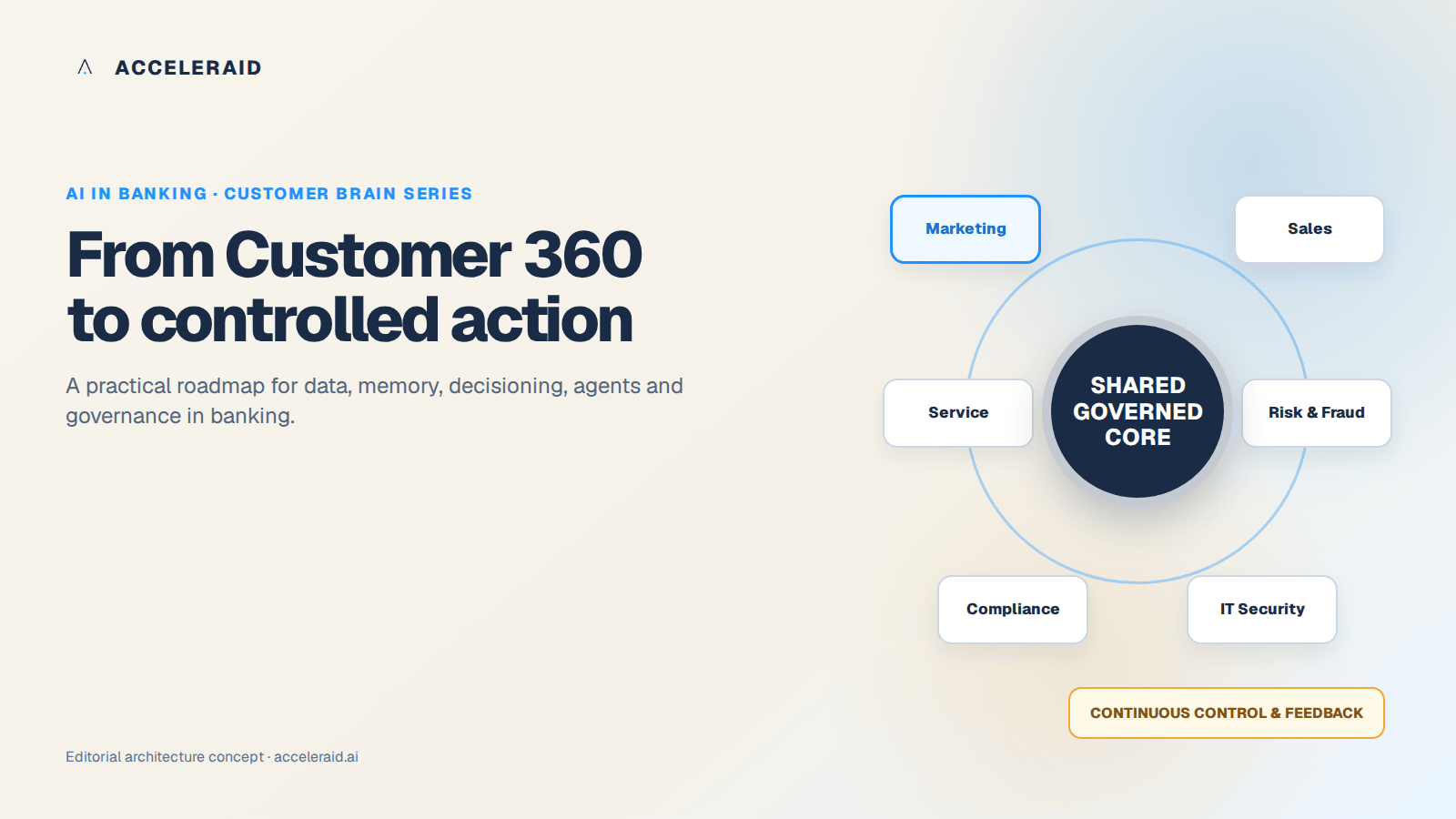
The next competitive divide in banking will not be between institutions that use AI and those that do not. Almost every bank will use models, assistants and automation. The real divide will be between banks that add these tools to yesterday’s operating model and banks that redesign how data, processes, decisions, employees and learning work together.
The second group can become a learning bank. Each relevant interaction creates context. Each decision follows explicit permissions. Each action produces an observable result. That result returns to the system and improves the next decision. The advantage compounds because the organisation does not merely execute more quickly; it becomes better at recognising what a customer needs and at choosing when a human, a process or an AI component should respond.
Search offers a useful strategic analogy. The lasting advantage was never just the search box. It came from an operating system that continually connected signals, ranking, user behaviour and feedback. Banks now face a similar design question at their customer interfaces: can they turn every permitted signal and every outcome into better service, more relevant decisions and a longer customer relationship?
That is the subject of our new five-part series: the AI Brain for banking customer interfaces across marketing, sales and service. “Customer Brain” is Acceleraid’s editorial architecture concept, not a standardised industry expression and, importantly, not a defined regulatory term. It describes one or several coordinated domain brains that combine reliable identity, business meaning, purpose-bound memory, controlled decisioning, bounded actions and observable feedback.
The operating model is the product
The technical starting point has changed. Language models can serve as reasoning components, but they are stateless without an external architecture; durable capability comes from connecting them with memory, tools and orchestration (CoALA; agentic AI architectures). An AI Brain is therefore not a model question. It is a systems, process and accountability question.
“The competitive advantage will not come from installing another AI tool. It will come from redesigning the bank as a learning operating system. The technology required for that is available today, including data-protection and regulatory controls. What matters now is how data, decisions, processes and people are connected.” — Michael Altendorf, CEO of Acceleraid
This does not imply that implementation is complete. Acceleraid does not currently ship a finished enterprise brain with organisation-wide shared memory, a knowledge graph or autonomous agents. Its position is a governed activation and feedback layer for segmentation, predictive decisioning, triggers, next best action and personalised activation (platform overview; data layer). A bank can build progressively on that foundation.
Intelligence should improve the relationship, not remove it
Customers do not experience separate data models for marketing, sales and service. They may call the service team after a failed digital interaction; receive a sales message shortly after making a complaint; or appear to be churning when the real cause is a temporary technical problem. An AI Brain should not flood these transitions with all available data. It should bring the right, permissible context to the right decision.
This does not describe a bank without people. It describes a bank that uses people where judgement, empathy and trust create value. If administrative work, information retrieval and routine status questions are automated, employees can spend more time speaking with customers. The quality of that conversation also improves when the employee knows that an earlier interaction failed, a complaint remains unresolved or the customer may be dissatisfied.
That handover can be more valuable than another automated offer. A timely conversation about satisfaction may prevent a relationship from deteriorating. Conversely, customers should not be forced to speak to a synthetic voice in every situation. Automation is useful when it gives an immediate, accurate answer or routes the case intelligently. A human remains essential when the situation is sensitive, ambiguous or consequential. Even an automated response is preferable to thirty minutes in a call-centre queue only when it genuinely resolves the customer’s need and offers a clear path to a person.
Five use cases illustrate the target:
Dynamic churn and retention: Combine a risk score with current events, open cases, contact policies and outcomes. High churn risk and sensitivity to an intervention are not the same (Ascarza, Retention Futility).
Next best action: A model may rank an option, while purpose, consent, contact pressure, eligibility and human approval determine whether it may be used.
Sales and service continuity: Transfer a digital journey to an employee with ordered context instead of reconstructing the situation.
Complaints and vulnerability: Let an open complaint override sales activity and keep sensitive signals within a bounded protection context.
Fraud and risk coordination: Share identity and timing where useful while keeping decision rights and access separate. The AI Act also classifies functions by use case (EU AI Act, Annex III).
Control cannot be the final project gate
In a conventional application, a late compliance review may still identify isolated defects. In a contextual decision and action system, that is too late. Purpose limitation, data minimisation, access, retention, correction and security determine which information may enter a context package in the first place. The GDPR requires data protection by design and by default when the means of processing are determined, not after deployment (GDPR, Articles 5 and 25).
Risk and ICT governance are not final sign-offs either. DORA requires a documented ICT risk-management framework and visibility into functions, assets, dependencies and third parties (DORA, Articles 5, 6 and 8). BaFin considers the AI lifecycle from data acquisition and development through operation and retirement (BaFin guidance). Changes to data, models, permissions or providers therefore need classification, ownership and an examination path shared with risk, compliance, data protection and IT security.
One bank may need several brains
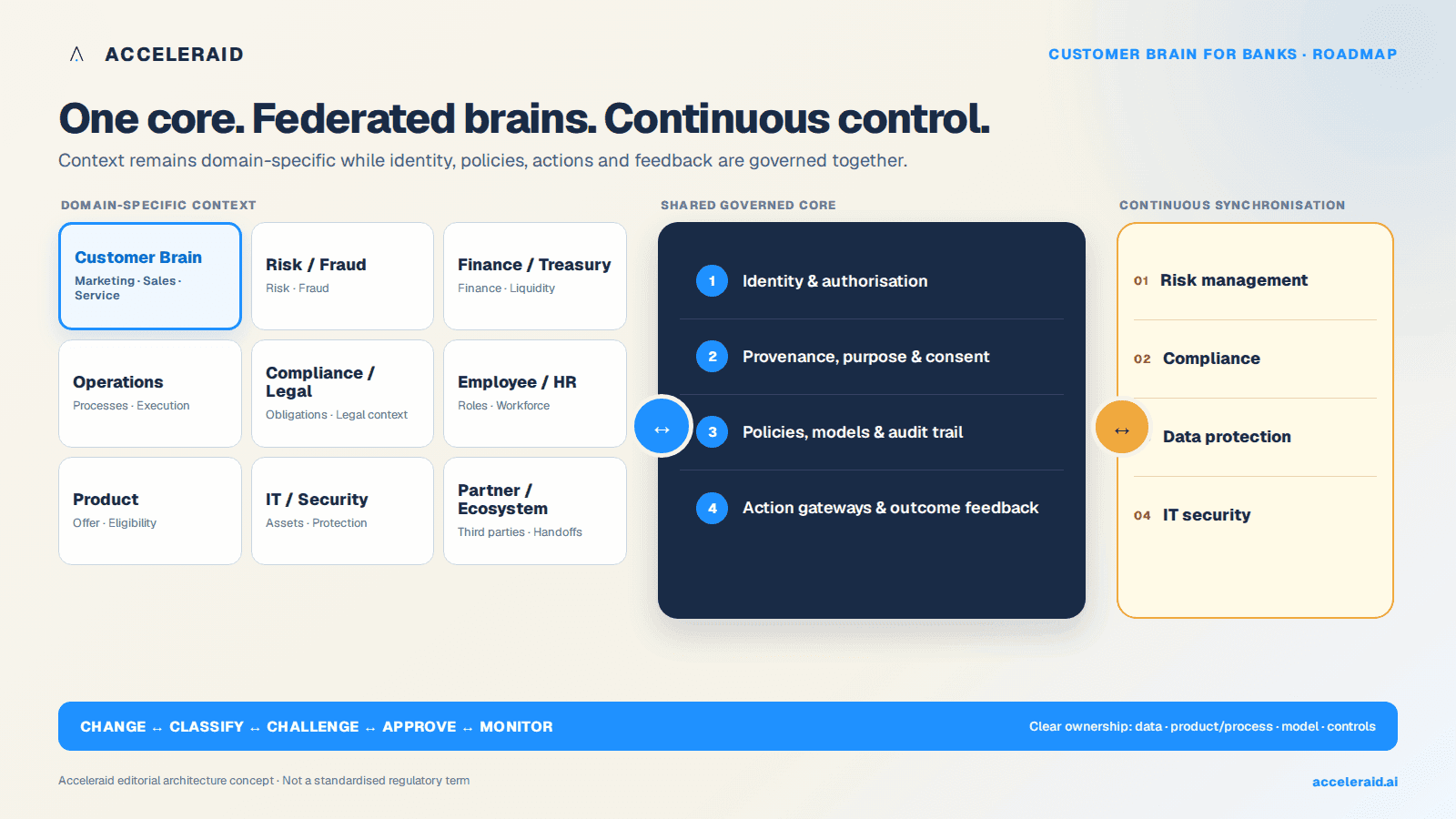
One all-knowing enterprise memory would be neither practical nor desirable. A federated architecture is more sensible. The shared governed core provides only capabilities that genuinely need to be common: identity and authorisation, provenance and freshness, purpose and consent logic, policies, model and rule versions, action gateways, an audit trail and standards for outcome feedback.
Around it sit domain-specific brains, memory and context areas. Beyond the Customer Brain, plausible functional architectures include:
Risk/Fraud,
Finance/Treasury,
Operations,
Compliance/Legal,
Employee/HR,
Product,
IT/Security,
Partner/Ecosystem.
These domains do not automatically share all their data. They exchange defined facts, events, decisions or blocking signals. Fraud can stop a transaction without exposing its full investigation context to marketing. Federation preserves different ownership, evidence and permitted uses while allowing controlled coordination.
The operating model determines readiness
Technical partitioning only works with explicit accountability. Every use case should identify at least data ownership, product or process ownership, model ownership and control ownership. It must also be clear who may change policies or memory records, approve exceptions, stop actions and roll changes back.
Federated governance combines common standards and central control capability with responsibility in the domain that understands the process, data and customer impact. The first line operates the use case and owns its risks; independent control functions set frameworks, challenge and monitor; a third line provides assurance.
The roadmap therefore does not begin with “the Brain”. It begins with a bounded process, authoritative sources, one permissible action, a measurable outcome and a clear way to stop execution. The team records the trigger, context, rule and model versions, decision, action, response and any side effects. Only when hand-offs, exceptions and feedback work reliably should context be opened to further channels or domains.
The strategic ambition is larger than a collection of use cases. A bank that closes these loops can improve service quality, employee effectiveness and customer relevance at the same time. A bank that only adds isolated assistants may automate individual tasks while leaving the organisation fragmented. The decisive capability is institutional learning: turning permitted experience into better future decisions without weakening accountability.
From one controlled loop to a federated Bank Brain
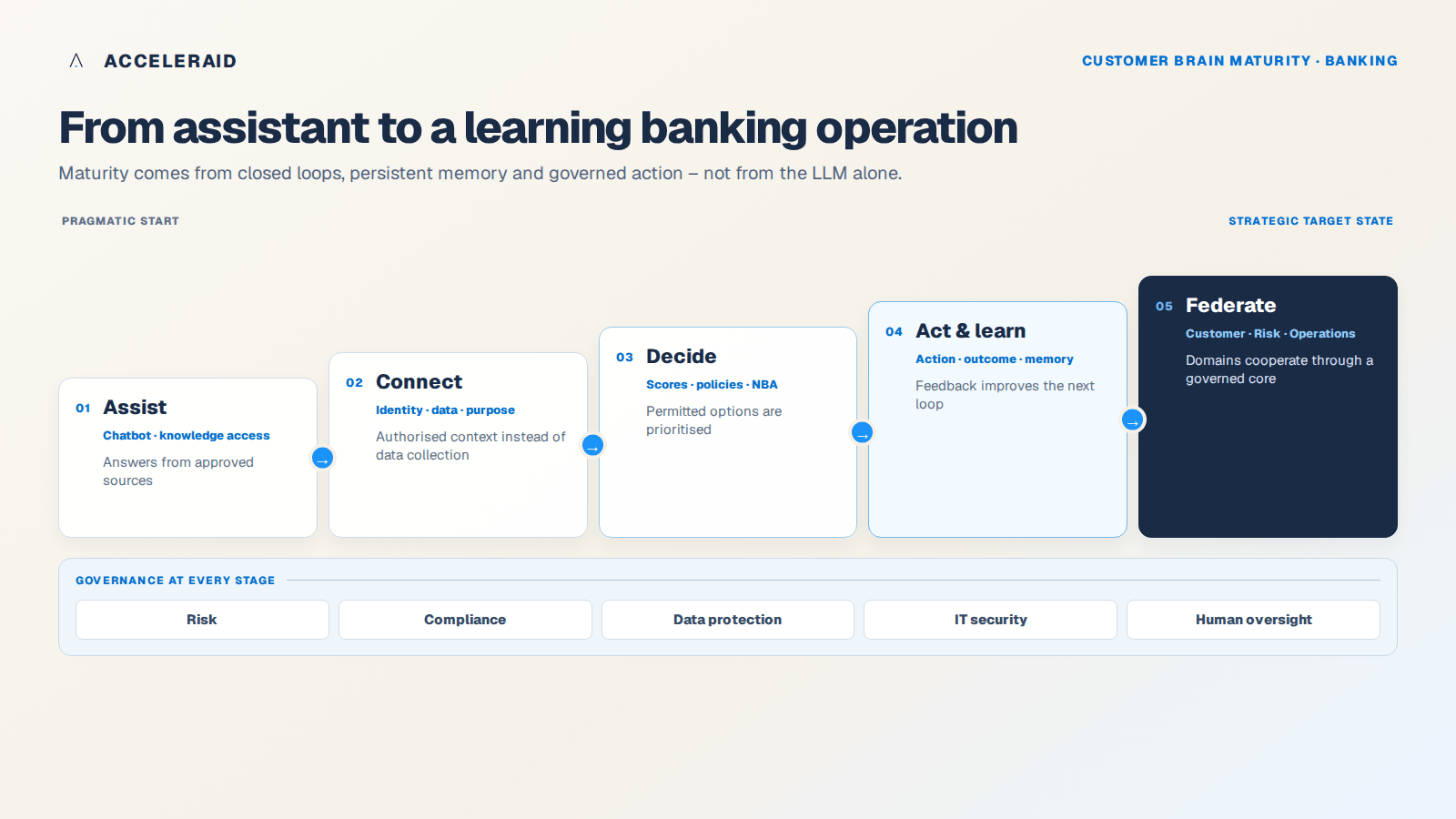
Not every bank needs to begin with the same target architecture. A sensible entry point is one bounded customer process in which the source, decision, permitted action, outcome and accountable owners are known. Only when that loop works under control should the bank add persistent memory, further channels and eventually coordinated collaboration across domains.
The maturity model separates five distinct stages. It is not a certification or a product promise. It is a decision aid: which capabilities already exist, what is missing for the next stage and at what point would the term “Customer Brain” be justified at all?
The Customer Brain series: five steps from vision to execution
This lead article establishes the strategic destination. The five articles below break it down into concrete decisions for data, marketing, sales, service, risk and control functions. Read them in sequence or start with the question that is most urgent for your bank.
PART 1 · STARTING POINT
Customer 360 is not yet a Customer Brain
Why a complete customer view does not decide or learn, and which activation layer is missing between stored data and customer outcomes.
Read Part 1: Why Customer 360 is not enough →
PART 2 · ARCHITECTURE
What components make a Customer Brain?
Data sources, semantic retrieval, ontology, memory, reasoning, agents, actions and feedback as one coherent operating model.
Read Part 2: The Customer Brain architecture →
PART 3 · DATA AND CONTROL
Bank data changes the architecture
How transaction data, PII, permissions, RAG, traceability and continuous involvement of risk, compliance and data protection fit together.
Read Part 3: Data and governance →
PART 4 · USE CASE
From a static churn score to a learning retention loop
Why risk alone does not determine an intervention, and how current signals, permitted actions, human contact and outcome feedback can extend the relationship.
Read Part 4: The retention loop →
PART 5 · ROADMAP
When does a system deserve the name Customer Brain?
A practical maturity model from chatbot and enterprise RAG to persistent memory, governed customer loops and federated collaboration.
Read Part 5: The maturity model →
Illustration: AI-generated. AI-assisted content: We use AI technologies and automated agents in the creation of our articles, including from Microsoft, Google, OpenAI, Anthropic and other providers. Topics, editorial direction and final approval remain with our team.
Further Insights
We use cookies 🍪
Strictly necessary cookies, such as for Pipedrive forms, remain active. With your consent, we also use Google Analytics for analysis and Leadfeeder for visitor identification. You can find further information in our privacy policy.
Decline
Accept all