Data & Technology
AI in Banking | Customer Brain 5/5: The Maturity Model
Eight maturity stages show when chatbots, RAG, memory and agents become a controlled Customer Brain for banks.
•
acceleraid Redaktion
7 min read
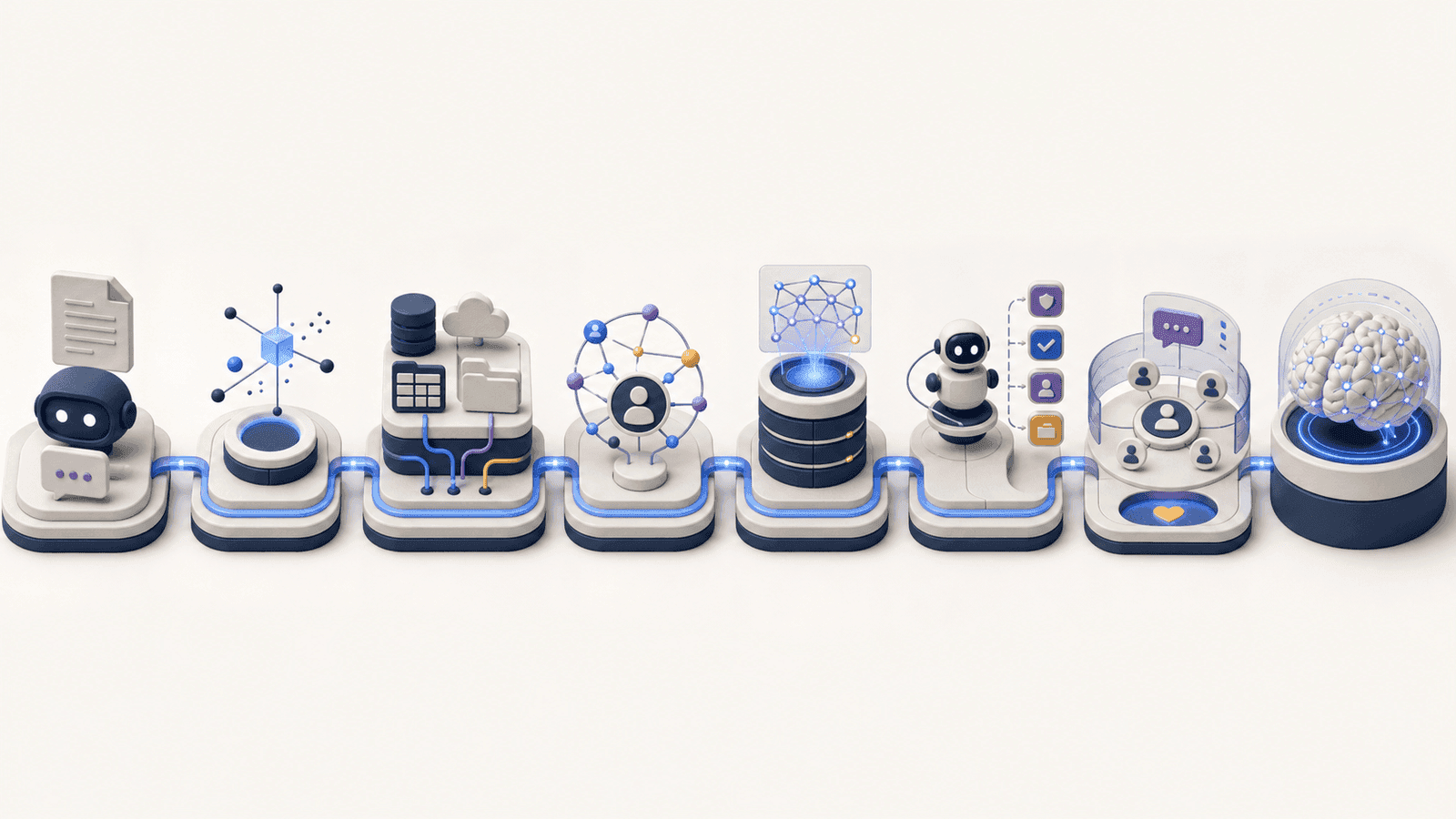
AI in Banking · Customer Brain Series · Part 5 of 5
Many systems are called a “brain” as soon as a language model can access company documents. That may be enough for a compelling demo. For a bank architecture, however, the term is too consequential to equate with a search interface and fluent answers.
A Customer Brain must do more than retrieve customer context. It must assign that context correctly over time, translate it into decisions under explicit rules, and learn from observable outcomes. Acceleraid therefore proposes an eight-stage editorial maturity model. It is not an official industry standard and not a product announcement. It is a diagnostic framework designed to separate concepts, expose architecture choices, and identify inflated claims early.
The threshold is not the LLM
The first six stages can produce valuable systems. They do not automatically deserve the name Customer Brain. In this model, the qualification threshold is stage 7: only persistent shared context combined with outcome feedback connects knowledge, decisions, and experience at customer level.
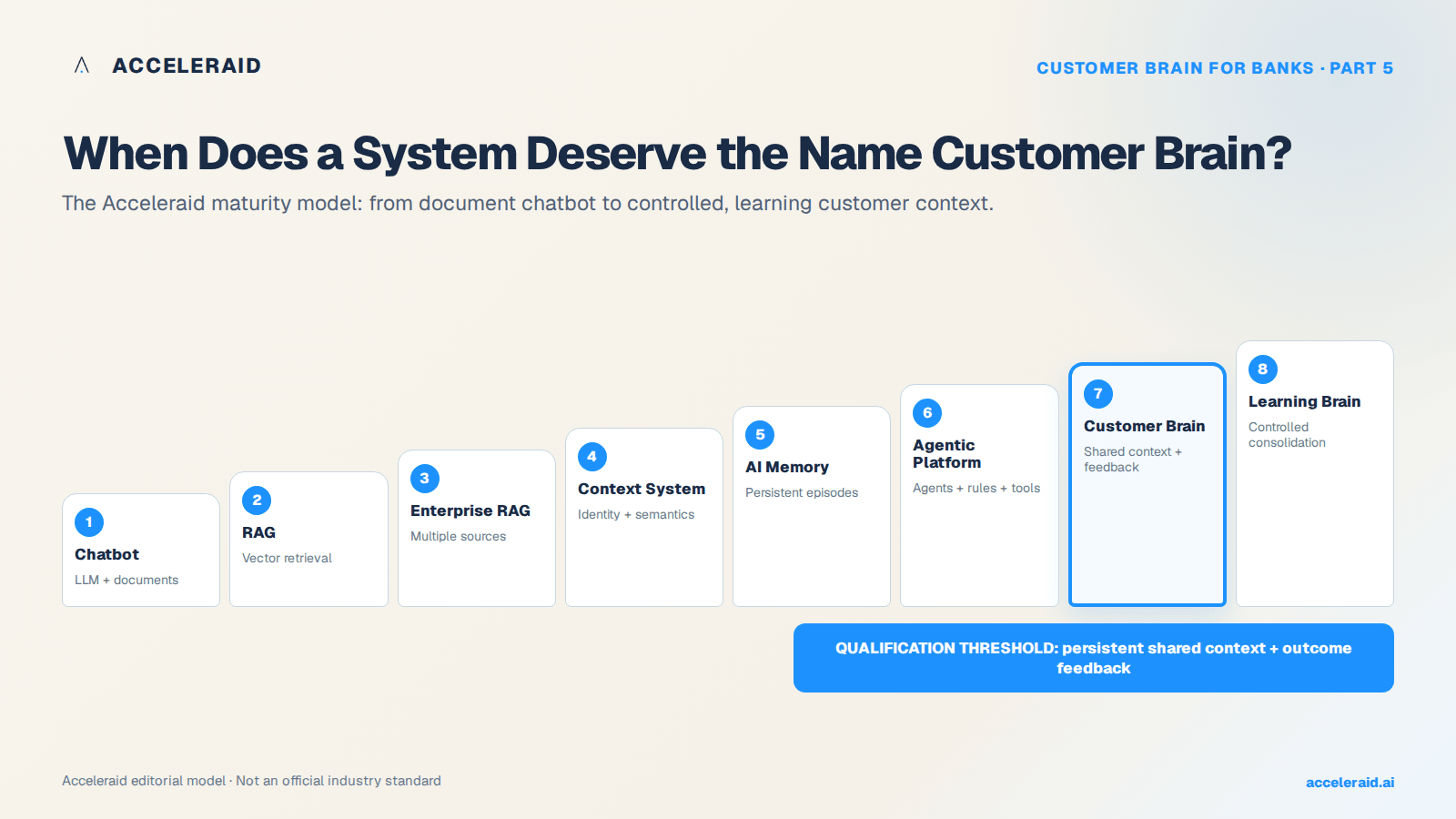
1. LLM + documents = Chatbot. A language model answers questions based on documents or prompts supplied to it. This can improve access to knowledge. Without systematic retrieval, reliable identity, and persistent customer experience, however, it remains a chatbot.
2. Vector Retrieval = RAG. Relevant passages are identified through vector search and supplied to the model as context. Retrieval-Augmented Generation can ground answers more firmly in approved sources. It does not create a consistent customer view or memory of completed interactions by itself.
3. Multiple sources = Enterprise RAG. Retrieval now spans several governed sources, such as policies, product knowledge, and service content. Permissions, freshness, and source attribution become more important. Enterprise RAG is a knowledge architecture; it is not yet a customer decision architecture.
4. Identity + semantics = Context System. Information is linked to a reliable identity and separated by business meaning: customer, account, contract, event, prediction, or rule. Only at this stage does retrieved text become structured context. Data protection remains an architecture issue. The European Data Protection Board makes clear that AI models trained with personal data are not automatically anonymous; this requires a case-by-case assessment (EDPB, Opinion 28/2024).
5. Persistent episodic Memory = AI Memory. The system can retain relevant episodes beyond one session: which question was asked, which recommendation was made, which approval was granted, or which exception occurred. Memory must not mean unlimited retention. Purpose, retention period, access, correction, and deletion must be explicit.
6. Agents + rules + tools = Agentic Platform. Agents can plan bounded tasks and execute them through approved tools. Deterministic rules, roles, approvals, and stop paths constrain reasoning. The platform can act, but it still lacks a shared customer memory linked to verifiable effects.
7. Shared Context + Outcome Feedback = Customer Brain. Authorised processes now use one persistent customer context. An action is connected to its trigger, applicable rule, model version, and decision; the customer’s actual response returns as an outcome. The system can distinguish what was recommended, what was executed, and what happened. In the Acceleraid model, only this connection justifies the name Customer Brain.
8. Controlled consolidation and learning = Learning Customer Brain. Experience is not merely stored; it is consolidated under defined procedures. Duplicates are resolved, contradictions flagged, outdated assumptions downgraded, and approved insights made available to future decisions. “Learning” does not mean uncontrolled self-training. It means governed consolidation with provenance, versioning, tests, approvals, and rollback.
What actually increases with maturity
Maturity is not the number of models or data sources. It is visible in four other properties:
Context integrity: Is it clear whom a piece of information concerns, when it was valid, and for which purpose it may be used?
Decision control: Can teams inspect rules, exclusions, approvals, and model boundaries?
Outcome linkage: Is a recommendation connected to the later customer response and possible side effects?
Portability: Does customer context remain usable when a model or provider changes?
The final point is strategic. BaFin identifies vendor lock-in as a risk and recommends measures including multi-vendor strategies; tested exit strategies are also among its concrete expectations for cloud outsourcing (BaFin, 2026 Focus Risks, BaFin supervisory notice on cloud outsourcing). FITKO offers a public implementation example: its municipal 115 chatbot was deliberately designed so that the cloud platform and language model can be replaced (FITKO).
The Customer Brain belongs to the bank. Models can change. Customer context, decision rules, and experience remain.
This editorial proposition changes the architecture question. The LLM becomes a replaceable reasoning component. Durable enterprise IP sits in clean identity, semantics, rules, episodic experience, and documented feedback. Michael Altendorf, CEO of Acceleraid, summarises the implementation perspective: “We are no longer facing a research problem, but an implementation and governance challenge.” For a Customer Brain, the data foundation is the starting point rather than the finished system.
What Acceleraid documents as available today
The model must not be confused with a blanket statement about current product scope. Acceleraid documents building blocks of a controlled customer-activation layer: working with customer and transaction data, Predictive Segments, Next Best Action, triggers, and—depending on configuration—a model-agnostic AI Assistant with RAG and PII filtering. These capabilities can support parts of several stages.
Acceleraid does not claim that all eight stages are universally delivered as one finished Customer Brain product. Persistent cross-role shared memory, broad outcome learning, or a self-learning bank architecture should only be promised for a specifically assessed configuration. The accurate position is therefore controlled activation today, with the Customer Brain as an architecture and maturity perspective.
A practical entry roadmap
First: choose one process and one outcome. Do not begin with “the entire customer relationship.” Start, for example, with card activation, service efficiency, or retention. Define one business metric and an existing baseline.
Second: establish identity, purpose, and the data contract. Specify the entities, events, and sources required, who may use them, and how freshness, consent, retention, and correction work.
Third: put decisioning before autonomy. Separate predictions, deterministic rules, and generative explanations. Define permitted actions, contact limits, approvals, human handoff, and stop criteria.
Fourth: record episodes and outcomes. Do not store only prompts and answers. Connect the trigger, context used, rule and model versions, decision, execution, and observed outcome.
Fifth: expand shared context only after evidence. Once a bounded process operates reliably, context can be opened to additional channels or agents. Every extension requires new permission, quality, and impact tests.
Qualification questions for vendors and internal teams
Which customer identity is authoritative, and how are conflicts between sources resolved?
What persists beyond a session, for which purpose, and under which deletion policy?
Can the system distinguish facts, predictions, rules, generated content, and experience?
Which agents or channels share context, and which are explicitly prohibited from seeing it?
How is a recommendation linked to execution, customer response, and side effects?
Who can change, approve, and roll back rules, models, or memory records?
Can the model be replaced without losing customer context and decision history?
What concrete evidence justifies the term Customer Brain rather than RAG, Context System, or Agentic Platform?
The series has built towards this threshold: Part 1 distinguishes Customer 360 from a Customer Brain, Part 2 describes the architecture building blocks, Part 3 organises bank data, meaning, and boundaries, and Part 4 moves from a static churn score to a retention loop. Part 5 provides the conceptual test: a Customer Brain does not begin with an eloquent model. It begins with durable, shared, and controlled feedback on customer context.
The complete Customer Brain series
Lead article: The Customer Brain roadmap · Part 1: Customer 360 is not enough · Part 2: Architecture · Part 3: Data and governance · Part 4: Retention loop · Part 5: Maturity model
Illustration: AI-generated. AI-assisted content: We use AI technologies and automated agents in the creation of our articles, including from Microsoft, Google, OpenAI, Anthropic and other providers. Topics, editorial direction and final approval remain with our team.
Further Insights
We use cookies 🍪
Strictly necessary cookies, such as for Pipedrive forms, remain active. With your consent, we also use Google Analytics for analysis and Leadfeeder for visitor identification. You can find further information in our privacy policy.
Decline
Accept all