CLM & CVM
From campaign calendar to AI Agent: How CLM becomes a closed loop
How a closed CLM loop connects signals, decisions, content, and feedback under clear governance guidelines.
•
acceleraid Editorial Team
5 min read
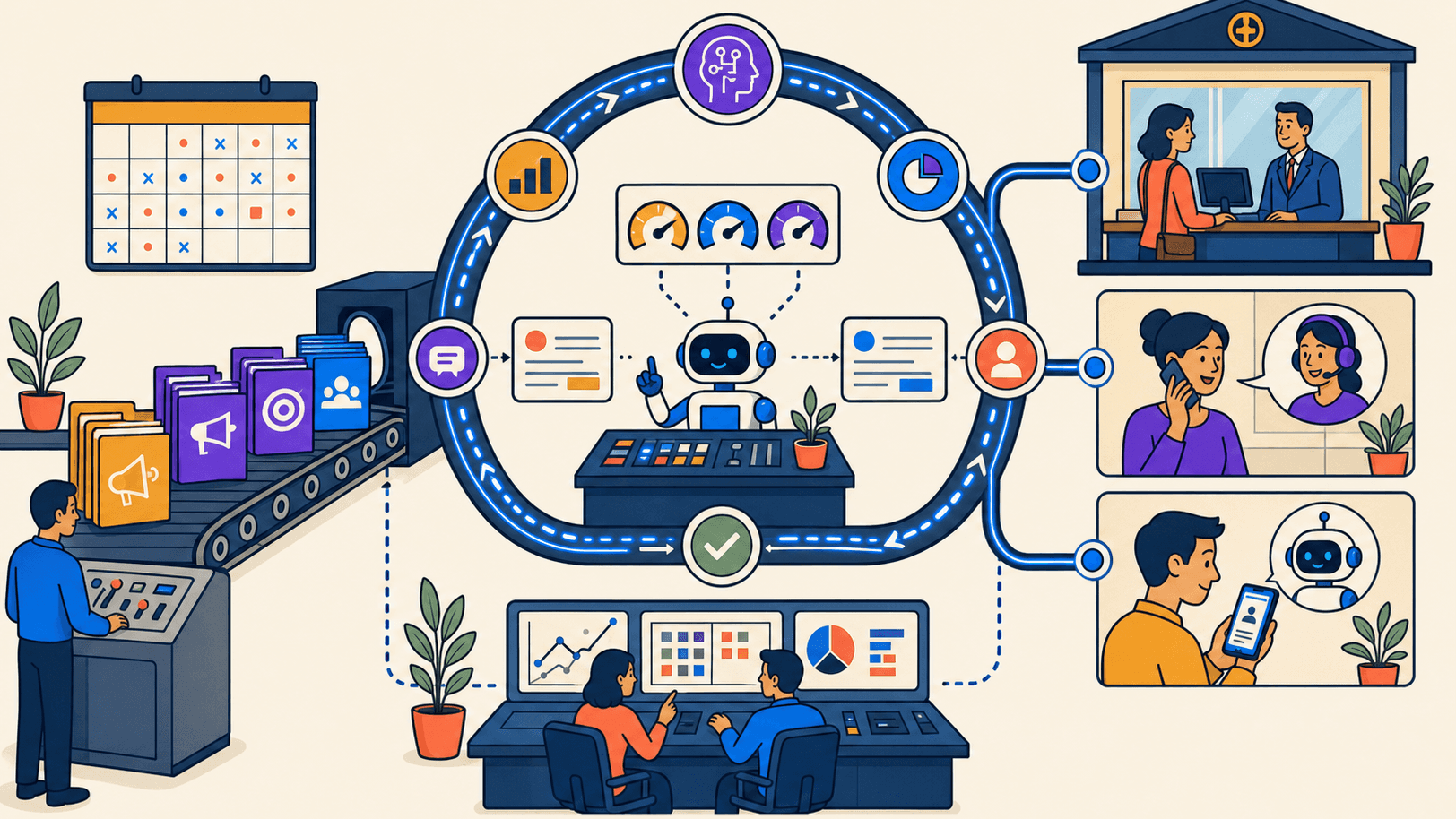
Part 1 of 5 of our series "AI Agents in the Customer Lifecycle for Financial Service Providers": A campaign calendar creates order for teams. However, it does not capture what customers are doing between two planning appointments. A closed-loop CLM therefore connects signals, decisions, delivery, and learning into an ongoing process – with firm guardrails where regulation and customer protection require them.
Author: acceleraid Editorial Team
The Campaign Calendar is Not a Decision Model
Campaign logic usually begins with a retrospective question: Which segment should be targeted in the next mailing? This approach is plannable, but the target group is often already different at the time of mailing. A newly initiated product interest, a change in activity, or a service contact can change the context before a previously planned approach goes live.
The difference to Customer Lifecycle & Value Management is not just a nicer name for CRM. A CRM documents contacts and activities; CLM/CVM orchestration connects customer profiles, transactional, and behavioral data with predictions and can derive a next best action from them. Acceleraid describes the shift from manual batch campaigns to real-time triggers, automatic feedback loops, and consent checks as the core of this orchestration (CLM/CVM Orchestration).
This is not a call for uncontrolled autonomy. Operational progress is made when the company no longer plans every message individually, but instead defines decision rules, allowable goals, and escalations in such a way that they take effect at the specific customer moment. In this way, a calendar becomes a system that processes context.
Five Phases, One Customer Relationship
Acquisition, activation, growth, retention, and reactivation remain useful orientations. The key is that these phases do not run as five separate programs. Within this series, we view them as five connected stages built on a common foundation.
This changes the handovers. A current complaint signal should not just "inform" a simultaneously prepared upsell message, but suppress it if necessary. A signal of increasing interest must not wait until the next quarterly briefing. The professional task is therefore: For each relevant signal, determine which lifecycle goals compete, which goal takes priority, and when a contact is excluded.
In practice, a shared decision map pays off instead of separate campaign lists. It brings together signals, permitted actions, contact limits, responsible roles, and key metrics. This does not give marketing, data, service, and compliance teams another round of coordination, but rather a shared operational logic.
The Closed Loop: From Signal to Learning Impulse
A closed loop begins with an observable signal and does not end with delivery. The following sequence is an operating model, not a promise of a single result:
Signal: Events from transactions, digital interactions, or existing systems make a potential trigger visible. Acceleraid mentions salary increases, started card applications, initial revenue, or detected inactivity as triggerable signals (Trigger & Campaign Automation).
Scoring: Predictive models condense context, for example, as propensity, churn, CLV, or next-best-action signals. The crucial aspect is not the score itself, but that its purpose and influencing factors are transparent and comprehensible (AI Prediction Engine).
Agent Decision: Within a defined mandate, a decision is made as to whether an action is appropriate and which alternative takes priority. The decision must be coordinated across contacts so that two journeys do not target the same person in contradictory ways.
GenAI Content: Only after these checks is the content created or varied. Orchestration can provide personalized messages in real-time for this (CLM/CVM Orchestration).
Outcome: Reaction, suppression, cancellation, or conversion are captured at the step and lifecycle level; this also reveals where a journey should not help (Trigger & Campaign Automation).
Model Feedback: Results flow back into the evaluation. Continuous retraining based on outcome feedback is a described building block of orchestration (CLM/CVM Orchestration).
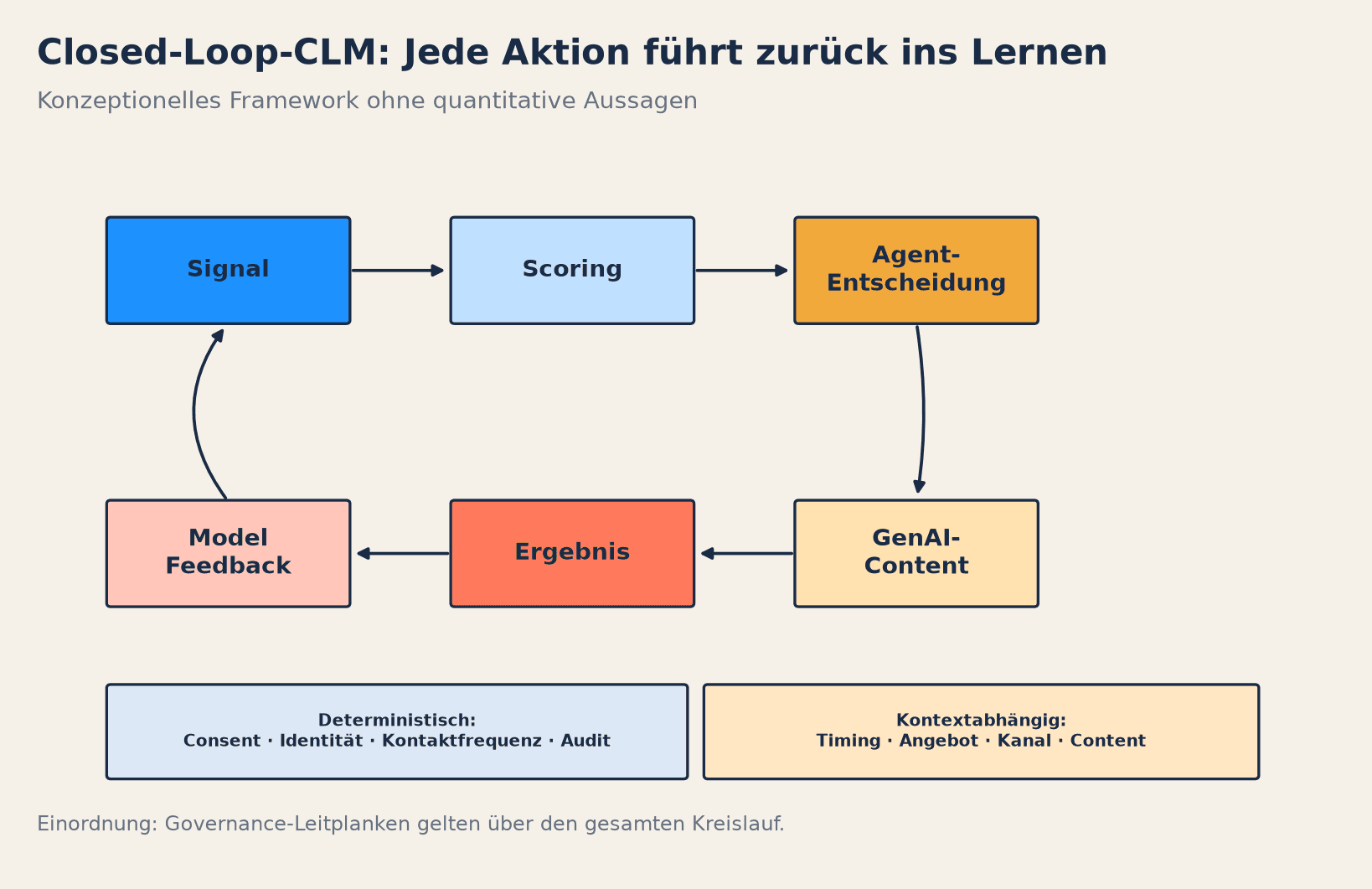
The feedback loop turns a campaign into a learning system. However, "learning" is not synonymous with free experimentation. A meaningful result can also be that an action was suppressed due to a lack of consent, a frequency limit, or a competing service case.
Cleanly Separate Deterministic Rules and Agents
The most demanding design decision lies at the boundary between fixed and context-dependent decisions. Compliance, identity, and consent checks must remain deterministic: same input, same permissible outcome. Contact frequencies, exclusions, and documented approvals also belong in this layer.
An agent complements this layer where the context leaves several permissible options open. This can include timing, sequence, channel, or content variant. It is not a general assistant with an unlimited mandate, but works within a defined scope. Acceleraid describes precisely this combination as deterministic governance plus dynamic, context-aware decisions (CLM/CVM Orchestration).
For the organization, a simple rule follows: Guardrails first, then optimization. Anyone starting the other way around may quickly generate variations, but not a resilient decision architecture. For each use case, stakeholders should document which goal is being optimized, which data may be used, which action is excluded, who can override, and which event is defined as success or a malincentive.
From Pilot to Operational Readiness
A pilot is useful if it does not just select a particularly attractive target group, but tests the entire loop. Clearly definable use cases with existing signals, a permitted action, and a measurable result are suitable. The team can then check whether data arrives on time, whether the score and decision are comprehensible, and whether the feedback actually ends up back in the system.
Management should distinguish between three levels. At the customer level, relevance, contact load, and suppressions count. At the journey level, the underlying signal, decision path, and outcome count. At the program level, rules reusability, data quality, and conflicts between goals count. This prevents banks from having local conversion optimization generate too much contact or too little trust system-wide.
Such a closed loop does not replace professional responsibility. It makes it executable: Policy, data access, decision rights, and feedback become parts of the same process. This is the prerequisite for reacting faster without having to establish governance retroactively.
The Series "AI Agents in the Customer Lifecycle for Financial Service Providers"
Part 1: From Campaign Calendar to AI Agent: How CLM Becomes a Closed Loop URL: https://blog.acceleraid.ai/blog/ai-agents-clm-closed-loop-financial-services
Part 2: The Intelligence Layer: Why CDP, Predictions, and AI Agents Belong Together
Part 3: AI Agents in the Customer Lifecycle: 15 Campaigns from Acquisition to Win-back
Part 4: One Framework, Three Industries: AI Agents for Banks, Cards, and Insurance
Part 5: Operationalizing AI Agents: Roadmap, Governance, and KPIs for Financial Service Providers
Illustration: AI-generated. AI-supported content: We use AI technologies and automated agents, including those from Microsoft, Google, OpenAI, Anthropic, and other providers, to create our articles. Topics, professional orientation, and final approval remain with our team.
