Data & Technology
Dynamic Banking Engagement Platforms: The Missing Layer Between Core and Customer Dialogue
Why dynamic engagement platforms connect core banking, governed decisions, channels, employee work, and customer dialogue.
•
acceleraid Redaktion
7 min read
01
Acquire
Signale erkennen
02
Onboard
Aktivierung steuern
03
Grow
Next Best Action
04
Retain
Churn reduzieren
05
Reactivate
Potenziale zurückholen

The customer dialogue of a bank is often constrained by a gap that neither a new front end nor a core replacement solves on its own. A balance changes, a service case opens, or a customer begins an application. The bank may know that event, yet still lack a controlled way to decide whether to act, coordinate the response across channels, and learn from the outcome.
Forrester uses Digital Banking Engagement Platform (DBEP) for the technology category addressing that space. Its Q2 2026 analysis says these platforms remain important to banking providers, but their purpose is changing. Rather than primarily delivering a fixed set of products and end-user experiences, leading DBEPs enable banks and third parties to explore ideas and build new capabilities rapidly. Forrester’s 2026 DBEP analysis frames the issue as adaptability, not as a case for replacing the core.
Author: acceleraid Redaktion
Date: August 13, 2026
A platform for making decisions executable
Core banking systems are systems of record. They maintain account, transaction, and product truth, and they must prioritize correctness, resilience, and control. Customer engagement requires a different set of capabilities: an approved customer context, a decision on the appropriate action, a workflow that can coordinate people and systems, and a way to deliver the result without losing governance.
This is where a dynamic engagement platform belongs. It sits between the core estate and the places where customers and employees interact. It should consume data and events through defined contracts, not quietly redefine the source of truth for a booking or account. One platform provider describes a digital banking platform as a software layer between the core banking system and daily customer experiences, coordinating data, workflows, and interactions across mobile, web, branch, and operations. Backbase’s architecture overview is a useful articulation of that boundary; it is not a reason to assume that every implementation will work the same way.
The distinction explains why a DBEP is not merely a new mobile app. A mobile app is one execution surface. It may offer a much better interface and still leave the bank with different decisions, contact rules, customer contexts, and hand-offs in web, the contact centre, branch, and relationship-manager tools. A platform layer addresses the coordination problem. It helps make one governed decision usable in several places, while preserving an audit trail and a route for feedback.
Forrester also sees the audience for these platforms expanding. DBEPs are increasingly connected to a growing range of systems and tools inside and outside a bank. Their users are changing too: vendors are increasing no-code and low-code capabilities while retaining pro-code options in key areas. Forrester’s DBEP commentary therefore describes a change in who can shape experiences and how, not only a change in customer-facing design.
The five layers that should work together
The following model is conceptual. It does not prescribe a single product suite or a universal target architecture. Its purpose is to make the responsibilities that are often hidden inside the label “platform” explicit.
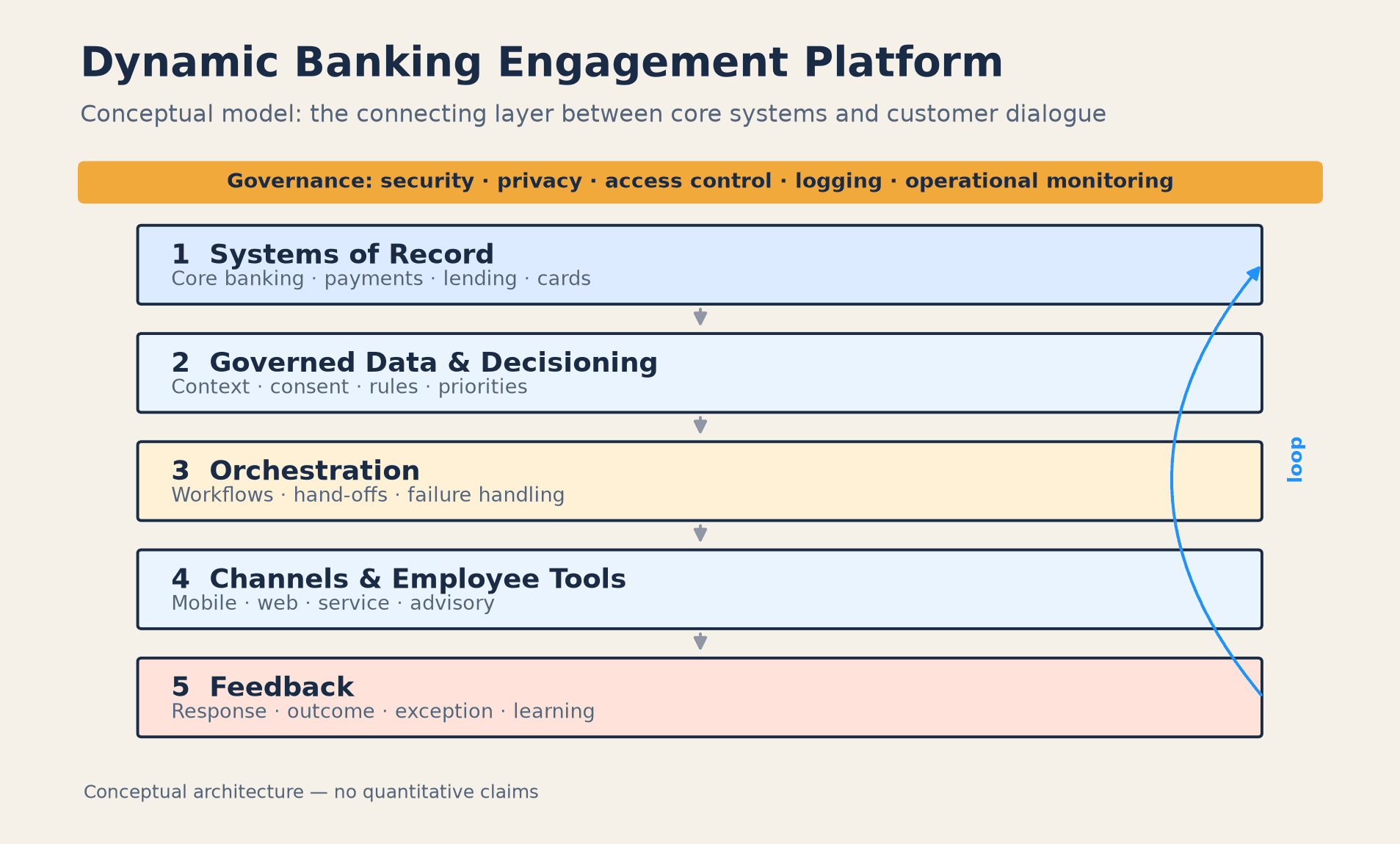
1. Systems of record. Core banking, payments, lending, cards, and other authoritative applications remain responsible for the transactions and data they own. The engagement layer needs explicit contracts for reading data, receiving events, invoking transactions, and handling failures. That boundary protects both operational integrity and future change.
2. Governed data and decisioning. This layer assembles permitted signals, identities, consent, product information, and interaction context. It also holds the logic that turns context into a decision: eligibility conditions, exclusions, priorities, frequency rules, and the valid outcome of taking no action. More data is not the objective. The objective is data with known origin, permitted purpose, suitable freshness, and accountable ownership.
3. Orchestration. Orchestration makes a decision operational. It coordinates steps, sequences dependencies, records state, and routes work to a person where automation should not proceed. It also resolves competition. A service notice, a fraud-related message, and a product offer should not independently claim the same customer moment.
4. Channels and employee tools. Mobile and web are important, but they are not the whole execution layer. Email, messaging, contact-centre tools, branch, and relationship-manager workspaces also matter. A useful platform gives employees the relevant context, the permitted action, and the preceding journey. That makes a human hand-off a continuation of the experience rather than a fresh start for the customer.
5. Feedback. Delivery, response, non-response, abandonment, manual overrides, and subsequent events should return to the platform. Feedback is not simply campaign reporting. It is the evidence used to refine a decision, identify a broken journey, and establish whether an interaction produced a helpful outcome.
Security, privacy, access control, logging, and operational monitoring must span all five layers. They are not a control step added after a journey has been designed. They shape which inputs may be used, who can alter a rule or workflow, how an exception is handled, and what can be reconstructed later.
The category is becoming a build-and-run environment
The important question is not whether a bank should build every experience itself. It is whether it can change a governed interaction without treating every change as a one-off integration project. Forrester says that the role of leading DBEPs is moving from prebuilt offerings toward enabling banks and partners to explore and build rapidly; it cites a platform toolkit that helps developers test and measure new products. That change in emphasis is set out in Forrester’s Q2 2026 post.
This shifts the operating model. Business teams need controlled freedom to configure content, priorities, and bounded journeys. Engineering and architecture teams need to own reusable integration, identity, reliability, and security components. Risk, compliance, and privacy specialists need to participate early in data use, policy design, approval, and ongoing review. A DBEP creates shared dependencies; it cannot be operated as the isolated property of a mobile team or marketing team.
It also makes vendor claims less useful than evidence. Forrester notes that virtually every DBEP vendor it evaluated positions APIs as central, while one banking digital leader reported that APIs sometimes do not work or the integration is far harder than advertised. Forrester’s caution on “API-first” positioning points to a simple diligence principle: test priority use cases against the bank’s own interfaces, error conditions, identity controls, and operational constraints.
The same discipline applies to AI. A conversational interface, code assistant, or workflow generator may be useful. None removes the need to establish data permissions, decision rights, human escalation, or traceability. A bank should be able to answer, for every material action, what triggered it, what policy constrained it, what information was used, and how the result will be reviewed.
Practical questions for a selection process
A demonstration can show an attractive journey. It rarely proves that the platform will fit the bank’s architecture and control environment. Selection teams should take a small number of real interactions and ask:
Authoritative systems: Which application owns each data element and transaction? Can the proposed interfaces be exercised in the bank’s environment, including failures and timeouts?
Decision controls: How are consent, contact policy, eligibility, suitability, prioritisation, and deliberate non-contact represented and enforced together?
Explainability: Can the platform reconstruct the data, rule, content, approval, and delivery path for one individual interaction?
Workflow resilience: What happens with duplicate events, delayed processes, unavailable dependencies, and a hand-off to an employee?
Cross-channel continuity: Do customers and employees see a coherent interaction history, or does each channel run a separate conversation?
Controlled change: What can business users configure? What requires engineering? Which changes require review before release?
Feedback and service ownership: Which outcomes return to the platform, and who owns monitoring for data quality, rule performance, delivery, and exceptions?
Exit readiness: Can the bank document and export its data mappings, content, decision logic, and integrations in a usable form?
A dynamic banking engagement platform is therefore not a cosmetic channel upgrade and not an alternative ledger. It is the layer that turns governed context into coordinated customer dialogue and employee work. The architecture is valuable only when the bank can run that loop reliably: observe, decide, act, supervise, and learn.
Illustration: AI-generated. AI-assisted content: We use AI technologies and automated agents in the creation of our articles, including from Microsoft, Google, OpenAI, Anthropic and other providers. Topics, editorial direction and final approval remain with our team.
We use Cookies 🍪
Strictly necessary cookies (e.g. Pipedrive forms) remain active. With your consent we also use Google Analytics (analytics) and Leadfeeder (visitor identification). More in our Privacy Policy.