CLM & CVM
Why Transaction Data Is the Most Important Signal for Next Best Action
Checking-account transaction data lifts AUC by up to 5.4 points. Why it outperforms demographics in NBA scoring.
•
acceleraid Redaktion
5 min read
01
Acquire
Signale erkennen
02
Onboard
Aktivierung steuern
03
Grow
Next Best Action
04
Retain
Churn reduzieren
05
Reactivate
Potenziale zurückholen

Part 3 of 3 in our series on next best action in banking — and the final part of the series. Part 1 covers the decision logic behind NBA (Part 1), Part 2 the channel playbook (Part 2). On the related topic of life events, see also Part 3 of our CLM series (Engage: Life Events & Transaction Data).
The checking account is the data asset many banks underuse
No other product delivers as many continuous, granular signals about a customer as the checking account. Every rent or salary payment, every transfer into savings, every card transaction with its merchant category is a data point that says something about a customer's current life situation — far more than a socio-demographic profile captured once and rarely updated. This is not intuition; it is documented across multiple independent studies. When behavioral data from prior transactions is available, "the presence of demographic characteristics adds little additional predictive power" — the authors point to earlier research showing that only 7% of the variance in price sensitivity is explained by socio-demographics (Wang, Carson et al., Journal of Business Research 151). For an NBA engine, this means that relying primarily on age, income, or location as predictors forgoes the single most informative signal a bank already has.
How much transaction data actually improves predictive accuracy
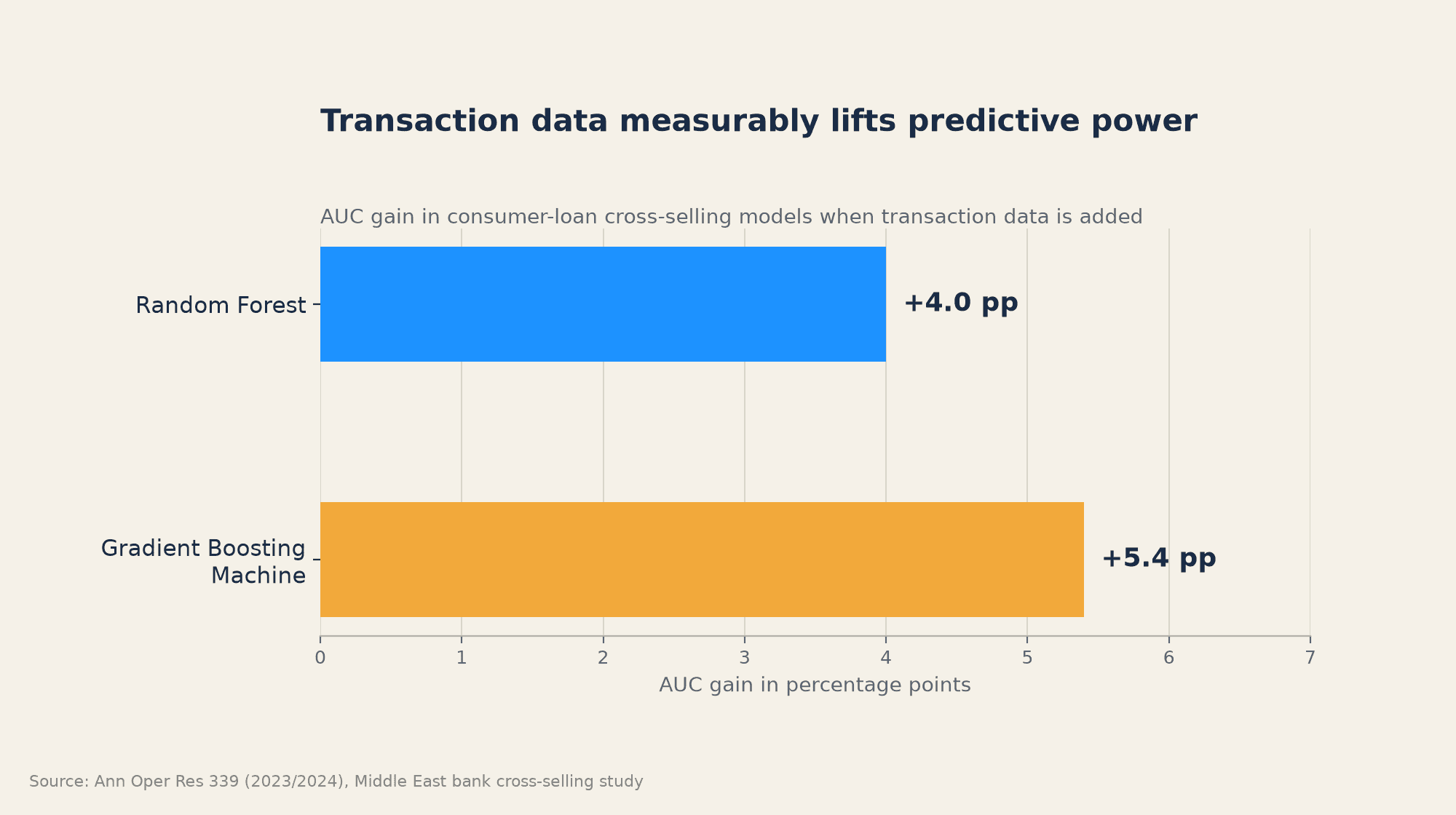
The numbers here are specific and verifiable. A study on cross-selling consumer loans at a bank in the Middle East — based on 6,127 retail customers and roughly 800,000 credit card transactions over one year, grouped into 22 merchant categories with 146 subcategories — shows that adding transaction data lifts AUC by 4 percentage points for random forest and 5.4 percentage points for gradient boosting machine, compared with models using only demographics and product ownership (Ann Oper Res 339). The same study notes that with methods such as CHAID and SVM, "transaction data carries more predictive value than demographics and product ownership." The same effect shows up in life-event prediction: fine-grained transaction data enhanced with RFM-based features improves the AUC for predicting a birth to 0.748, versus 0.725 using only aggregated data, and for a new relationship to 0.730 versus 0.681 — with transaction data contributing the largest share of variable importance in the model (De Caigny, Coussement & De Bock, Decision Support Systems 130).
What transaction data actually reveals
This predictive power exists because transaction data carries several signal types at once, none of which would be as current or granular if collected separately:
Rent payments often reveal an intended or actual move weeks before any address change appears in a core record.
Salary deposits signal income changes, job switches, or new employment near real time.
Savings patterns show whether a customer is consolidating funds toward a goal — property, education, a major purchase — or just starting to build reserves.
Merchant-category shifts in card transactions — new spending at baby-supply retailers, moving companies, or furniture stores — provide early indicators of life events, consistent with documented research on relocation, birth, new relationships, and separation (De Caigny, Coussement & De Bock).
These signals explain why transaction data does not just add incremental predictive power over core customer records — it adds a structurally different kind: continuously current, behavior-based rather than self-reported, and able to capture change before a customer even reports it to the bank.
Regulatory framework: GDPR, legitimate interest, and the PSD2 boundary
This depth of data requires a clean legal basis. Processing a bank's own transaction data within an existing customer relationship typically relies on legitimate interest under Article 6(1)(f) GDPR. The European Data Protection Board requires three cumulative conditions for this: a legitimate interest, necessity of the processing for that interest, and a balancing test in which the data subject's interests and fundamental rights must not override it — this assessment has to happen before processing begins, and financial data is explicitly treated as more "private" in nature (EDPB, Guidelines 1/2024 on legitimate interest).
It is important to distinguish this from open-banking data under PSD2, which is subject to a narrower, different purpose limitation: Article 66(3)(f)/(g) PSD2 prohibits payment initiation service providers (PISPs) from requesting or using data beyond what is needed for the payment order itself, and Article 67(2)(d)/(f) restricts account information service providers (AISPs) to the accounts and purposes explicitly authorized by the user — an AISP must contractually state exactly what account data is processed for and why (EDPB, Guidelines 06/2020 on the interplay of PSD2 and the GDPR). For a bank running NBA on its own transaction data collected in the course of account servicing, this is a different — and generally simpler — framework than the one that applies to third parties accessing external account data via PSD2 interfaces. That distinction deserves to be made explicit in any internal compliance documentation for NBA models.
Why this is more than a data-science detail
The practical implication for banks: relying primarily on core customer records and one-off segmentation for NBA scoring forgoes the signal with the best-documented predictive power — while risking outdated assumptions about a customer's actual life situation. The combination of 4 to 5.4 percentage-point AUC gains in cross-selling and the documented improvements in life-event prediction shows that this difference is structural, not marginal. At the same time, this richness of signal demands disciplined data governance — from legal basis to explainability toward supervisors and customers, as described in Part 1 of this series.
How Acceleraid operationalizes transaction data
Acceleraid has built its experience on the analysis of 3.5 billion transactions, translating exactly these signal classes — rent payments, salary deposits, savings patterns, property searches, merchant-category shifts — into lifecycle-stage scoring across acquisition, growth, maturity, and retention (Platform). CDP & Data Governance provides the necessary foundation: real-time connectivity to core banking and card processing, consent management, lineage, and PII protection with German hosting and GDPR-by-design (Banking). This turns the regulatorily complex field of transaction-data analysis into a controlled, auditable foundation for the NBA scores described in Part 1 of this series.
Conclusion: Closing the series
Across three parts, a consistent picture has emerged: next best action is a decision logic built from propensity, lifecycle, channel, and regulatory guardrails (Part 1), one that must be delivered differently by channel (Part 2) — and whose single most important input is not core customer data, but the ongoing transaction data flowing through the checking account (Part 3). Banks that connect these three layers end up with an NBA capability that is not just more precise, but explainable to supervisors, advisors, and customers alike.
Illustration: AI-generated. AI-assisted content: We use AI technologies and automated agents in the creation of our articles, including from Microsoft, Google, OpenAI, Anthropic and other providers. Topics, editorial direction and final approval remain with our team.
We use Cookies 🍪
Strictly necessary cookies (e.g. Pipedrive forms) remain active. With your consent we also use Google Analytics (analytics) and Leadfeeder (visitor identification). More in our Privacy Policy.