AI & Banking
AI Personalization Platform for Banks: What to Look For
Choosing an AI personalization platform for banks: five capability dimensions, vendor questions and regulatory criteria to test before you buy.
•
acceleraid Redaktion
6 min read
01
Acquire
Signale erkennen
02
Onboard
Aktivierung steuern
03
Grow
Next Best Action
04
Retain
Churn reduzieren
05
Reactivate
Potenziale zurückholen

This piece extends our Next Best Action series with the buyer's perspective: before signing a contract for an AI personalization platform for banks, you need to know which capabilities actually matter. We covered the underlying decision logic in How a Next-Best-Action Engine Decides — this article is about how to verify that a vendor can actually deliver it.
Why this is harder than comparing feature lists
You cannot evaluate an AI personalization platform for banks from a feature sheet, because nearly every vendor uses the same words: real-time, AI-driven, omnichannel. The real difference sits in the depth of implementation, and that only becomes visible once you ask specific questions. Industry maturity data shows why this matters: only 8% of banks can apply predictive ML insights to campaigns at all, only 28% can integrate internal structured customer data into AI models quickly enough, and only 9% have a full ML model suite for every touchpoint (McKinsey, July 19, 2022). That gap between ambition and practice is exactly where marketing claims and demonstrable capability part ways — provided you ask the right questions.
The short answer: a genuine AI personalization platform for banks can be tested against five capability dimensions — real-time data access, model breadth across touchpoints, decisioning depth, channel coverage matched to actual usage, and regulatory defensibility. Attaching concrete vendor questions to each dimension is what separates marketing language from real delivery.
The five dimensions of a capability map
A structured evaluation can follow the five martech dimensions McKinsey uses for personalization in banking: data, design, decisioning, distribution, measurement (McKinsey, July 19, 2022). That framework translates directly into a vendor checklist.
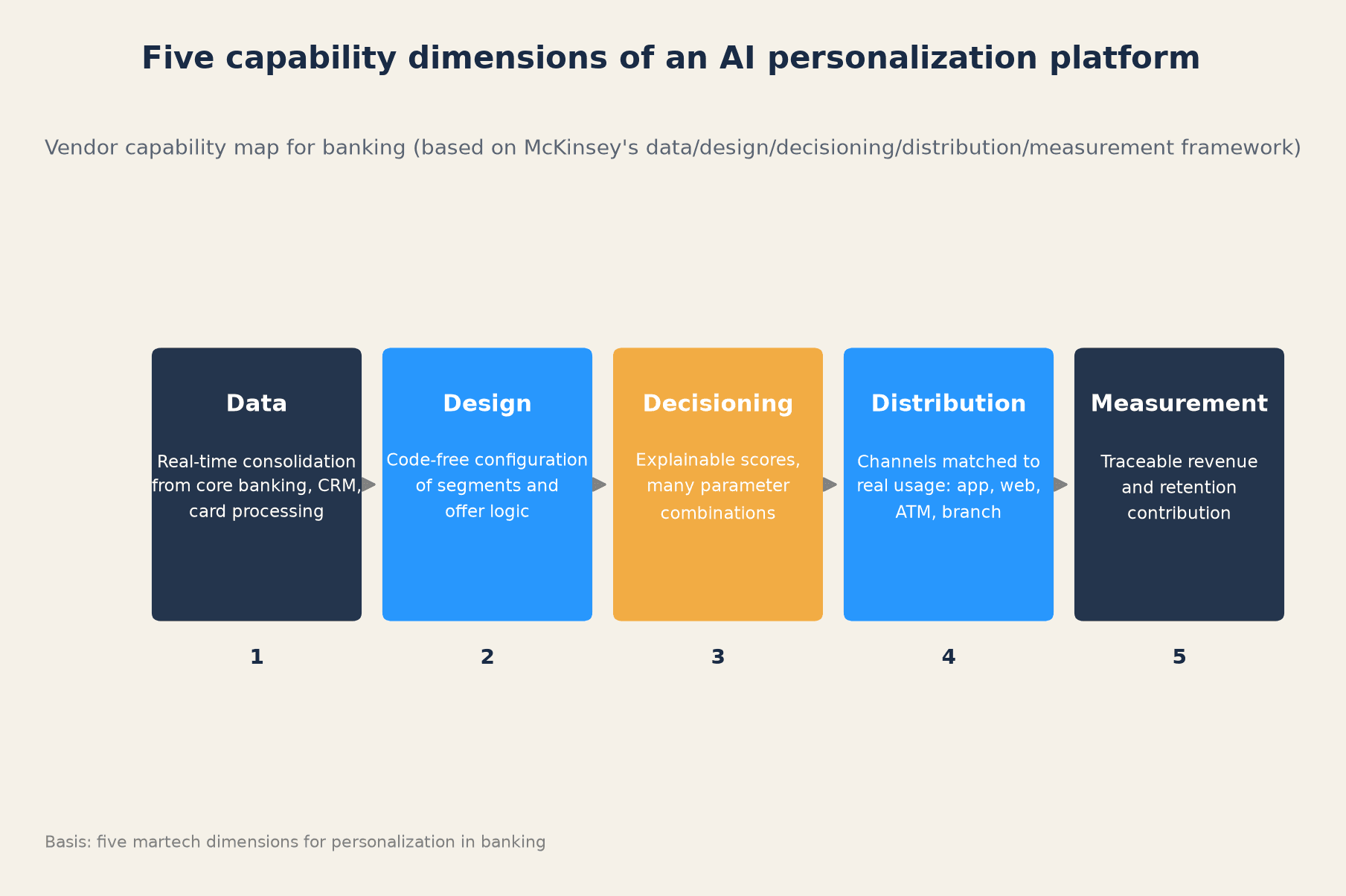
Data. Can the vendor consolidate structured customer data from the core banking system, CRM and card processing in real time, or does it still rely on overnight batch loads? The answer determines whether later decisioning promises are even technically achievable.
Design. Are segments and offer logic configured code-free by business teams, or only through IT tickets? This governs the real time-to-market for campaign changes.
Decisioning. This is the hardest dimension to prove. One documented example shows the bar: a decisioning layer processed 50 billion parameter combinations and generated a 20% increase in fee revenue within the first eight months after launch; after the first live use case, 1,500 features were available for subsequent models (McKinsey, July 19, 2022). A vendor question that gets at this directly: "How many parameter combinations does your decisioning layer evaluate per recommendation, and how many features carry over from the first use case to the second?" A vendor who cannot answer with concrete orders of magnitude likely has a rules engine, not a decisioning platform.
Distribution. Does the platform cover the channels customers actually use? Real channel weighting per customer per year runs at 152 app contacts, 96 website contacts, 52 ATM contacts and 8 branch contacts (Accenture, Global Banking Consumer Study 2025). Importantly, chatbots score the lowest satisfaction of any channel in the same study, at 21% — a reason to ask not just which channels a platform technically supports, but with what quality it delivers on them. A pure channel checklist falls short.
Measurement. Can you trace each recommendation's contribution to revenue and retention cleanly, or does the impact stay a black box? Without solid measurement, the business case for the platform is neither defensible nor optimizable over time.
Why demand and trust deserve their own evaluation criterion
Customers do not perceive personalization neutrally — it demonstrably shapes behavior in both directions. 72% of bank customers say personalization influences which bank they choose, yet only 3% actively use personalization tools their own bank provides; 62% are open in principle to an AI-powered financial assistant (Accenture 2025). At the same time, privacy is not a footnote: 84% of customers actively think about how their data is used, 53% have concrete privacy concerns, 58% fear hacking, and only 26% are interested in extensive AI analysis of their data (Accenture 2025). A platform that ignores this reticence risks reputational damage even if it is technically strong. So the vendor question is not just "what can the model do" but "how transparently does the platform explain to the end customer why a recommendation was shown."
Regulation as a mandatory part of the capability map
For automated decisions with legal or similarly significant effects, GDPR Article 22(1) gives individuals the right not to be subject to such a decision, except where it is necessary for a contract, permitted by law with safeguards, or based on explicit consent (GDPR Art. 22). In the permitted cases, the platform must technically and organizationally guarantee at minimum the right to obtain human intervention, to express a viewpoint, and to contest the decision (Art. 22(3)); decisions generally may not be based on special categories of data under Art. 9(1) (Art. 22(4)) (GDPR Art. 22). The EU AI Act is precise on high-risk classification: Annex III(5)(b) covers AI systems used to evaluate creditworthiness or establish credit scores, excluding fraud-detection systems, while (5)(c) covers risk assessment and pricing for life and health insurance (EU AI Act, Annex III). A useful vendor question: "Which of your models fall under Annex III, and how is the architecture separated so that marketing personalization doesn't automatically fall into the high-risk category?"
A related but distinct selection criterion is integration capability within the existing martech stack — for example Braze, Adobe or Salesforce Marketing Cloud — which we cover in more depth in "No Rip and Replace: Seamless Integration Instead of System Swaps".
Where a critical or important function is outsourced, the EBA Guidelines on outsourcing arrangements also apply. Before signing, the bank must assess whether such a function is affected, verify regulatory requirements, identify risks and conduct due diligence on the provider (para. 61) (EBA/GL/2019/02). Concretely, the guidelines require a documented exit strategy (para. 106), unrestricted audit rights for the institution and its supervisor (para. 87), and an assessment of the provider's substitutability (para. 31(h)) (EBA/GL/2019/02). Other solid contract questions: is sub-outsourcing of critical functions permitted (para. 76–78), does the sub-contractor grant the same access rights (para. 79(b)), and in which countries is data processed and stored (para. 75f) (EBA/GL/2019/02).
Why testing capacity is an underrated selection criterion
One often-overlooked criterion is whether a platform is built to test continuously rather than be configured once. Leading personalizers run several hundred tests per year, and faster-growing companies generate 40% more revenue from personalization than slower-growing peers (McKinsey, 2021). A platform without built-in testing infrastructure — such as multi-armed bandit methods for continuous traffic allocation — structurally slows this iteration cycle, regardless of how good the underlying models are. There is also a market-structure effect worth noting: the number of martech vendors in the US has roughly doubled over five years (McKinsey, October 2024 — one more reason to evaluate against a capability map rather than a vendor list.
Category clarity: what "real-time interaction management" actually means
If a vendor claims to deliver "real-time interaction management" (RTIM), a precise definition is a useful benchmark. Forrester describes RTIM as connecting personalization strategy with CX initiatives, featuring next-best-experience decisioning, cross-functional alignment, and optimization of customer outcomes (Forrester, "The State of Real-Time Interaction Management, 2024," June 21, 2024). That is more than "we send messages in real time" — it implies cross-functional alignment across marketing, service and sales. A good follow-up: "Show us an example where the same customer interaction, in real time, accounted for both a marketing and a service-related logic."
How Acceleraid covers this capability map
Acceleraid's Prediction Engine & AI Framework computes affinity, churn, propensity and NBA scores in an explainable, auditable way; CDP & Data Governance consolidates data in real time from CRM, core banking and card processing, with consent management, lineage, PII protection and German hosting built for GDPR-by-design (Platform). Experience Optimisation applies AI-driven traffic allocation through multi-armed bandit methods to personalized landing pages and application flows, while CLM/CVM orchestration translates contact-frequency limits and channel preferences directly into delivery — across online banking, app, email and branch CRM (Banking). The platform is also built to be model-agnostic: the underlying AI model can be swapped without losing accumulated knowledge, context or configuration — a point that becomes practically relevant when assessing substitutability under the EBA guidelines. Over 250 enterprise deployments and more than 15 years of banking-sector experience feed directly into the product roadmap (Platform).
Conclusion
A defensible vendor selection for an AI personalization platform in banking does not start with a feature list — it starts with five concrete capability questions across data, design, decisioning, distribution and measurement, backed by evidence on customer demand, privacy, regulatory defensibility and testing capacity. Asking these questions before the first demo call is what separates real delivery from marketing language. The next part of this series turns to how the resulting business case actually adds up for an AI personalization platform in banking.
Illustration: AI-generated. AI-assisted content: We use AI technologies and automated agents in the creation of our articles, including from Microsoft, Google, OpenAI, Anthropic and other providers. Topics, editorial direction and final approval remain with our team.
We use Cookies 🍪
Strictly necessary cookies (e.g. Pipedrive forms) remain active. With your consent we also use Google Analytics (analytics) and Leadfeeder (visitor identification). More in our Privacy Policy.