Automation
No Rip-and-Replace: Why We Integrate Seamlessly with Braze, Adobe, and Salesforce
Only 42% of the martech stack gets used. Why integration beats replatforming for banking marketing teams.
•
acceleraid Redaktion
6 min read
01
Acquire
Signale erkennen
02
Onboard
Aktivierung steuern
03
Grow
Next Best Action
04
Retain
Churn reduzieren
05
Reactivate
Potenziale zurückholen

Part 1 of 2 in our series "Future-Ready Martech": why the next technology leap in banking marketing rarely comes from a new system — but from a new layer on top of what's already there.
An expensive stack that goes largely unused
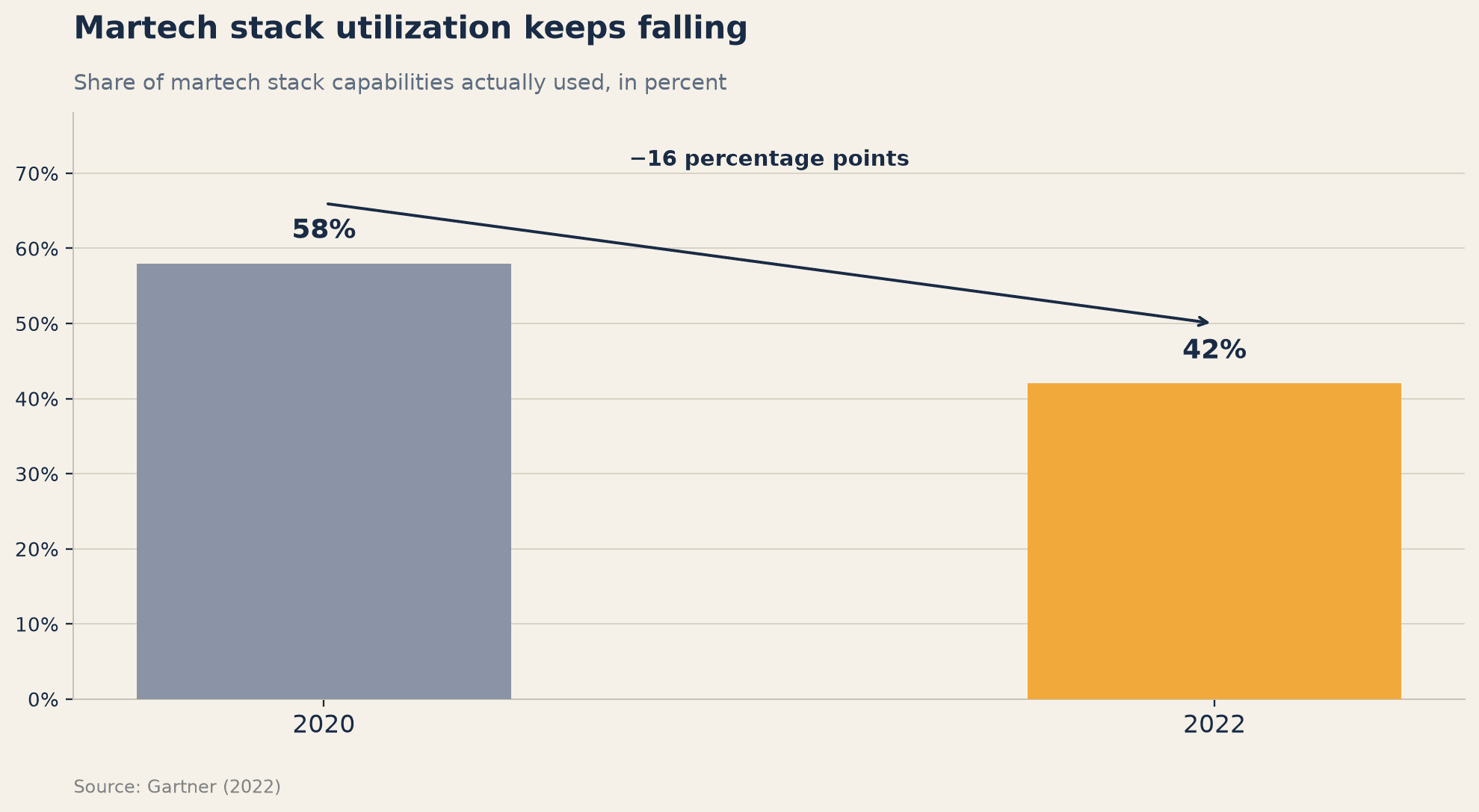
Banks and other financial institutions have poured years of investment into martech: CDPs, customer engagement platforms, marketing automation, data warehouses. The contradiction behind that spend is well documented. According to Gartner, martech spending now accounts for nearly 24% of total marketing budgets, yet only about a third of the stack is actually being used. A Gartner survey of 324 marketers makes the trend even clearer: in 2022, marketing teams used on average just 42% of their stack's capabilities — down 16 percentage points from 58% in 2020. This happened even as CMOs continued to allocate a quarter of their budget to technology in the same period.
The same survey points to structural causes rather than a lack of effort: 30% of respondents cite overlap between tools as the leading reason, 28% point to a lack of internal expertise to drive adoption, and 27% cite the sheer complexity and sprawl of the ecosystem. That aligns with the finding that 76% of martech leaders audit their stack at least twice a year — a sign of how much governance effort alone the inventory work absorbs, before any new value is even created.
Why replatforming projects fail more often than they succeed
The obvious response to an underused stack is the big swing: rip everything out, bring in a new system, start clean. In practice, that approach fails disproportionately often. McKinsey cites a digital strategy survey showing that banks realize, on average, less than a third of the value expected from digital transformations; only 16% of surveyed executives report transformation programs that delivered sustained success. The outcome is rarely a clean cutover — it's usually a prolonged period running old and new platforms in parallel, with the consequences McKinsey names directly: delayed decisions, added security and compliance risk, and structurally higher costs from operating two complex environments at once.
For a bank with a grown IT landscape spanning a core banking system, CRM, several campaign tools, and historically siloed data stores, that's not an abstract risk — it's a real budget and timeline question. A replatforming project ties up capacity across IT, compliance, and the business for years — capacity that isn't going toward better customer engagement in the meantime. Choosing that path means betting against odds that, based on McKinsey's data, are structurally stacked against you.
The market shift: composability over the monolith
The market itself is moving away from the "one system for everything" model. MarTech.org's landscape analysis shows a clear shift for 2025: CDPs are losing centrality in B2C/B2B2C environments, dropping from 26.9% to 17.4% as the primary system, while cloud data warehouses climb to 23.9% and marketing automation platforms rise to 26.1%. The study counts 15,384 available martech tools overall — up 9% year over year. But more choice doesn't mean more control if every new tool becomes another island in the data landscape.
The reason behind that shift is the growing weight of integration capability as a purchase criterion. According to the composability survey by chiefmartec/MartechTribe, 83.9% of respondents consider APIs important or very important when evaluating new martech solutions — yet only 17.3% rate their core platform's actual API coverage as "great." That gap between expectation and reality is the real driver of the composability trend: organizations want to combine individual, interchangeable capabilities rather than lock into a single monolithic vendor. Tellingly, the same study finds that 71% of respondents already run a cloud data warehouse within their martech stack, with 61.3% of those connecting more than half of their applications to it. The study's core thesis on the composable CDP sums it up directly: the software layer should sit on top of the data that already exists — "data should not be copied."
Metric | Value | Source |
|---|---|---|
Share of martech stack used (2022) | 42% (−16 pp since 2020) | |
Top reason for underuse: tool overlap | 30% | |
CDP share as central system (B2C/B2B2C) | 26.9% → 17.4% | |
Cloud data warehouse as central system | 23.9% | |
APIs "important/very important" in tool choice | 83.9% | |
Core platform's API coverage rated "great" | 17.3% |
Acceleraid as an intelligence layer: integration, not replacement
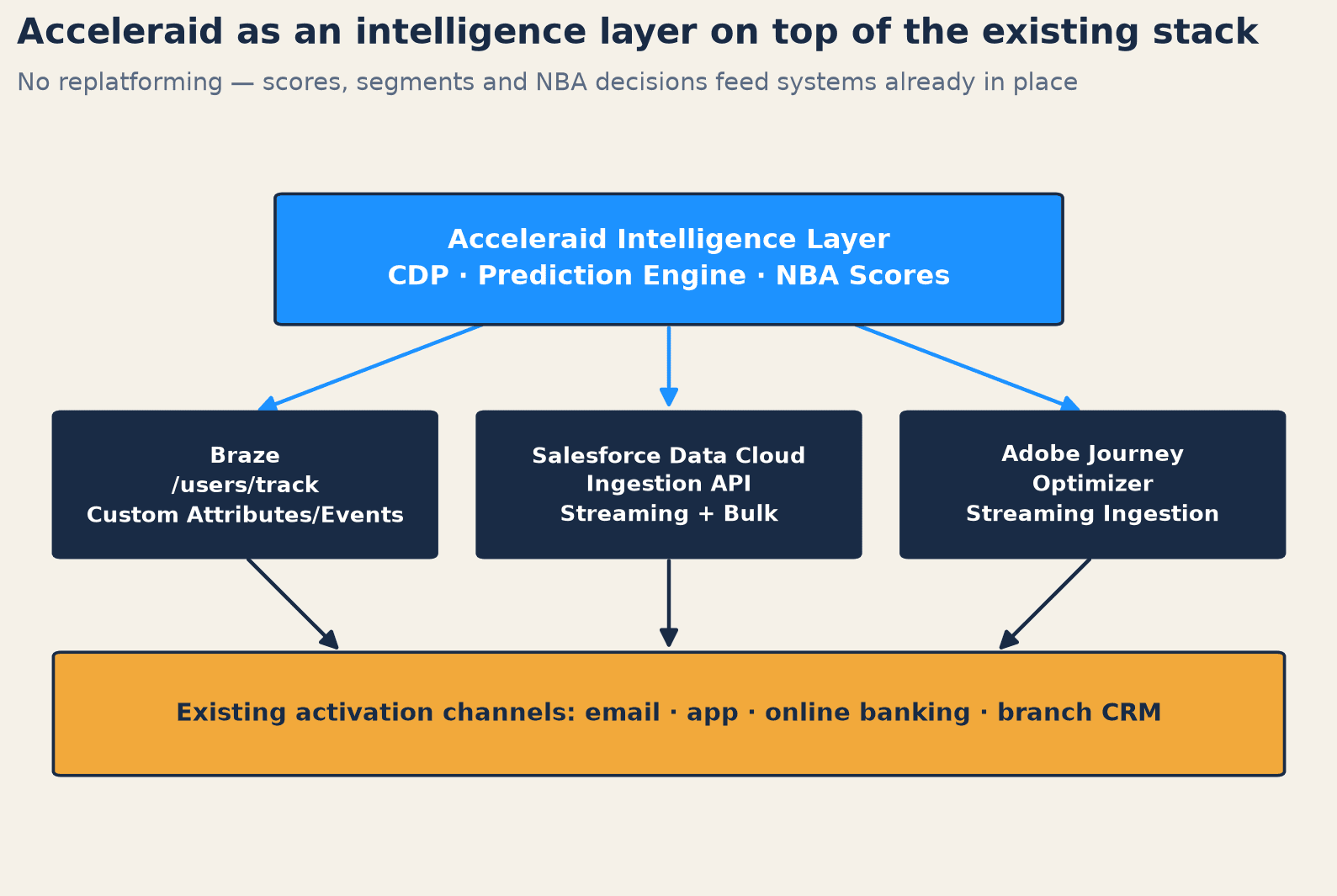
This backdrop is exactly what shapes our product philosophy: Acceleraid does not replace a bank's existing martech stack — it operates as an intelligence layer on top of it. The Prediction Engine calculates affinity, churn, and propensity scores as well as next-best-action decisions from real-time data drawn from CRM, core banking, and card processing systems. Those scores, segments, and decisions aren't then managed in a new, isolated interface — they're fed into the systems marketing and CRM teams already use every day.
Technically, these integration patterns follow what the established customer engagement platforms document themselves. Braze offers the /users/track endpoint, which lets external systems write custom attributes, custom events, and purchases directly to user profiles — with clearly documented limits (up to 75 objects per request, a burst limit of 3,000 requests per three seconds on Data Points contracts). An externally computed score can be delivered as an attribute update to an existing user profile this way, without Braze itself becoming the source of truth. Salesforce, in turn, provides two complementary patterns through the Data Cloud/Data 360 Ingestion API: streaming for incremental updates the moment a score changes, and bulk for periodic synchronization via CSV files — both addressable through the same data stream. Adobe Journey Optimizer, according to Adobe Experience League, uses streaming ingestion APIs to bring events from external systems into a unified profile, complemented by runtime lookups that enrich journeys at execution time with current values from external record datasets.
These patterns make one thing clear: the infrastructure needed for an intelligence layer sitting on top of the existing stack already exists within the platforms themselves — it doesn't need to be reinvented. Acceleraid positions itself accordingly, as a provider that feeds scores, segments, and NBA decisions into systems like Braze, Salesforce, and Adobe through these documented interfaces, rather than building yet another competing activation platform. The same capability extends to additional engagement platforms a bank may already run — the specific connection follows whatever integration pattern the target platform documents.
What this means for banking marketing teams
For marketing, digital, and data leaders, this reframes the decision logic away from the classic tool-purchase question. Instead of asking "which system replaces what we have?", the more useful question is: "what capability are we missing, and how does it feed into what's already running?" A pragmatic approach follows three steps. First, map the existing estate honestly — which systems are in place, which data already flows, and where do the overlaps Gartner describes actually occur? Second, name the gap precisely: is it predictive scoring, a consolidated view of transaction data, or automated NBA decisions that's missing? Third, evaluate integration through documented APIs before jumping to a replatforming plan whose odds of success are, per McKinsey's data, structurally limited.
This approach doesn't just reduce project risk — it also shortens time-to-value considerably, since the activation systems stay unchanged and simply receive smarter inputs. That's exactly the theme we build on in part two of this series, where we look at orchestrating these signals across every channel. For a closer look at how NBA decisions themselves get made and activated in real time, see our Next Best Action series. More on the platform and specific banking use cases is available on our banking page.
Illustration: AI-generated. AI-assisted content: We use AI technologies and automated agents in the creation of our articles, including from Microsoft, Google, OpenAI, Anthropic and other providers. Topics, editorial direction and final approval remain with our team.
We use Cookies 🍪
Strictly necessary cookies (e.g. Pipedrive forms) remain active. With your consent we also use Google Analytics (analytics) and Leadfeeder (visitor identification). More in our Privacy Policy.