Regulation & Compliance
EU Banking Competitiveness 2026: What the Reform Agenda Means for Technology and Customer Processes
What the EU’s 2026 banking reform agenda could mean for data architecture, reporting and cross-border customer processes.
•
acceleraid Redaktion
6 min read
01
Acquire
Signale erkennen
02
Onboard
Aktivierung steuern
03
Grow
Next Best Action
04
Retain
Churn reduzieren
05
Reactivate
Potenziale zurückholen

Author: acceleraid Redaktion | 17 August 2026
On 17 July 2026, the European Commission adopted a Communication on the competitiveness of the EU banking sector. It sets out measures intended to strengthen the single market for banking; it is not legislation already in force. European Commission, 17 July 2026
The distinction matters. The Commission has described an agenda and says it will deliver legislative proposals in the first quarter of 2027. The content, negotiations, legal form and eventual application of any measure therefore remain open. European Commission, 30 July 2026
That does not make the agenda irrelevant for technology and customer operations. It is a useful prompt to test whether cross-border controls, supervisory data and customer processes can adapt without assuming that a future target operating model has already been mandated.
An agenda built around three obstacles, not a finished rulebook
The Commission identifies three constraints on competitiveness: nationally fragmented markets, implementation of global standards that does not always reflect the features of Europe’s banking landscape, and parts of the EU framework that are overly complex and burdensome. European Commission, 30 July 2026
This is not a case for deregulation for its own sake. The 17 July Communication links a better-balanced framework to resilience, financial stability and better services for households and businesses. European Commission, 17 July 2026
The economic context is material: the Commission’s factsheet states that banks provide 75% of corporate debt financing in the EU, while the banking single market and Banking Union remain incomplete. European Commission factsheet, July 2026
For bank leaders, the practical response is not to build against assumed future requirements. It is to distinguish three layers: obligations in force, a published policy agenda, and improvements that would be worthwhile regardless of the legislative process. That separation prevents a technology programme from being justified by rules that do not yet exist.
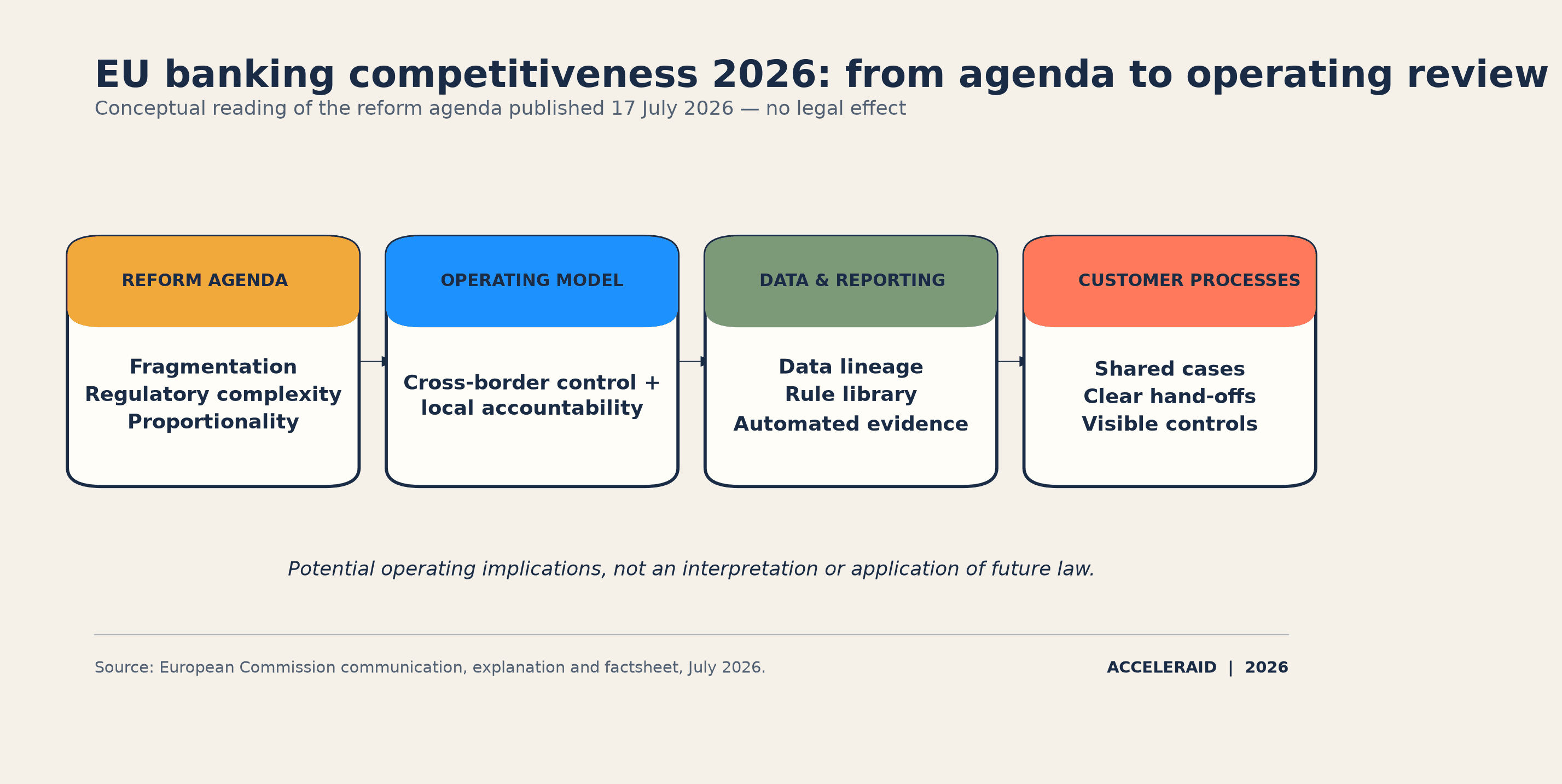
Fragmentation is also a process and data problem
The Commission’s direction includes enabling cross-border banking groups to manage liquidity and capital more efficiently across the EU, with stronger safeguards and a new proposal to replace the 2015 proposal for a European deposit insurance scheme. European Commission, 30 July 2026
This is a policy objective, not an instruction for every bank to centralise its operating model. For groups that operate in several countries, however, it makes familiar sources of friction more visible: inconsistent master data, separate case handling, divergent evidence trails and integrations built only for domestic journeys.
A sound response separates a shared core from local variation that is legally or commercially necessary. Common definitions for customer, account, case, product, consent and risk event make it easier to move information between entities. Country-specific rules, languages, service ownership and time limits should remain explicit configuration, rather than becoming unexplained forks of the same process.
That is an architecture principle, not a prediction of future law. A bank can establish common standards, clear data lineage and reusable process components without obscuring the accountability of a local entity. If the European framework changes, the impact assessment is quicker; if it does not, the operating model is still easier to govern.
Simplification calls for traceability, not weaker controls
The Commission says it wants to reduce unnecessary complexity and make requirements more predictable and transparent for banks and authorities. Its explanation also stresses that trust in banking relies on strong safeguards. European Commission, 30 July 2026
Simplification should therefore not be read as fewer controls. For technology teams, the more useful question is whether the bank can show which data was used, which rule applied, who decided an exception and which report version resulted.
A reporting stack that assembles data manually immediately before a submission is difficult to explain and expensive to change. A more resilient design connects a business data model, lineage, quality-controlled transformations, approved metric definitions and a reproducible reporting run. Controls belong in the flow, not in a final spreadsheet review.
Proportionality and automated supervisory reporting
The factsheet lists greater proportionality for smaller banks and more simplified, proportionate and automated supervisory reporting among the planned measures. It also refers to more targeted and transparent bank-specific requirements and supervisory guidance. European Commission factsheet, July 2026
It does not tell banks which individual return will be removed, automated or subject to a different threshold. The Commission has said proposals are planned for the first quarter of 2027. European Commission, 30 July 2026
Banks can nevertheless start to treat reporting as a product: with named data owners, a controlled rule library, traceable exception handling and tests that expose business-rule changes before a monthly or quarterly close. Automation then has a narrow and valuable purpose: execute recurring data flows, validations and evidence reliably. It does not replace professional judgement or supervisory dialogue.
For smaller institutions, a shared core of standard interfaces and reusable controls can be a proportionate design choice. Proportionality does not mean careless execution. It means matching scope and effort to risk, business model and actual complexity, within the requirements that apply today.
Customer processes: consistency without false uniformity
The Communication connects competitiveness with better services for households and businesses. European Commission, 17 July 2026
There is no automatic customer-experience benefit from a more integrated banking group. Customer value appears only when a cross-border process provides relevant information, a clear status and a dependable next step at the right moment.
Useful starting points are journeys that depend on coordinated hand-offs: onboarding, identity checks, changes to address or master data, service cases, complaints and movement between digital and assisted channels. A shared event and case reference can stop a customer having to repeat information in one channel while another part of the bank is already working on the same issue.
The boundaries must be modelled just as clearly. Which data may be used for which purpose? What contact should be suppressed while a complaint remains open? When should a local specialist take over? A capable platform answers these questions through visible rules, permissions, statuses and review routes; it does not assume that one “customer view” can replace every local decision.
A pragmatic programme before the Commission’s package
Banks can begin four workstreams before the planned package. First, map regulatory data flows, manual rework and country-specific exceptions. Second, establish accountable ownership, provenance and quality checks for material metrics and customer events. Third, redesign one or two cross-border journeys around explicit hand-offs and local variations. Fourth, create change governance that brings policy monitoring, supervisory guidance, business teams and technology together early.
The measure of success is not the number of systems centralised. It is the ability to implement change in control: identify impacts, adapt data and rules, test local variants, equip colleagues and observe the customer effect.
The Commission’s agenda provides a direction, not a final specification. Banks that invest now in transparent data chains, configurable processes and clear accountability create a more dependable starting point—whatever form the 2027 proposals ultimately take.
Illustration: AI-generated. AI-assisted content: We use AI technologies and automated agents in the creation of our articles, including from Microsoft, Google, OpenAI, Anthropic and other providers. Topics, editorial direction and final approval remain with our team.
We use Cookies 🍪
Strictly necessary cookies (e.g. Pipedrive forms) remain active. With your consent we also use Google Analytics (analytics) and Leadfeeder (visitor identification). More in our Privacy Policy.