CLM & CVM
Why transaction data is the most important signal for Next Best Action
Checking account transaction data increases the AUC by up to 5.4 points. Why it outperforms sociodemographic data in NBA scoring.
•
acceleraid Editorial Team
5 min read
01
Acquire
Recognize signals
02
Onboard
Control activation
03
Grow
Next Best Action
04
Retain
Reduce churn
05
Reactivate
Reclaim potential

Part 3 of 3 of our series on Next Best Action in banking — and the conclusion of the series. Part 1 describes the decision logic behind NBA (Part 1), Part 2 the channel playbook (Part 2). Complementary to the topic of life events, see also Part 3 of our CLM series (Engage: Life Events & Transactional Data).
The current account is the data treasure that many banks underestimate
No other product provides as many ongoing, granular signals about a customer as the current account. Every rent or salary payment, every savings transfer, every card transaction with its merchant category is a data point that says something about the current life situation — significantly more than a socio-demographic profile collected once. This observation is not intuition, but is proven in several independent studies: when behavioral data from past transaction behavior is available, "the presence of demographic characteristics adds little additional predictive power" — the authors refer to earlier research showing that only 7% of the variance in price sensitivity is explained by socio-demographics (Wang, Carson et al., Journal of Business Research 151). For an NBA engine, this means: anyone who primarily relies on age, income, or place of residence as predictors is waiving the most meaningful signal that a bank already possesses.
How much transactional data actually increases predictive quality
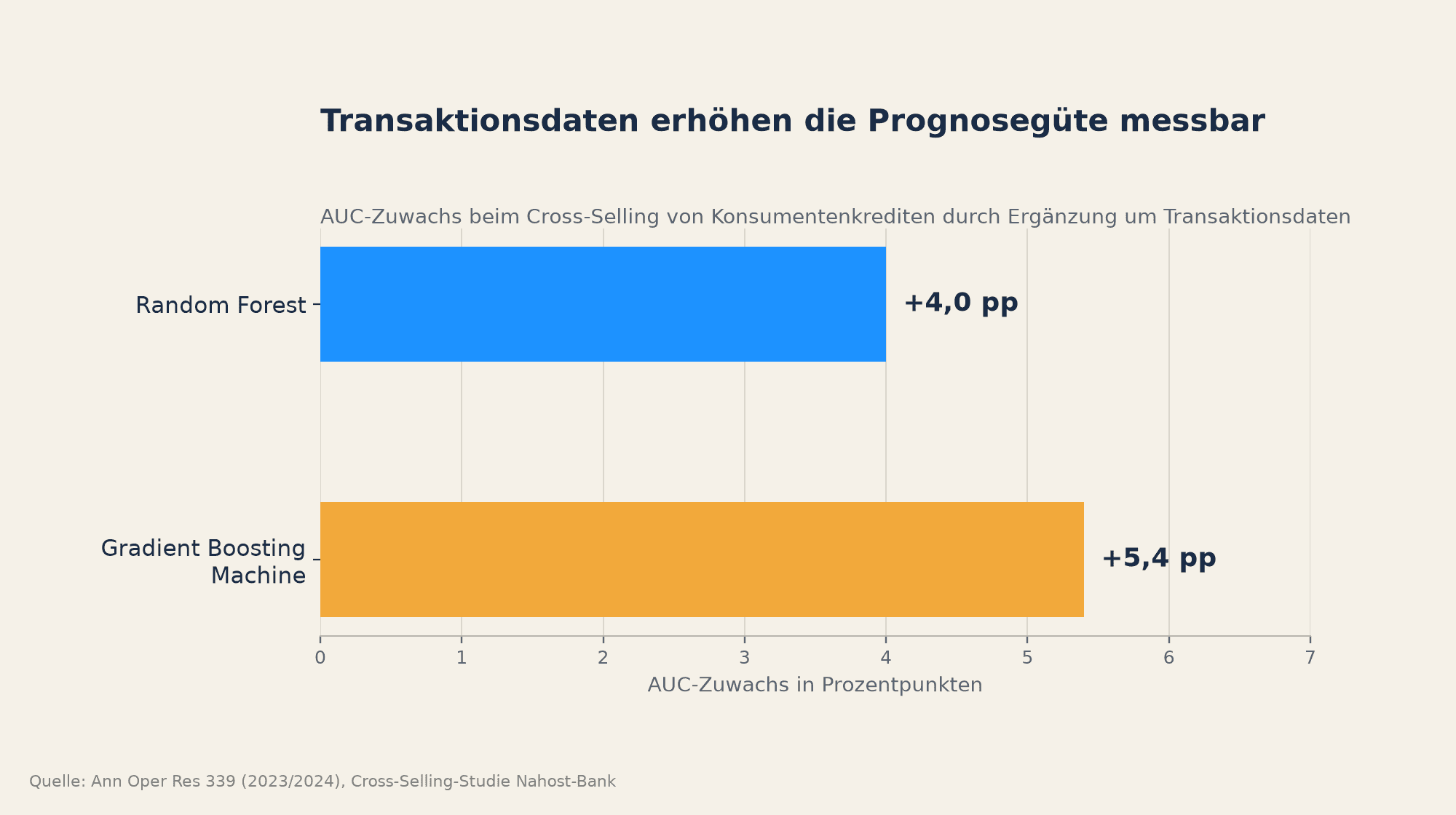
The numbers on this are robust and can be stated concretely. A study on the cross-selling of consumer loans at a bank in the Middle East — based on 6,127 retail customers and around 800,000 credit card transactions over a year, grouped into 22 merchant categories with 146 subcategories — shows that the addition of transaction data increases the AUC value by 4 percentage points for Random Forest and by 5.4 percentage points for Gradient Boosting Machine compared to models that work only with demographics and product ownership (Ann Oper Res 339). The study also notes that with methods like CHAID and SVM, "more predictive value lies in transactional data than in demographics and product ownership". The same effect is also shown in predicting life events: fine-grained transaction data with RFM-extended features improves the AUC value when predicting a birth to 0.748 compared to 0.725 for aggregated data alone, and for a new relationship to 0.730 compared to 0.681 — with transaction data providing the largest share of variable importance in the model (De Caigny, Coussement & De Bock, Decision Support Systems 130).
What transactional data concretely makes visible
This predictive power arises because transactional data contains several signal types at the same time, which would never be as up-to-date and granular if collected individually:
Rent payments often show intention to move or actual move weeks before any address change in the master record.
Salary receipts signal income changes, job changes, or new employment in near real-time.
Savings patterns show whether a customer is currently consolidating for a goal — real estate, education, purchase — or is just beginning to build up reserves.
Merchant category shifts in card transactions — such as new spending at baby stores, moving companies, or furniture stores — provide early indicators of life events, as documented in research on moving, birth, new relationship, and the end of a relationship (De Caigny, Coussement & De Bock).
These signals are the reason why transaction data provides not just additional, but structurally different predictive power than master data: they are continuously updated, behavioral instead of self-reported, and cover changes before the customer even informs the bank.
Regulatory framework: GDPR, legitimate interest, and the boundary to PSD2
This depth of data requires a sound legal basis. For the processing of one's own transaction data within the customer relationship, the legitimate interest according to Art. 6 Para. 1 lit. f GDPR regularly comes into consideration. The European Data Protection Board requires three cumulative conditions for this: a legitimate interest, the necessity of processing for this interest, and a balancing test in which the interests and fundamental rights of the data subject must not override — this assessment must take place before processing, and financial data is explicitly classified as more "private" (EDPB, Guidelines 1/2024 on legitimate interest).
Importantly, a distinction must be made from open banking data under PSD2, which is subject to a different, narrower purpose limitation: Art. 66 Para. 3 lit. f/g PSD2 prohibits payment initiation service providers (PISPs) from requesting or using data beyond the actual order, and Art. 67 Para. 2 lit. d/f limits account information service providers (AISPs) to the accounts and purposes explicitly authorized by the user — an AISP must explicitly state in the contract for what purpose account data is being processed (EDPB, Guidelines 06/2020 on the interplay of PSD2 and the GDPR). For a bank that operates NBA on the basis of its own transaction data collected as part of account management, a different — fundamentally simpler — framework applies than for third parties accessing external account data via PSD2 interfaces. This distinction should be made explicit in any internal compliance documentation on NBA models.
Why this is strategically more than a data science detail
The practical consequence for banks: anyone who builds NBA scoring primarily on master data and one-off segmentations misses out on the signal with the highest documented predictive power — and at the same time risks working with outdated assumptions about a customer's life situation. The combination of AUC increases of 4 to 5.4 percentage points in cross-selling and the documented improvements in life event prediction shows that this difference is not marginal, but structural. At the same time, this very abundance of signals requires a clean data processing governance — from the legal basis to explainability towards the supervisor and customer, as described in Part 1 of this series.
How Acceleraid operationalizes transactional data
With the analysis of 3.5 billion transactions, Acceleraid has built a wealth of experience that translates exactly these signal classes — rent payments, salary receipts, savings patterns, real estate searches, merchant category shifts — into lifecycle phase scoring across acquisition, growth, maturity, and retention (Platform). The CDP & Data Governance provides the necessary foundation: real-time connectivity to core banking and card processing, consent management, lineage, and PII protection with German hosting and GDPR-by-design (Banking). This turns the regulatorily complex field of transaction data analysis into a controlled, auditable foundation for the NBA scores described in Part 1 of this series.
Conclusion: The wrap-up of the series
Across three parts, a consistent picture has emerged: Next Best Action is a decision logic of propensity, lifecycle, channel, and regulatory guardrails (Part 1), which must be delivered differently depending on the channel (Part 2) — and whose most important input is not master data, but the ongoing transaction data of the current account (Part 3). Banks that think these three levels together possess an NBA capability that is not only more precise but also explainable to regulators, advisors, and customers.
Illustration: AI-generated. AI-supported content: We use AI technologies and automated agents, including those from Microsoft, Google, OpenAI, Anthropic, and other providers, to create our articles. Topics, professional orientation, and final approval remain with our team.
Further Insights
We use cookies 🍪
Strictly necessary cookies (e.g. Pipedrive forms) remain active. With your consent, we also use Google Analytics (analytics) and Leadfeeder (visitor identification). Learn more in our Privacy Policy.