CLM & CVM
Digital Euro 2027: Why banks must test the customer journey now
The 2027 digital euro pilot turns the customer journey into a banking task: from education and activation to offline payment and service.
•
acceleraid Editorial Team
6 min. read
01
Acquire
Recognize signals
02
Onboard
Control activation
03
Grow
Next Best Action
04
Retain
Reduce churn
05
Reactivate
Reclaim potential

The potential launch of the Digital Euro is not a technical event that can simply be ticked off with an interface and a go-live. For banks and other payment service providers, the crucial work begins with the customer experience: How is a new means of payment explained clearly, activated, topped up, used for the first time, utilized when there is no connection, supported in the event of an error, and subsequently reused? This is precisely the chain that should be tested now.
The baseline is clear, but it is not yet applicable law. The European Central Bank (ECB) FAQ was updated on August 17, 2026. Following the European Parliament's position on July 9, 2026, trilogue negotiations are underway between Parliament, the Council, and the Commission. The ECB Governing Council will decide on an issuance only after the regulation is adopted. A potential first issuance in 2029 requires that the necessary regulation be adopted by the end of 2026. ECB FAQ on the digital euro
The pilot is a customer journey test, not just an infrastructure test
The Eurosystem plans a twelve-month pilot for the second half of 2027. 36 selected payment service providers – banks and non-banks – are to provide the services required for the payments. Participants will use a beta version in real-life situations to validate technical functions, operational processes, and user experience. The beta is intended exclusively for the pilot; it is neither an issued Digital Euro nor a commitment to the final product. ECB FAQ on the digital euro
This shifts the correct question for bank executives. Not: "Does the connection work?" But rather: "Can a customer understand the entire process independently and securely?" A successful first payment transaction is important, but it does not yet prove sustainable usage. Customers remember the points where they get stuck: unclear terms, insufficient funds, an interrupted process, an unfamiliar transaction, or an unreachable service channel.
The ECB blog explicitly describes the pilot as an opportunity to test infrastructure functions under real conditions and to gather insights for later implementation decisions. Participating banks can help shape integration approaches, existing components, partners, and the choice between internal and external development. These decisions affect not only IT costs but also compliance, capacities, and the workflow at the customer touchpoint. ECB Blog: Digital euro: an opportunity for banks
From the moment of information to repeated use
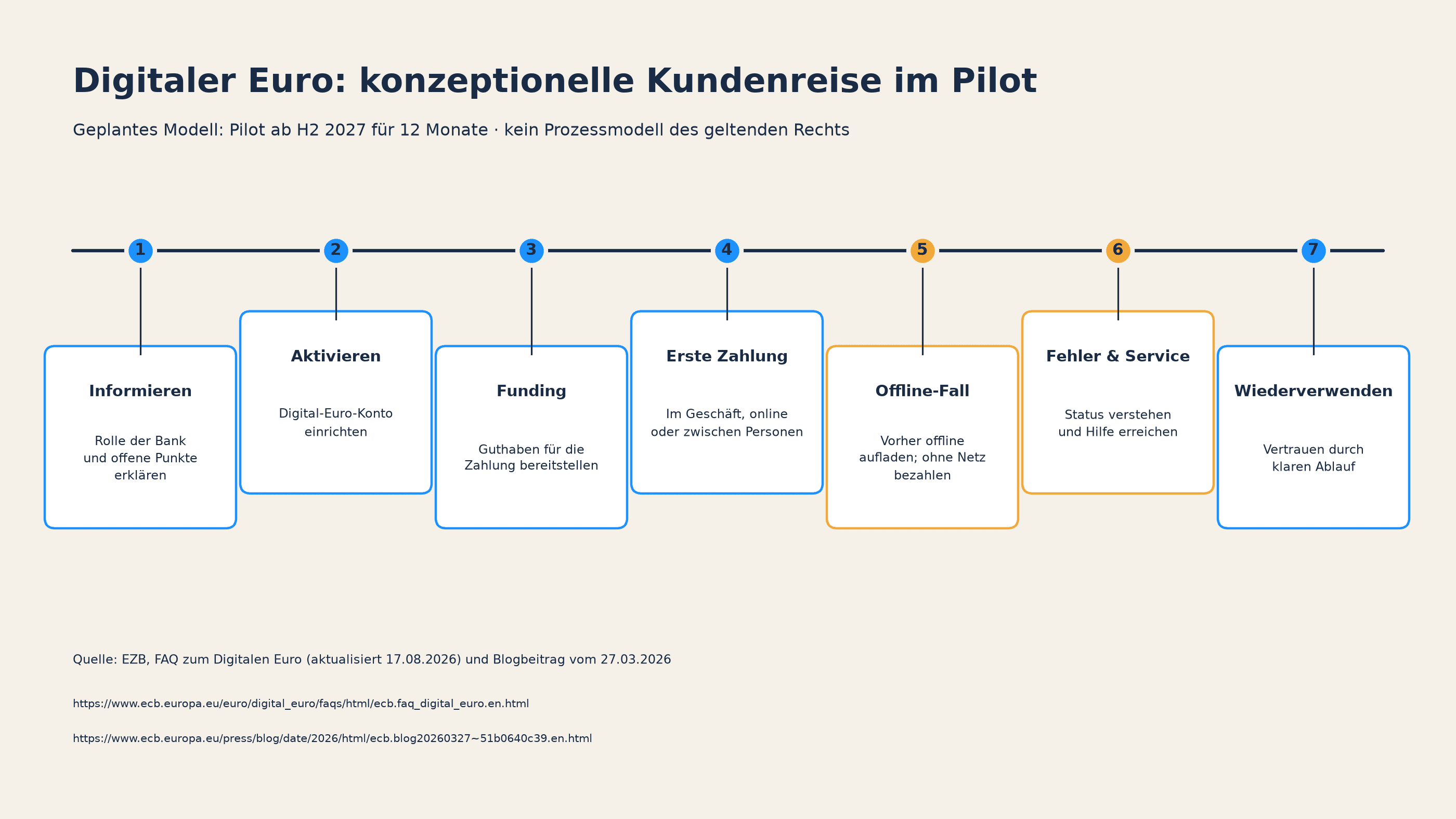
A resilient journey begins before the account is opened. Customers need a brief, consistent explanation: What is the Digital Euro according to the currently proposed model? What is still unresolved? What role does one's own bank play? The ECB envisages supervised payment service providers as the central point of contact for private individuals, merchants, and businesses; they would provide all end-customer services. This is a design of the proposed regulation, not the current legal status. ECB FAQ on the digital euro
Activation is the second critical moment. According to the planned design, users would set up a Digital Euro account through their bank or an EU payment service provider. This is followed by consents, information on data and security features, as well as the decision on how access is visualized in the app, card, or service channel. In the pilot, teams should not just measure completion, but also check whether test subjects can explain what they are currently setting up and who to contact if they have questions.
Next comes funding: providing a balance for a payment. It is precisely here that misunderstandings arise when an additional balance appears alongside the familiar checking account. The ECB blog also describes a potential "reverse waterfall": if a Digital Euro balance is insufficient, the missing amount could automatically come from a linked bank account or card. However, the source describes no obligation, no consent logic, and no concrete setup steps. These gaps are not a reason to wait, but rather precise hypotheses for the pilot. ECB Blog: Digital euro: an opportunity for banks
The first payment attempt must cover multiple situations
The planned design includes payments in stores, in online retail, and peer-to-peer. With an online checkout, users could select the Digital Euro and authorize the payment directly via their banking app. For a first use, a single demo case is therefore not enough. A pilot plan should map at least one personal transfer, one payment at the point of sale, and one online purchase as interconnected journeys. ECB FAQ on the digital euro
The offline case is particularly important. The planned Digital Euro is intended to work online and offline, meaning it should be usable even with a weak or non-existent network connection. For this, the offline Digital Euro account would first need to be topped up; users could then, for example, tap their phone against another phone or a merchant terminal. This is a planned function. This is precisely why pilot and service teams must linguistically and operationally differentiate between "no reception," "insufficiently topped up," and "payment not completed." ECB FAQ on the digital euro
Privacy belongs in the same journey, not in a separate compliance appendix. For offline payments, a cash-like level of privacy is envisioned; only the payer and payee should know the personal transaction details. For online payments, the Eurosystem should not be able to identify the payers and payees, while payment service providers could identify users as they do today to fulfill anti-money laundering requirements. This also describes a future design to be regulated. Good customer copy must clearly separate these levels instead of making a blanket promise of "anonymity." ECB FAQ on the digital euro
Service is part of the payment, not the post-processing
A customer journey does not end with authorization. Banks should test in the pilot whether customers understand the status, balance, error messages, and contact persons. This includes questions such as: What is visible in the event of an interrupted offline payment? When is a process retried? What information can the service desk securely request? What explanation do those affected receive when a payment does not appear at the expected time? The primary sources do not define ready-made service processes for these workflows. However, they show that payment service providers are intended as the main contact for all Digital Euro matters. ECB FAQ on the digital euro
A potential conditional payment also belongs in a controlled test scenario. According to the proposal, the Digital Euro would not be programmable money; however, it could facilitate conditional payments, for instance, when money is transferred only after confirmed delivery. The ECB blog cites as an example a train ticket where payment is made only if the trip actually occurs. These are options for future services, not a feature available today, and not a commitment to a specific use case. Nevertheless, for the customer journey, it is crucial that conditions, triggers, status, and reversals are easy to understand. ECB FAQ on the digital euro ECB Blog: Digital euro: an opportunity for banks
Testing now means preparing decisions in good time
The effort is significant, but that makes early learning all the more important. Based on analyses of several banks, the ECB estimates total bank investments at 4 to 5.8 billion euros, corresponding to 1 to 1.44 billion euros annually over four years. The estimate is not a binding cost commitment; according to the ECB, it does not yet include internal bank synergies and may change with standards, regulation, and implementation decisions. ECB Blog: Digital euro: an opportunity for banks
A sober priority follows from this: the customer journey is a steering object. Product, Operations, Compliance, Service, and Technology should define clear customer copy, a responsible role, an exception case, and an observable test goal for each step. Not to build a preemptive final solution, but to make assumptions visible. The pilot can then not only answer integration questions, but also show whether a planned payment function can become a trustworthy, repeatedly usable banking service.
Illustration: AI-generated. AI-assisted content: In the creation of our articles, we utilize AI technologies and automated agents, including those from Microsoft, Google, OpenAI, Anthropic, and other providers. Topics, professional direction, and final approval rest with our team.
Further Insights
We use cookies 🍪
Strictly necessary cookies (e.g. Pipedrive forms) remain active. With your consent, we also use Google Analytics (analytics) and Leadfeeder (visitor identification). Learn more in our Privacy Policy.