AI & Banking
What does AI in marketing really cost?
Subscription prices, image costs per API call, and the leap through agentic use: a cost overview for marketing teams, as of August 2026.
•
acceleraid Editorial Team
7 min. read
01
Acquire
Recognize signals
02
Onboard
Control activation
03
Grow
Next Best Action
04
Retain
Reduce churn
05
Reactivate
Reclaim potential

Since August 3, 2026, the same questions have been circulating in marketing teams as with every new model launch: Which subscription is actually enough, and what does it really cost when AI doesn't just help with drafting, but executes entire campaign steps itself? For marketing professionals with typical tasks like campaign planning, copywriting, image generation, and blog articles, a sober look at the current price lists of the providers is worthwhile — because there is a cost difference between simple chat use and fully agentic application that is not directly shown in any price table.
What the subscriptions cost
The entry point into paid AI tools now starts well below the psychological mark of 20 US dollars. OpenAI has introduced ChatGPT Go, a plan for 8 US dollars per month, while the established Plus plan is at 20 US dollars and, according to OpenAI, unlocks "expanded deep research and agent mode". Anyone who needs more pays 100 or 200 US dollars monthly for ChatGPT Pro, depending on the usage tier (OpenAI Help). At Anthropic, Claude Pro starts at 17 US dollars (annual payment) or 20 US dollars (monthly), while Max plans begin at 100 US dollars (claude.com/pricing). Google is positioning its consumer plans starting at 4.99 US dollars for AI Plus up to 99.99 US dollars for AI Ultra (Google AI Plans). For image generation, separate tools are added: Midjourney starting from 10 US dollars for the Basic plan (Midjourney Docs) and Adobe Firefly starting from 9.99 US dollars for the Standard plan (Adobe Firefly).
Tool | Plan | Price / Month | Source |
|---|---|---|---|
ChatGPT | Go | $8 | |
ChatGPT | Plus | $20 | |
ChatGPT | Pro | $100–$200 | |
Claude | Pro | $17 (annually) / $20 (monthly) | |
Claude | Max 5x / 20x | from $100 | |
Google AI | Plus | $4.99 | |
Google AI | Pro | $19.99 | |
Google AI | Ultra | from $99.99 | |
Microsoft 365 Copilot | Business | List $21, promo from $18 | |
Midjourney | Basic–Mega | $10–$120 | |
Adobe Firefly | Standard–Premium | $9.99–$199.99 |
For Microsoft 365 customers, Copilot Chat is included in suitable subscriptions at no additional cost, while the full Microsoft 365 Copilot Business costs from 18 US dollars per user per month instead of the regular 21 US dollars according to the current promotion (July 1 to September 30, 2026) (Microsoft 365 Copilot Pricing). This spectrum already shows: The pure subscription costs are manageable for an individual marketing team. It only gets interesting when you look at what the quotas are actually used for.
Image Generation: The Price per Image
For campaign material and blog article illustrations, the subscription ultimately matters less than the price per generated image — especially when image generation is run via API instead of a consumer interface. Here, significant differences emerge between providers and even between quality levels of the same model.
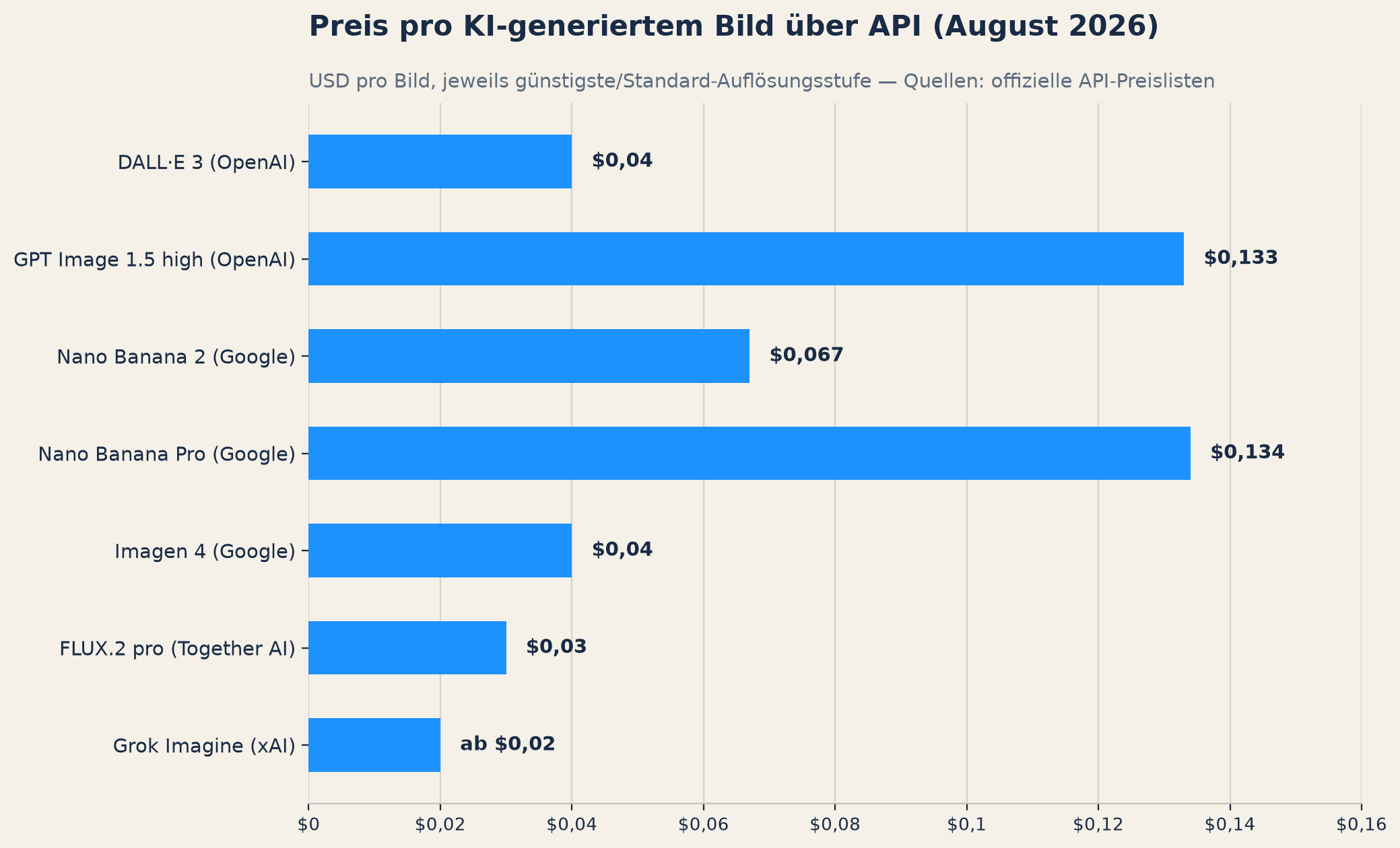
OpenAI's DALL·E 3 is 0.04 US dollars per image in standard mode, while GPT Image 1.5 in the "high" setting costs more than three times as much at 0.133 US dollars (OpenAI API Pricing). For Google, Nano Banana 2 (Gemini 3.1 Flash Image) is 0.067 US dollars in 1K resolution, the more powerful Nano Banana Pro is 0.134 US dollars, while Imagen 4 remains significantly cheaper in standard mode at 0.04 US dollars (Gemini API Pricing). At the lower end of the price spectrum are FLUX.2 pro via Together AI at 0.03 US dollars (Together AI Pricing) and Grok Imagine from xAI starting at 0.02 US dollars per image (xAI Docs). For a marketing team that regularly needs image material for social media campaigns or blog articles, this factor of three to seven between the cheapest and most expensive models makes a noticeable difference for larger quantities — even if the single image price seems small at first glance.
Agentic Use: Why the Jump Is So Big
The actual cost driver is not the individual chat or the single image, but the transition from chat use to agentic use — that is, to workflows in which the AI independently executes several steps, calls tools, and processes intermediate results further. Anthropic documents for Claude Code that agent teams consume about seven times as many tokens as standard sessions as soon as several team members work in parallel in plan mode, because each team member maintains their own context window (Claude Code: Manage costs). Additionally, there is a structural detail: With every request, the complete previous conversation is sent along, and every tool call generates another request including the tool result — a single short follow-up question in a session that remains open all day therefore incurs consumption for the entire conversation (Claude Code: Manage costs).
How heavily this impacts available quotas is evident in OpenAI's message limits: In the ChatGPT Plus plan, 40 Agent mode messages are available per month, while in the Pro plan, there are 400 (ChatGPT agent). The factor of 10 between the plans fairly accurately reflects how many more resources an agentic workflow ties up compared to a simple chat request. With Google, the AI Ultra subscription scales the Gemini limits by up to twenty times compared to free access and additionally unlocks Gemini Agent and Deep Think, which are not included in the cheaper Plus and Pro plans (Google AI Plans). A custom derivation from the sample session documented by Anthropic (0.55 US dollars total cost with 1.2k input, 5.3k output, 940k cache-read, and 50k cache-write tokens) illustrates the scale: Extrapolated to four agent runs per working day over 21 working days, this would result in around 46 US dollars per month and person for standard sessions — with the documented factor of 7 for agent teams, that would equal about 320 US dollars per month. This calculation is a custom derivation from the provider's specifications, not a target value published by Anthropic — actual costs depend heavily on context length, model choice, and caching behavior according to the provider documentation (Claude Code: Manage costs).
For marketing teams, this specifically means: An agent that independently researches a campaign, creates several text variations, checks them against each other, and generates image suggestions, consumes in a single run many times what a comparable chat conversation would cost. This is not a reason to do without agents — but a reason to target their use specifically to tasks where automating multiple steps actually saves time, instead of running agents by default for every request.
When Is the Cheap Model Enough?
Not every task needs the most powerful model available — and the providers themselves now explicitly recommend starting with the cheaper model. Anthropic expressly advises starting with Claude Haiku 4.5, testing the respective use case, and only switching to a stronger model when capability gaps are concretely proven; Haiku 4.5 is described as "near-frontier performance" at the cheapest price point and is explicitly recommended for high-volume, clearly defined tasks as well as latency- and cost-sensitive applications (Choosing the right model). For content creation, Anthropic explicitly names Claude Sonnet 5 as the starting model — not the most expensive in the model family (Choosing the right model). The suggested procedure is highly pragmatic: Run benchmarks with your own prompts and data, compare accuracy and response quality, and only switch to a more powerful model if a proven gap exists.
What does this mean concretely for the text costs of a blog article? A custom derivation from the published prices: A 1,000-word article roughly corresponds to 1,300 to 1,500 output tokens. With a cheap model like gpt-5.4-nano (1.25 US dollars per 1 million output tokens), the pure output costs less than 0.002 US dollars, with gpt-5.4 (15 US dollars per 1 million) around 0.02 US dollars, and even with the most expensive model available, Claude Fable 5 (50 US dollars per 1 million), it lies at about 0.07 US dollars. Pure text production is therefore negligibly cheap in practically every model tier — the cost drivers are not the finished articles, but the research effort, tool calls, and agentic repetitions, as described in the previous section. Additional leverage independent of the model: Batch processing saves 50 percent at Anthropic and Google compared to real-time requests (Anthropic Pricing, Gemini API Pricing), and prompt caching reduces input costs at OpenAI from 2.50 to 0.25 US dollars per 1 million cached input tokens for gpt-5.4 (OpenAI API Pricing).
In practice, a simple rule of thumb can be derived from this: For research, strategy work, and complex agentic workflows, a more powerful model is worth it because mistakes are expensive there. For the pure text generation of a fully researched and briefed article, however, the cost difference between the model tiers is so small that the decision should depend on quality requirements rather than price.
This choice of model should not be a one-time decision, but remain continuously reviewable — this is precisely what we took into account when developing our Acceleraid Assistant: It is designed to be model-agnostic, meaning the underlying model can be switched at any time, for example from a more expensive frontier model to a cheaper one, as soon as a use case turns out to be less demanding than assumed. Knowledge, contexts, and configurations are fully preserved, so that a model change does not require a new setup, but remains a purely economic optimization.
Before a marketing team reorganizes its AI setup, four control questions are worth asking: For which concrete tasks is agentic use with multiple automation steps actually needed instead of simple chat interaction? How many images are generated per month via which API, and is it worth switching to a cheaper model like FLUX.2 pro or Grok Imagine? Has it ever been tested for your own copywriting and blog article workflows whether a cheaper model like Haiku 4.5 or Sonnet 5 is sufficient before automatically choosing the most expensive model? And: Is the current choice of tools flexible enough that a model switch is possible without losing existing configurations and campaign knowledge?
Illustration: AI-generated. AI-supported content: In creating our posts, we use AI technologies and automated agents, including those from Microsoft, Google, OpenAI, Anthropic, and other providers. Topics, editorial direction, and final approval remain with our team.
Further Insights
We use cookies 🍪
Strictly necessary cookies (e.g. Pipedrive forms) remain active. With your consent, we also use Google Analytics (analytics) and Leadfeeder (visitor identification). Learn more in our Privacy Policy.