AI & Banking
The $100 Million Bar: How Large Banks Now Prioritise AI Use Cases
HSBC prioritises only AI use cases above $100 million. BNP Paribas, Société Générale and Deutsche Bank set their own rules. Three decisions that matter.
•
acceleraid Redaktion
5 min read

When HSBC announced its expanded AI partnership with Google Cloud in June, one sentence said more about the industry's maturity than the number of planned use cases: only initiatives expected to return more than 100 million US dollars in revenue or efficiency will be prioritised for delivery. The Asian Banker has compiled the details: Gemini models and the agent platform, Google engineering teams working inside the bank, more than 200 new use cases within two years, and three initial areas (wealth management, financial crime risk, tools for frontline staff).
The 100 million bar is not a technology criterion but a financial one. HSBC has committed to a return on tangible equity of at least 17 percent through 2028 and capped 2026 cost growth at around one percent. Its chief executive called generative AI the bank's largest new technology investment area. A bank that invests this much while capping costs needs a filter.
A pattern, not a one-off
The Asian Banker weekly round-up of 25 September shows how other large banks answer the same question.
BNP Paribas signed a five-year partnership with Google Cloud on 24 September and plans to integrate Gemini into an internal assistant for more than 65,000 employees in corporate and institutional banking, with corporate credit memoranda as one proposed agent use. Notable is what the bank is not doing: in 2025 it said no client data or sensitive production environments sat in public cloud, and existing data-governance rules continue to determine what may be processed there. For sensitive processes such as KYC checks, it is developing on-premises solutions with Mistral AI.
Société Générale has put a number on its AI initiatives in its 2026–2029 plan: 500 to 600 million euros in savings by 2029, around 350 million of which it says it has already identified, with roughly 200 use cases in production and a dedicated group entity coordinating deployment.
Deutsche Bank went live at the beginning of September with an AI tool for source-of-wealth checks in its Singapore and Hong Kong private-bank booking centres. It draws on client records and approved external sources to prepare documentation, identifies gaps and supports assessments that staff review. The same principle has applied to supplier document reviews since December 2025: the AI cites the passages behind a suggested outcome, and a human decides.
Bank of America reports coding-productivity gains of 15 to 20 percent among some 20,000 developers and plans to double its AI budget next year.
Bank | Announcement | Steering metric | Data rule |
|---|---|---|---|
HSBC | Google Cloud, June 2026 | Only use cases above USD 100m; 200 cases in two years | Two platforms: Mistral self-hosted, Google in the cloud |
BNP Paribas | Google Cloud, 24 Sept 2026 | Assistant for 65,000 staff | Sensitive data not in public cloud; KYC with Mistral on premises |
Société Générale | 2026–2029 plan | EUR 500–600m savings by 2029; 200 cases in production | Central entity SocGen AI |
Deutsche Bank | 22 Sept 2026 | AI prepares, staff decide | Client records plus approved external sources |
Bank of America | 23 Sept 2026 | 15–20% productivity among 19,000–20,000 developers | AI budget doubled in 2027 |
Three decisions that keep recurring
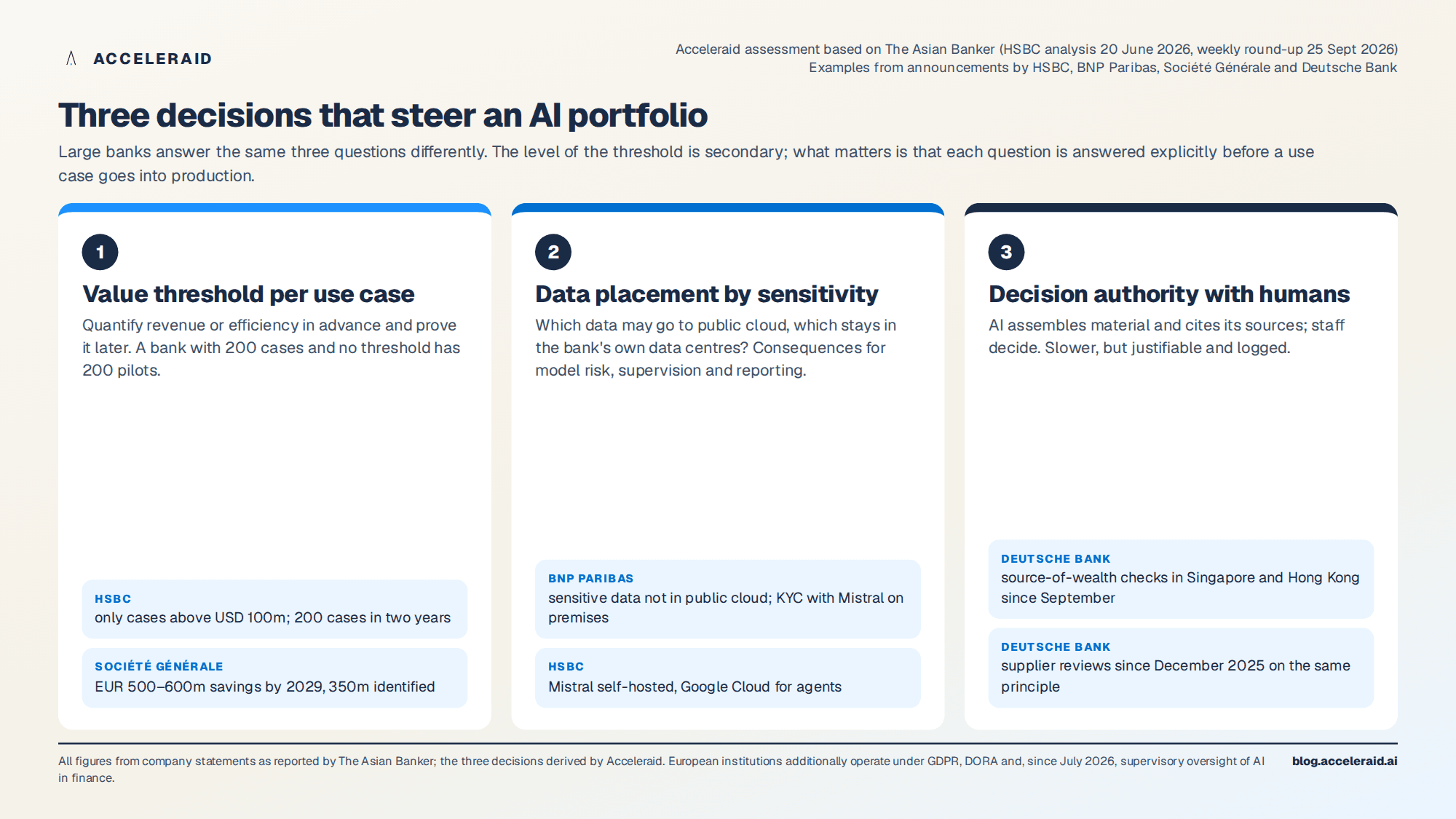
Behind the announcements are three decisions every bank must make.
The first is the threshold: 100 million US dollars at HSBC, a savings figure per initiative at Société Générale. What matters is not the level but that it exists: a bank with 200 use cases and no prioritisation has 200 pilots. A mid-sized bank can apply the same logic at two or five million euros; it forces the institution to quantify the return per initiative in advance and prove it afterwards.
The second is data placement. BNP Paribas draws the line between public cloud and its own data centres along data sensitivity; HSBC runs two platforms in parallel. Both have consequences for model risk, supervision and reporting that, as The Asian Banker notes, neither announcement addresses. For European banks under GDPR, DORA and, since July, supervisory oversight of AI in finance, this decision is the precondition for a use case being allowed into production at all.
The third is decision authority. Deutsche Bank lets the AI assemble material and cite its sources, but humans decide. That is slower than an autonomous agent, but it can be justified to supervisors and customers, and it produces the audit trail a more autonomous operation will later need.
What follows for the customer interface
Striking is where the large banks look for their first above-threshold cases: wealth advisory, credit preparation, source-of-wealth checks, fraud prevention. These are fields with high volume, clear rules and measurable outcomes. Retail customer engagement rarely appears as a first case, although McKinsey and Celent place the largest untapped lever there. The reason is not a lack of value but of measurability: a bank that cannot attribute a customer contact to an outcome cannot test it against a threshold. The large banks' sequence thus shows where mid-sized institutions should begin: with measurement.
Five takeaways
HSBC prioritises only AI use cases with more than 100 million US dollars in expected revenue or efficiency; the threshold is a financial filter, not a technology criterion.
BNP Paribas, Société Générale, Deutsche Bank and Bank of America answer the same question with data rules, savings targets, human decision authority and a doubled budget.
Three decisions recur: a value threshold per initiative, data placement by sensitivity, decision authority with humans.
The first above-threshold cases sit in wealth advisory, credit preparation and review processes because impact is measurable there; customer engagement is missing because attribution is missing.
A mid-sized bank can apply the same logic with a smaller threshold if it quantifies the return per initiative in advance and measures it afterwards.
Illustration: AI-generated. AI-assisted content: We use AI technologies and automated agents in the creation of our articles, including from Microsoft, Google, OpenAI, Anthropic and other providers. Topics, editorial direction and final approval remain with our team.
