Data & Technology
Self-Hosting Open-Weight Models: When running your own is worth it — and when it isn't
Open-weight models are production-ready. When self-hosting pays off, what fine-tuning achieves — and where the API remains the more honest approach.
•
acceleraid Editorial Team
5 min read
01
Acquire
Recognize signals
02
Onboard
Control activation
03
Grow
Next Best Action
04
Retain
Reduce churn
05
Reactivate
Reclaim potential
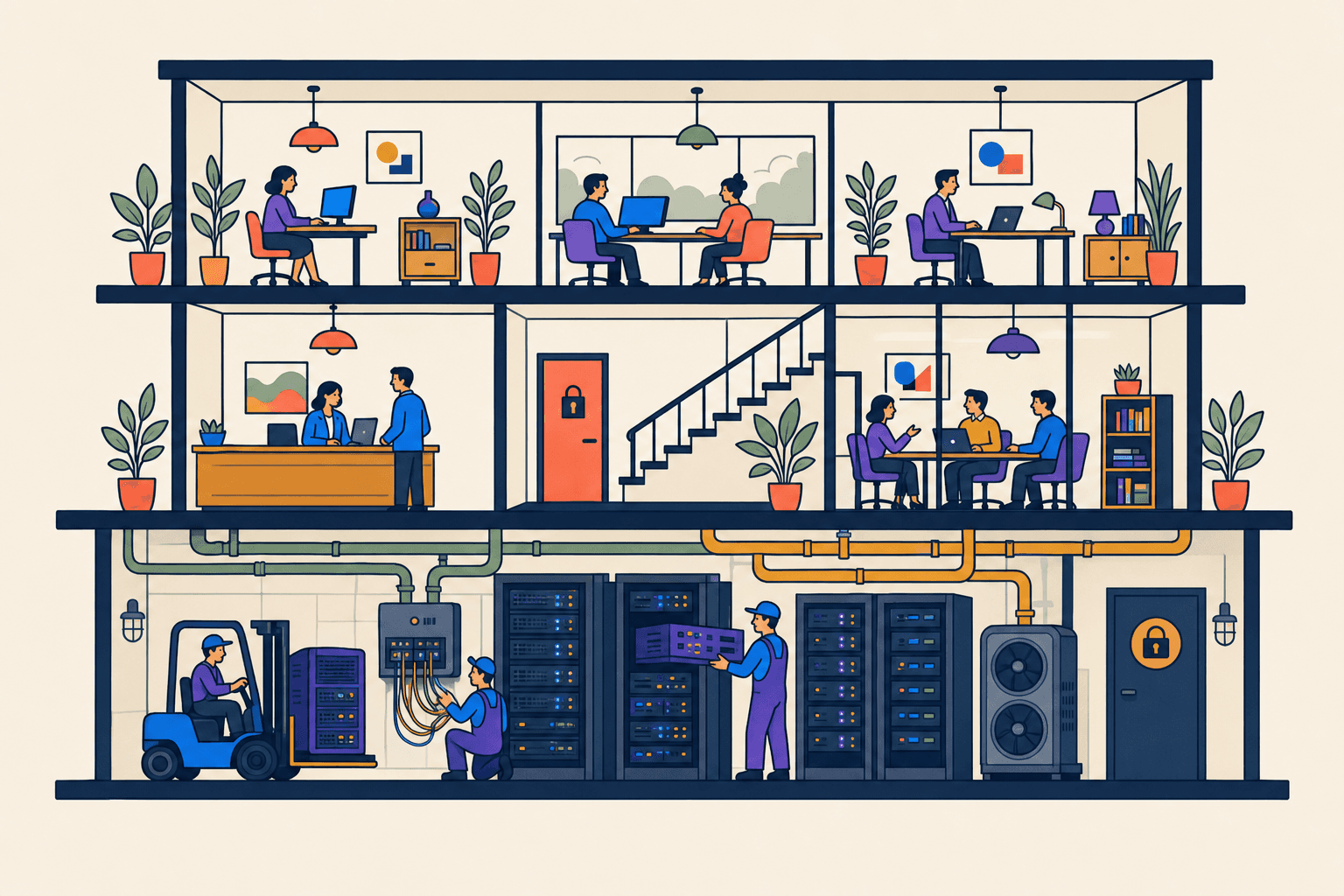
The question of whether companies can run large language models themselves has been answered in 2026: they can. Open-weight models have caught up with the proprietary leaders in independent comparisons, serving software is production-ready, and the licensing situation has simplified significantly. With the release of Moonshot's Kimi K3 weights in late July — a model that surpasses several leading closed models in blind comparison tests — the last fundamental hurdle has fallen. Today, the real question is: Should you? And it is of an economic and organizational nature, not a technical one.
What "Open Weight" means — and what it doesn't
An open-weight model is a model whose trained parameters are published for download. Companies can inspect, customize, and run it on their own hardware — in the data center, in the private cloud, or in their own cloud tenant. Prompts, documents, and results do not leave their own infrastructure. This is the core of the sovereignty promise.
However, open weight is not the same as open source. As a rule, you receive the finished model and the permission to use it, but neither training data nor the complete recipe. And the license can contain real restrictions. Nevertheless, a lot has moved here: Qwen3, Mistral, and Gemma 4 are now under Apache 2.0, DeepSeek under MIT — Meta's Llama remains the exception as a large family with its own special terms. Still, license verification remains mandatory for procurement and legal departments.
The selection is large — and the demand is real
The relevant model families for self-operation in 2026 are called Llama 4, Qwen3, Mistral, Gemma 4, DeepSeek, and since July, Kimi K3. They cover all size classes, from a compact model for a single GPU to a frontier model with trillions of parameters. The demand is corresponding: According to a study by McKinsey QuantumBlack, around 40 percent of business decision-makers prefer models they can host themselves for data protection and security reasons.
The price dynamics are also interesting: Kimi K3 prices its hosted API at the level of top closed models — but the open weights allow any company with sufficient infrastructure to operate it themselves, where no more costs per token are incurred after the initial investment. This is exactly the calculation that decides the business case.
The honest economic calculation
Self-hosting trades variable API costs for fixed infrastructure and operating costs. Whether this is worth it depends almost entirely on utilization. Analyses from 2026 show an enormous range: Depending on the token volume, the break-even is between a few months and several years. The rule of thumb: High, consistent load speaks for self-operation; sporadic or highly fluctuating usage speaks for the API — because self-operated GPU capacity that lies idle at night ruins any calculation.
Added to this is the operating effort, which tends to disappear in presentations: serving stack (such as vLLM or SGLang), model updates, monitoring, security patches, evaluation of new model versions. Self-hosting does not eliminate the operational, security, and quality layers — it shifts them in-house. Anyone who does not have or want to build these teams should calculate the numbers twice.
Own training: Fine-tuning has become accessible — and often unnecessary
The second major benefit of open weights is customizability. Today, with methods like LoRA and QLoRA, models can be adapted on a single GPU to professional language, tonality, and recurring task patterns; typical projects get by with a few hundred to a few thousand curated examples and run in hours instead of weeks. What required a cluster and an ML team two years ago is a manageable project today.
All the more important is the counter-question: What for, actually? The most common wrong decision in 2026 is fine-tuning for purposes that other methods solve better. Up-to-date company knowledge does not belong in the model, but in a retrieval layer (RAG) — there it remains updatable, traceable, and deletable. Fine-tuning pays off where behavior needs to change: terminology, format adherence, domain-specific patterns. Those who follow the sequence — first prompting, then retrieval, then customization — save themselves many expensive detours.
Regulatory tailwind for self-operation
In Europe, self-operation is getting an additional boost from regulation. In June 2026, the EU passed the Cloud and AI Development Act, a uniform framework for cloud sovereignty that makes services evaluable across four levels; in parallel, hyperscalers are investing in sovereign EU offerings. For banks, DORA is added to the mix, which requires managing concentration risks with critical third-party providers. In this logic, a self-operated open-weight model is not just a cost issue, but a building block of exit capability: It proves that one's own AI value creation does not depend on a single external provider.
A decision framework for practice
A simple grid that evaluates four dimensions per use case has proven useful for practical weighing. First, the data situation: The more sensitive the processed data and the stricter the internal or regulatory guidelines, the more the case speaks for self-operation. Second, the load profile: Constant, predictable volumes justify dedicated capacity; peaks and experiments belong on the API. Third, the quality requirement: For many operational tasks — classification, extraction, summarization — medium-sized open models are sufficient; the most expensive frontier quality is needed less often than providers suggest. Fourth, team maturity: Without MLOps expertise in-house, self-operation becomes a permanent construction site — in which case a sovereign managed service is often the more honest path. Passing every use case through this grid replaces the fundamental debate with a series of small, reversible decisions. The result is rarely spectacular, but resilient: a portfolio of sourcing channels that evolves with the market instead of chasing it.
Hybrid is the realistic target state
In practice, the weighing rarely ends with "all self-hosted" or "all API". The viable pattern is hybrid: sensitive, high-volume, and well-predictable workloads on self-operated open-weight models; peak loads, rare specialized tasks, and the most demanding reasoning work on frontier APIs. The prerequisite for this is an architecture that treats models as exchangeable components — with its own evaluation and knowledge layer that remains intact when changing models. Then, the question "to host yourself or not?" becomes an ongoing portfolio decision per use case — and that is exactly where it belongs.
Illustration: AI-generated. AI-supported content: In the creation of our articles, we use AI technologies and automated agents, including those from Microsoft, Google, OpenAI, Anthropic, and other providers. Topics, professional direction, and final approval lie with our team.
Further Insights
We use cookies 🍪
Strictly necessary cookies (e.g. Pipedrive forms) remain active. With your consent, we also use Google Analytics (analytics) and Leadfeeder (visitor identification). Learn more in our Privacy Policy.