CLM & CVM
Personalization at scale instead of hyper-personalization: Why execution limits the value
Why data activation, orchestration, and the operating model—rather than maximum model granularity—determine the value of personalization in banking.
•
acceleraid Editorial Team
5 min read
01
Acquire
Recognize signals
02
Onboard
Control activation
03
Grow
Next Best Action
04
Retain
Reduce churn
05
Reactivate
Reclaim potential

This post belongs to the Acceleraid series on effective personalization in banking. It strategically situates the Practical Guide to AI Personalization, the CLM Operating Model, and the decision logic of a Next-Best-Action Engine: It is not maximum detail depth in the model that creates value, but the ability to reliably translate relevant decisions into customer experiences.
Author: acceleraid Editorial Team
Two Terms, Two Different Aspirations
Personalization at scale and hyper-personalization are often used interchangeably. For the management of a bank, however, they represent different goals. Personalization at scale means making relevant content, decisions, and contact rules available across journeys, products, and channels in an industrialized way. The goal is not to model every moment with maximum individuality. It is to deliver a large number of sensible decisions in a repeatable, controlled, and measurable manner.
Hyper-personalization, on the other hand, describes maximum granularity in the individual moment: a vast number of signals, variants, and actions are weighed against each other in near-real-time. This can make sense. As a starting point, however, it is often too demanding. Anyone who wants to build a perfect individual decision first, without seamlessly connecting data, approvals, content, and channels, is optimizing an isolated moment instead of a functioning customer relationship.
The difference is operationally relevant. In the BCG Personalization Index, only ten percent of the brands studied are personalization leaders. This is not proof that banks need fewer models. It is an indication that the interplay of data, decision logic, content, and delivery is the rare part of the capability.
The Gap Occurs Between Insight and Delivery
The central question is therefore not: "How finely can our next model segment?" It is: "What decision can a team reliably execute today in a relevant contact – and how quickly does it learn from it?" It is precisely at this handoff that many programs lose their economic value.
A BCG analysis on personalization clearly describes this speed difference: average companies require two to three months to launch and measure a personalized campaign; leaders complete the cycle in one week at most. The same study cites a revenue potential of two trillion US dollars that could shift within five years to companies with compelling personalized experiences and communication. This figure is not a business case for a single institution. However, it shows why cycle time is a strategic metric: a decision that is approved only after the relevant customer moment has passed is too late, regardless of its model quality.
For banks, this problem is particularly visible. According to BCG's banking study, almost nine out of ten institutions had developed personas or behavioral segmentations. Fewer than three out of ten systematically used persona-specific communication variants. Around one third had laid the foundations for hyper-personalization; roughly one tenth had selected new technology platforms and begun integrating them. Between "we know a segment" and "we deliver an appropriate variant," there is no purely analytical task. Located there are product ownership, content processes, channel rules, consents, measurement, and daily workflows.
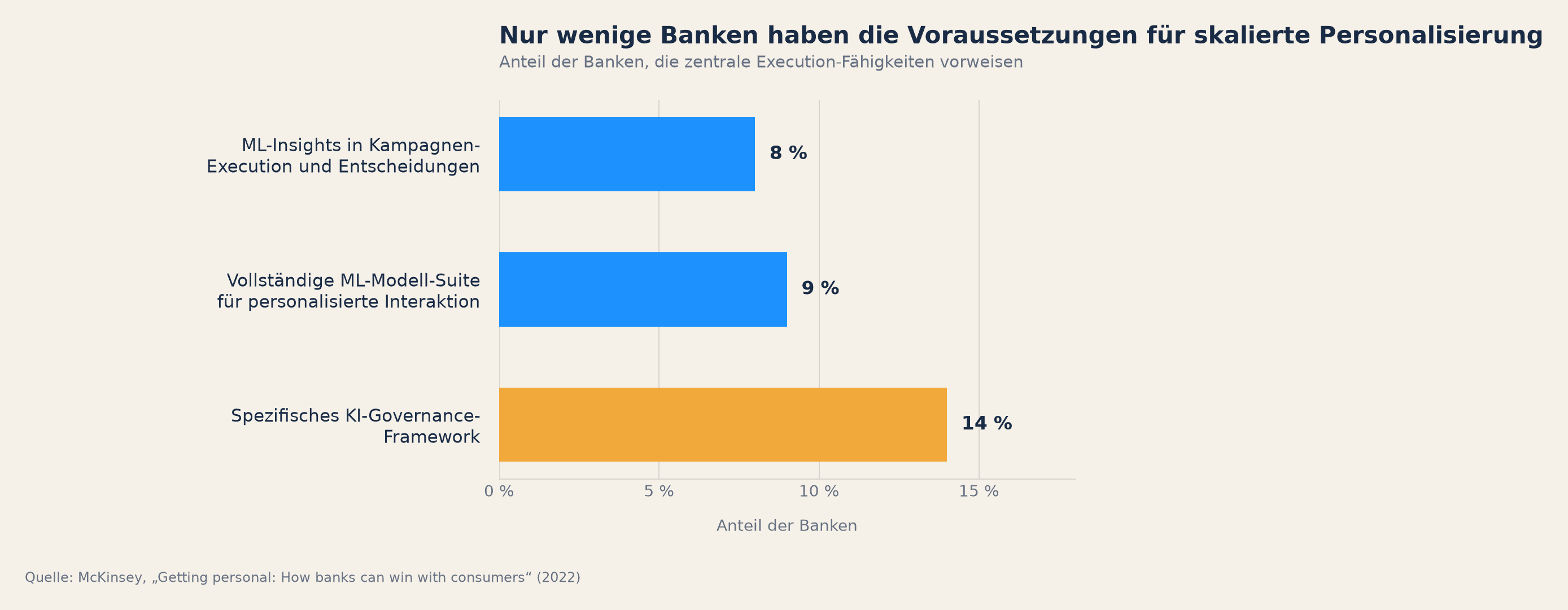
The values in the chart are taken from a McKinsey survey on personalization in banking. They do not measure the quality of individual campaigns. They make visible how rarely the prerequisites are simultaneously present: activating predictive insights in decisions, providing a complete suite of models, and establishing a specific AI governance framework.
Personalization at Scale is an Operating Model
Hyper-personalization is a potential outcome. Personalization at scale is the necessary organizational capability that must precede it. It consists of four interconnected disciplines.
First: a usable pool of decisions. Teams do not need an infinite number of variants. They need a prioritized list of permissible actions: inform, advise, offer, remind, or deliberately not contact. Each action requires a clear goal, an expected benefit, exclusion criteria, and accountability. This turns a score into a decision that can be operationalized.
Second: shared data and clear activation. A customer view is only valuable if it enters delivery with consent, freshness, and identity logic. McKinsey reports that only eight percent of banks can translate predictive insights from machine learning models into campaign execution and decisions. Only about nine percent have a complete ML model portfolio for personalized interaction at every touchpoint, and fourteen percent have a specific AI governance framework. This does not imply a rejection of technology. It implies an order of operations: first the reliable activation of repeatable decisions, then the next stage of granularity.
Third: a cross-channel orchestration rhythm. A decision does not have to appear everywhere at once. It needs a channel preference, frequency limits, rules for competing products, and clean feedback on whether the contact helped, disrupted, or made no difference. That is the difference between a personalized message and a managed experience. The article on the Next-Best-Action decision shows how propensity, lifecycle stage, channel preference, and regulatory requirements come together into an executable recommendation.
Fourth: learning in operation. Instead of measuring a large program against a distant target image, the bank should choose a limited class of decisions and shorten its cycle: check the signal, prioritize the action, approve the content, play it out, evaluate the impact, and adjust the rule or model. What matters is not a maximum volume of testing, but a robust learning loop that business, data, and channel teams can actually operate together.
Why "More Data" Does Not Automatically Equal More Relevance
Customer expectations increase the pressure, but they do not exempt banks from this sequence of priorities. According to the Twilio State of Customer Engagement Report, eighty-eight percent of consumers are more likely to buy when communication is personalized in real time; yet only forty-four percent of brands say they deliver at this level. The study thus reveals an expectation-execution gap, not a call for uncontrolled data collection.
This is especially true for financial services. Relevance is not created by using every available attribute, but by the bank's ability to explain which context led to which action and whether the outreach was appropriate. Governance is therefore not a approval gate at the very end. It is part of the decision logic: data usage, consent, contact frequency, product prioritization, and measurement must be established before delivery.
The maturity comparison also supports this assessment. In a study conducted by Forrester Consulting for Blend, only nineteen percent of surveyed banks reached the "highly mature" range in the personalization model. The study is North American and sponsor-funded; therefore, it is not a DACH benchmark. As a diagnosis, however, it remains helpful: maturity is distributed across experiences, data, recommendations, channels, lifecycle, and enablement – not just a model.
A Pragmatic Decision Framework for Banks
Instead of declaring hyper-personalization a technology program, decision-makers should evaluate every initiative against five questions:
Is the customer moment clear enough for an action to actually be helpful?
Is the necessary data available with consent, freshness, and business ownership?
Is there a prioritized action, including a legitimate "no contact" option?
Can the desired channel execute the action with frequency and conflict rules?
Is a metric agreed upon from which the team can learn within a short cycle?
If any question remains unanswered, the correct next investment is usually not another model. It lies in content, data activation, decision rights, or instrumentation. This framework prevents two expensive mistakes: a demo for maximum individualization that never makes it into production, and a campaign operation that sends out many messages but makes no visible decision.
Acceleraid can provide the execution foundation for this: CDP and Data Governance as the System of Record, a Prediction Engine for comprehensible Affinity, Churn, Propensity, and NBA scores, as well as CLM/CVM orchestration with channel preferences and contact frequency limits. The platform connects these building blocks; for banking, Acceleraid describes delivery in online banking, app, email, and branch CRM in its industry solution. Acceleraid cites an average conversion uplift of fifteen percent and an ROI in six to nine months. These values are product specifications, not a general industry forecast.
Conclusion: Scale Before Maximum Granularity
This comparison is not an argument against hyper-personalization. It is an argument for the right sequence. Banks create value when they build a repeatable delivery process out of reliable data, clear decisions, appropriate content, and managed channels. A finer, closer-to-real-time individualization can then be built on top of this later.
The strategic metric is therefore not the number of available models or segments. It is the time from a relevant signal to a comprehensible, permissible, and measurably effective action. Those who systematically shorten this time make personalization scalable – and do not limit its value through their own execution.
Illustration: AI-generated. AI-supported content: In creating our articles, we use AI technologies and automated agents, including those from Microsoft, Google, OpenAI, Anthropic, and other providers. Topics, professional orientation, and final approval remain with our team.
Further Insights
We use cookies 🍪
Strictly necessary cookies (e.g. Pipedrive forms) remain active. With your consent, we also use Google Analytics (analytics) and Leadfeeder (visitor identification). Learn more in our Privacy Policy.