Automation
No Rip-and-Replace: Why We Seamlessly Integrate with Braze, Adobe, and Salesforce
Only 42% of the martech stack is utilized. Why integration instead of replatforming is the better way forward.
•
acceleraid Editorial Team
5 min read
01
Acquire
Recognize signals
02
Onboard
Control activation
03
Grow
Next Best Action
04
Retain
Reduce churn
05
Reactivate
Reclaim potential

Part 1 of 2 of our "Future-Ready Martech" series: Why the next technological leap in banking marketing succeeds not through a new system, but through a new layer on the existing stack.
The Martech stack is expensive — and unused
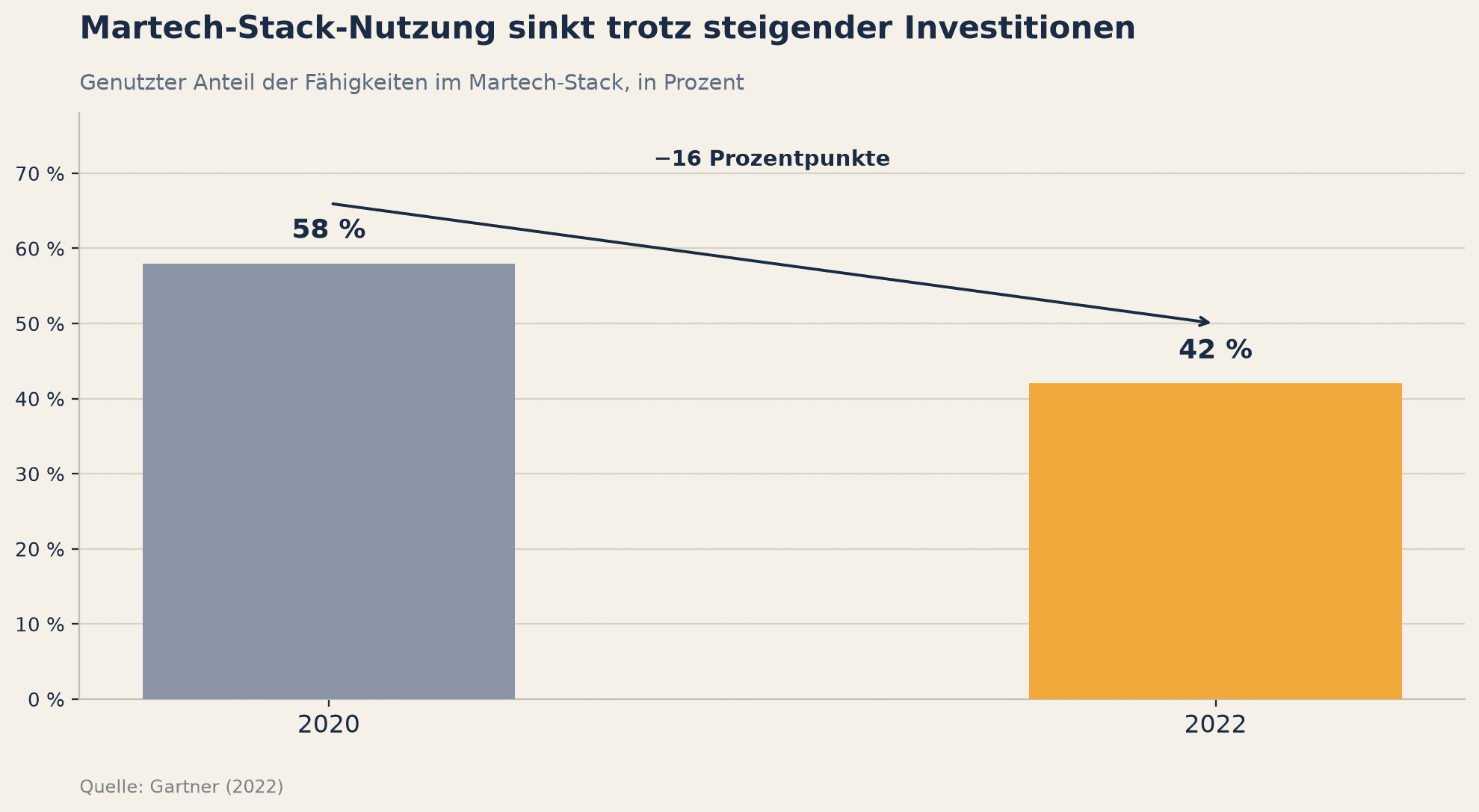
Banks and other financial service providers have been investing in Martech for years: CDPs, Customer Engagement Platforms, Marketing Automation, Data Warehouses. The contradiction behind this is well documented. According to Gartner, Martech spending now accounts for nearly 24% of overall marketing budgets, yet only about a third of the stack is actually used. A Gartner survey of 324 marketers highlights this trend even more clearly: in 2022, marketing teams utilized on average only 42% of their stack's capabilities — a drop of 16 percentage points compared to 58% in 2020. This is despite CMOs putting a quarter of their budget into technology over the same period.
According to the same survey, the causes are structural rather than a lack of willingness: 30% of respondents cite overlap between tools as the main reason, 28% a lack of internal expertise for adoption, and 27% simply the complexity and "sprawl" of the ecosystem. This aligns with the observation that 76% of Martech leaders audit their stack at least twice a year — an indication of how much governance effort is tied up in taking stock alone, before any new value is even created.
Why replatforming fails more often than it succeeds
The obvious reaction to an underutilized stack is the big move: replace everything, introduce a new system, and start fresh with a clean slate. In practice, however, this very approach fails far more often than not. McKinsey points to a digital strategy survey showing that banks realize on average less than a third of the expected value from digital transformations; only 16% of the executives surveyed report sustainably successful transformation projects. The result is often not a clean restart, but parallel operations of old and new platforms — with the consequences outlined by McKinsey: delayed decisions, additional security and compliance risks, and structurally increased costs due to having to run two complex environments simultaneously.
For a bank with a legacy IT landscape consisting of a core banking system, CRM, multiple campaign tools, and historically siloed data stores, this is not an abstract risk, but a real question of budget and schedule. A replatforming project ties up capacity in IT, compliance, and business units for years — resources that, in the meantime, do not flow into better customer engagement. Those who choose this path are betting against a success rate that, according to McKinsey data, is structurally against them.
The market trend: Composability instead of monoliths
The market itself is moving away from the "one size fits all" approach. The Martech landscape analysis by MarTech.org shows a clear shift for 2025: CDPs are losing central importance in the B2C/B2B2C space, with their share dropping from 26.9% to 17.4%, while Cloud Data Warehouses as central systems rise to 23.9% and Marketing Automation Platforms grow to 26.1%. Overall, the study counts 15,384 available Martech tools — a 9% increase compared to the previous year. However, more choice does not mean more control if every new tool becomes another island in the data landscape.
The reason for this shift is the growing importance of integration capabilities as a purchasing criterion. According to the Composability Study by chiefmartec/MartechTribe, 83.9% of respondents consider APIs important or very important when evaluating new Martech solutions — yet only 17.3% rate the actual API coverage of their core platform as "great". This gap between aspiration and practice is the real driver behind the composability trend: companies want to combine individual, interchangeable capabilities instead of locking themselves into a monolithic provider. It is also telling that in the same study, 71% of respondents already run a Cloud Data Warehouse within their Martech stack, with 61.3% of those having more than half of their applications connected to it. The study's core message on the composable CDP puts it in a nutshell: the software layer should sit directly on top of the existing data — "Data should not be copied."
Metric | Value | Source |
|---|---|---|
Utilized share of the Martech stack (2022) | 42% (−16 pp since 2020) | |
Main reason for underutilization: tool overlap | 30% | |
CDP share as a central system (B2C/B2B2C) | 26.9% → 17.4% | |
Cloud Data Warehouse as a central system | 23.9% | |
APIs "important/very important" for tool selection | 83.9% | |
API coverage of the core platform rated "great" | 17.3% |
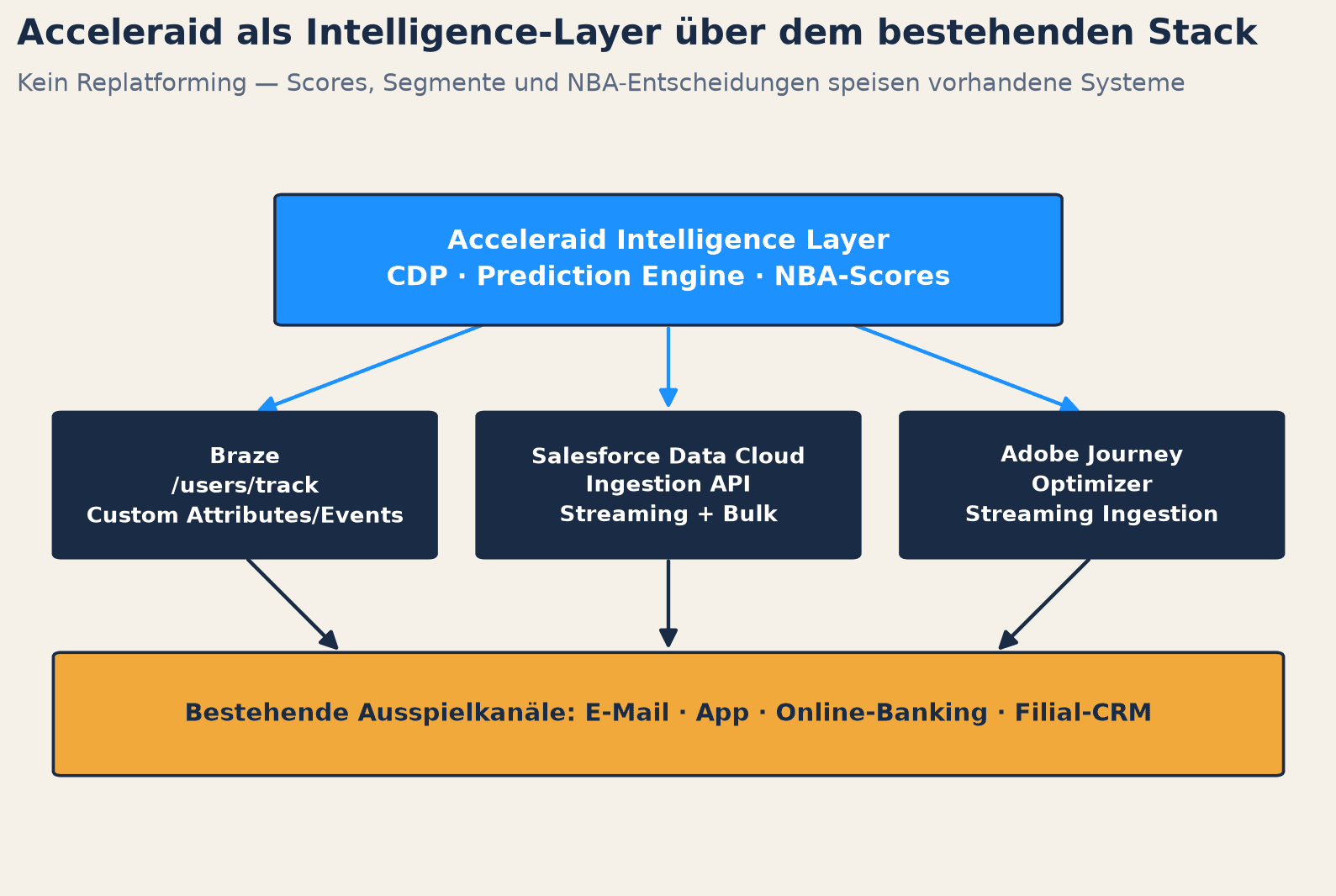
Acceleraid as an Intelligence Layer: Integration instead of replacement
This starting point shapes our product philosophy: Acceleraid does not replace a bank's existing Martech stack, but acts as an intelligence layer on top of it. The Prediction Engine calculates affinity, churn, and propensity scores as well as next-best-action decisions based on real-time data from CRM, core banking systems, and card processing. Rather than being managed in a new, isolated interface, these scores, segments, and decisions are fed into the systems that marketing and CRM teams already use every day.
Technically, these integration patterns align with what established customer engagement platforms document themselves. Braze offers the ability to write custom attributes, custom events, and purchases directly to user profiles via the /users/track endpoint — complete with clearly documented limits (up to 75 objects per request, burst limit of 3,000 requests per three seconds for data points contracts). An externally calculated score can thus be passed as an attribute update to an existing user profile without Braze having to become the data source itself. Salesforce, on the other hand, provides two complementary patterns with the Ingestion API of Data Cloud/Data 360: streaming for incremental updates as soon as a score changes, and bulk for periodic syncs via CSV files — both accessible via the same data stream. According to the Adobe Experience League, Adobe Journey Optimizer uses streaming ingestion APIs to integrate events from external systems into a unified profile, complemented by runtime lookups that enrich journeys with up-to-date values from external datasets on the fly.
These patterns demonstrate: the infrastructure for an intelligence layer on top of the existing stack already exists within the platforms themselves — it does not need to be reinvented. Acceleraid positions itself accordingly as a provider that feeds scores, segments, and NBA decisions via these documented interfaces into systems like Braze, Salesforce, and Adobe, instead of building another competing delivery platform. The same capability applies to other engagement platforms that banks are already using — the specific connection follows the integration pattern documented by each destination platform.
What this means for banking marketing teams
For leaders in marketing, digital, and data, this shifts the decision-making logic compared to traditional tool acquisition. Instead of asking "Which system replaces our current one?", it pays to ask: "What capability are we missing, and how does it feed into what is already running?" A pragmatic approach involves three steps: first, a sober mapping of the status quo — which systems are in use, what data is already flowing, and where do the overlaps described by Gartner occur? Second, defining the gap precisely: is it a lack of predictive scores, a consolidated view of transactional data, or automated NBA decisions? Third, checking integration capabilities via documented APIs instead of prematurely planning a replatforming project whose chances of success are structurally limited according to McKinsey data.
This approach does more than reduce project risk. It also significantly shortens the time-to-value, because the delivery systems remain unchanged while receiving smarter inputs — an aspect we will explore in depth in the second part of this series when discussing the orchestration of these signals across all channels. Additionally, we have described how NBA decisions are generated in detail and delivered in real time in our Next-Best-Action series. You can find out more about the platform and specific banking use cases on our banking page.
Illustration: AI-generated. AI-supported content: In creating our articles, we use AI technologies and automated agents, including those from Microsoft, Google, OpenAI, Anthropic, and other providers. Topics, professional direction, and final approval remain with our team.
Further Insights
We use cookies 🍪
Strictly necessary cookies (e.g. Pipedrive forms) remain active. With your consent, we also use Google Analytics (analytics) and Leadfeeder (visitor identification). Learn more in our Privacy Policy.