CLM & CVM
NBA per Channel: What works in online banking, app push notifications, email, and in the branch
Channel Playbook for Next Best Action: Comparing strength, latency, format, and compliance guidelines across five banking channels.
•
acceleraid Editorial Team
5 min read
01
Acquire
Recognize signals
02
Onboard
Control activation
03
Grow
Next Best Action
04
Retain
Reduce churn
05
Reactivate
Reclaim potential

Part 2 of 3 of our series on Next Best Action in banking. Part 1 describes the decision logic behind NBA (Part 1), Part 3 goes into detail on transaction data as the most important signal (Part 3).
One recommendation, five possible playout locations
A Next-Best-Action recommendation is only effective if it reaches the customer where they currently are — and in a format that fits the channel. The same recommendation "offer customer X a savings product" can be played out as a discreet tile in online banking, as a short push notification, as a detailed email, or as a conversation guide for the advisor in the branch. Which channel is suitable depends on three things: how powerful the channel is in principle, how quickly a message arrives there, and which regulatory requirements apply to format and documentation.
How strongly digital channels are already being used in the DACH region
The baseline can be clearly quantified: 89% of respondents with checking account access used online banking in 2025, an increase of 8 percentage points compared to 2023 — and the Bundesbank explicitly emphasizes that this increase took place "among all population groups", meaning it is not just a youth trend (Deutsche Bundesbank: Payment behavior in Germany 2025). Bitkom comes to a similar peak of 86% for Germany and shows that digital channels are increasingly prevailing over the branch: according to this survey, 44% of online banking users no longer go to the branch at all (Bitkom). Internationally, Accenture confirms this picture with concrete contact numbers: In a study with 49,300 customers in 39 countries, the app records 152 contacts per year, while the branch only comes to 8 contacts per year (Accenture Global Banking Consumer Study 2025). For an NBA strategy, this means: The branch remains relevant, but as a rare, high-value touchpoint — not as the primary playout channel for ongoing recommendations.
Why context determines success or failure on the push channel
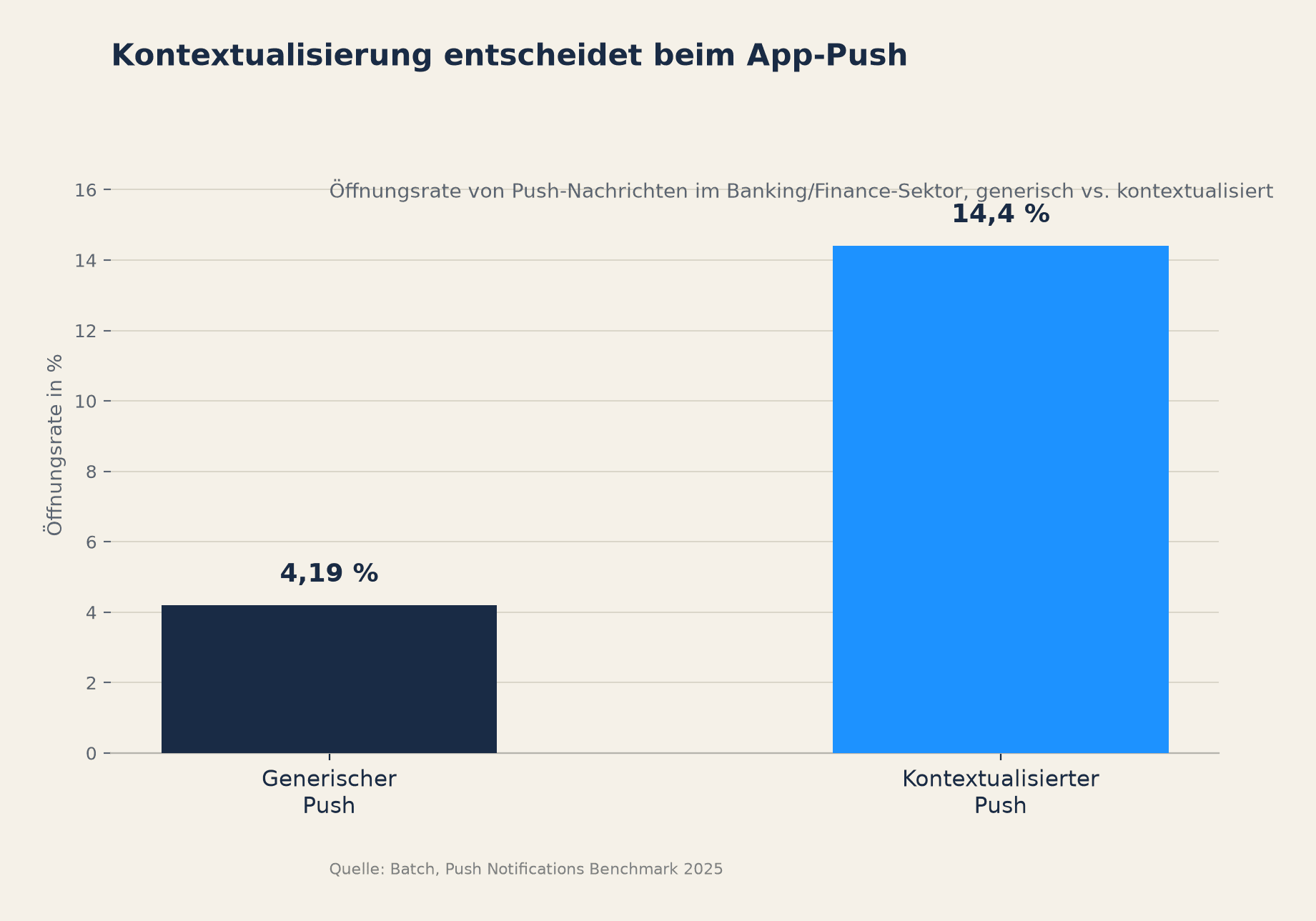
No other channel shows as clearly how much relevance determines impact as app push. Generic push notifications in the banking and finance sector achieve an average open rate of only 8.8% (Android) or 7.2% (iOS) — contextualized messages related to actual customer behavior, on the other hand, achieve 14.4% compared to 4.19% for purely generic pushes, which is more than three times as much (Batch: Push Notifications Benchmark 2025). Tight segmentation further enhances this effect: it can drive the click-through rate up to 9.35% — more than fourteen times the average —, and mere personalization with first names doubles the click-through rate (Pushwoosh). For an NBA engine, this is the key lesson: Push is the channel with the widest range between poor and good implementation, and it is precisely this range that can only be closed through precise, behavior-based targeting.
Channel Playbook for Next Best Action
The following overview ranks the five most important NBA playout channels by strength, latency, suitable format, and compliance requirements.
Channel | Strength | Latency | Format | Compliance Note |
|---|---|---|---|---|
Online Banking | High reach (89% usage), context of the ongoing login can be used | Immediately upon login | Discreet tile/banner, no pop-up forcing | Playout in the secure login area, no additional consent required for display alone, but keep contact frequency limits in mind |
App Push | Highest frequency (152 contacts/year according to Accenture), but only effective when contextualized (14.4% vs. 4.19% open rate) | Almost immediately, if opt-in exists | Short text, one Call-to-Action, deep link into the app | Opt-in rate is declining (Android 85%→67%); consent and unsubscribe option must be documented |
Established channel, sector open rate 31.35% / click rate 2.78% on average, significantly higher for triggered emails | Minutes to hours | More detailed, with justification and action steps | Advertising consent according to UWG/GDPR, unsubscribe link, documentation of the legal basis | |
Branch CRM/Advisor Queue | Lowest frequency (8 contacts/year), but highest trust role — 64% rely on the branch for conflict resolution | Next appointment/consultation | Conversation guide with score justification for the advisor | Explainability of the recommendation to advisor and customer particularly important (MaRisk AT 4.3.5 Tz. 6) |
SMS | Very high open rate (guideline 90–98%), but concise format | Immediately | Very short, mostly alert/reminder character | Highest barrier to consent, handle shipping costs and opt-in requirement particularly strictly |
Sources for the table: Deutsche Bundesbank, Bitkom, Accenture, Batch, Mailchimp, Emarsys/SAP, BaFin.
What channel choice has to do with AI acceptance
Channel choice is not just a question of technical reach, but also of the acceptance of AI-supported recommendations in themselves. A recent Bitkom survey shows a divided picture: 27% of respondents could imagine letting an AI make the majority of their financial decisions, while 49% fundamentally reject AI in financial matters; 56% see AI in the financial sector as an opportunity, 40% as a risk — with a clear age gap: 68% of 16- to 29-year-olds see opportunities, but only 35% of those over 65 (Bitkom: A quarter want to let AI decide on finances). For the channel strategy, it follows that: One and the same NBA recommendation should be formulated differently depending on the likely skepticism of the customer segment — more reserved and explaining more strongly in the digital channel for customers with lower AI acceptance, more direct for digitally savvy segments. This differentiation cannot be implemented without an understanding of channel and target group preferences, as described in Part 1 of this series.
The branch remains a case of its own
Despite falling contact frequency, the branch is not an expiring channel for NBA — it is a different one. According to Accenture, 65% of customers continue to see branches as a symbol of stability, even though the number of branches in Europe has fallen by 40% over the last decade (Accenture Global Banking Consumer Study 2025). For the NBA logic, this means: instead of playing out every recommendation digitally, a portion of the high-value, advice-intensive recommendations — such as complex financing or pension products — must flow specifically into the advisor queue of a CRM system, including a justification of the score that is comprehensible to the advisor. This explainability to the advisor is ultimately the same requirement that MaRisk AT 4.3.5 Tz. 6 places on the regulator (BaFin) — except that here it must be fulfilled directly in the customer conversation.
Email and SMS as a supplement, not a replacement
Despite declining attention, email remains an important channel for more detailed NBA messages that need justification and several action steps — the sector average for Business & Finance is 31.35% open rate and 2.78% click rate (Mailchimp Email Marketing Benchmarks), while current omnichannel benchmarks for 2026 show a B2C open rate of 40.0% (Emarsys/SAP: Omnichannel Engagement Benchmarks for 2026). According to the same benchmarks, SMS achieves open rates of 90–98% with a concise format — suitable for time-critical, short NBA impulses such as due date reminders, but not for product recommendations requiring explanation.
How Acceleraid implements cross-channel playout
Acceleraid's CLM/CVM orchestration translates a single NBA recommendation into the format appropriate for each channel and plays it out in real time in online banking, app, email, and branch CRM (Platform). Contact frequency limits and channel preferences are an integral part of the orchestration, ensuring that a customer is not addressed with the same message through multiple channels at the same time (Banking). This capability is the practical response to the channel heterogeneity described in this article: One and the same recommendation needs five different implementations.
Conclusion
Channel choice is not a downstream detail of NBA logic, but part of the decision itself. Data from the Bundesbank, Bitkom, and Accenture show a clear trend toward online banking and apps as primary touchpoints, while the branch is becoming rarer but symbolically more significant. Anyone who does not map these differences in strength, latency, and compliance requirements wastes a large part of the uplift that contextualization — as shown by the push example — can achieve. The third and final part of this series will focus on the data source that makes this contextualization possible in the first place: transaction data.
Illustration: AI-generated. AI-assisted content: In creating our posts, we use AI technologies and automated agents, including those from Microsoft, Google, OpenAI, Anthropic, and other providers. Topics, technical direction, and final approval lie with our team.
Further Insights
We use cookies 🍪
Strictly necessary cookies (e.g. Pipedrive forms) remain active. With your consent, we also use Google Analytics (analytics) and Leadfeeder (visitor identification). Learn more in our Privacy Policy.