AI & Banking
Perplexity instead of three subscriptions? What multi-model platforms really cost
$60 for three individual subscriptions or $20 for a single platform? The cost analysis for Perplexity, you.com, and Poe – for personal and business use.
•
acceleraid Editorial Team
5 min read
01
Acquire
Recognize signals
02
Onboard
Control activation
03
Grow
Next Best Action
04
Retain
Reduce churn
05
Reactivate
Reclaim potential

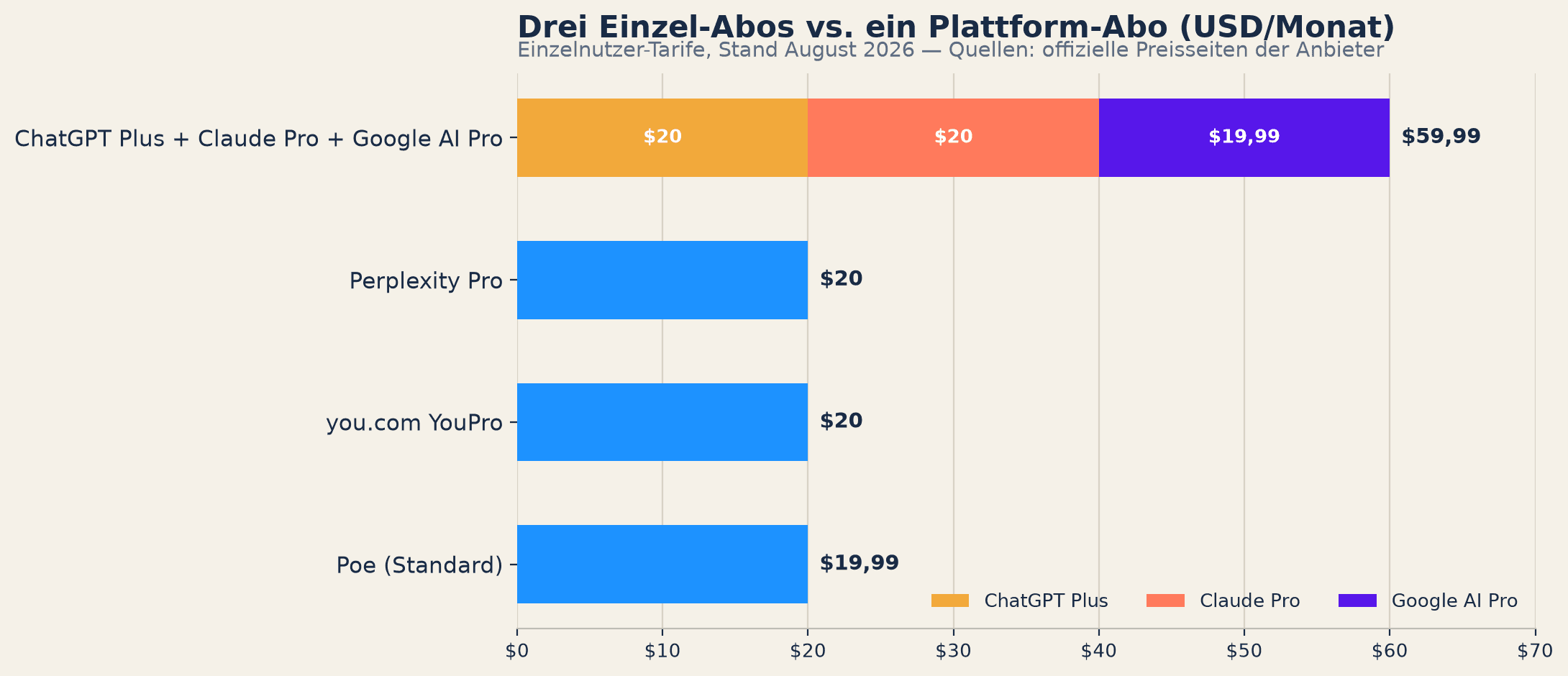
Anyone who wants to use the best AI models today faces a simple math problem: ChatGPT Plus costs 20 USD a month, Claude Pro 17 to 20 USD, Google AI Pro 19.99 USD. Anyone who subscribes to all three providers pays 57 to 60 USD per month and person — and manages three accounts, three invoices, and three privacy policies. Multi-model platforms like Perplexity, you.com, or Poe promise the same spectrum of models in a single subscription for around 20 USD. What is the truth behind this calculation, where are the catches, and what does the comparison look like at the enterprise level?
The Calculation at the Single-User Level
The price difference is real. Perplexity Pro costs 20 USD per month or 200 USD per year and, according to the official Help Center, includes selectable models from OpenAI (GPT-5.2), Anthropic (Claude Sonnet 4.6), Google (Gemini 3.1 Pro), and xAI (Grok 4) as well as its own Sonar model. With YouPro, you.com offers a comparable package for 20 USD monthly (15 USD with annual payment); Poe by Quora bundles models from all major providers via a points system starting at 19.99 USD in the standard tariff. Compared to the triple combination of individual subscriptions, a platform subscription therefore saves around two-thirds of the costs — a comparison test shows exactly this 60-versus-20-dollar calculation.
However, you should not rely on these terms permanently: aggregators constantly adjust their quotas. At the end of March 2026, for example, Poe cut the daily free points allowance from 3,000 to 300 points — anyone who seriously wants to use the platforms cannot avoid the paid tariff.
The catch lies in the usage limits. The platform subscription does not include the full contingent of each individual provider, but rather limited queries per model. For users who work intensively with a single model daily, a direct subscription to the respective provider may remain the better choice. As a rule of thumb from practice: those who regularly use three or more top models in parallel fare cheaper with the platform; those who intensively use only one or two models fare better with a direct subscription. In addition: provider-specific functions beyond the pure model — such as deep Office integrations or proprietary work environments — are naturally not fully replicated by an aggregation platform.
At the Enterprise Level, It Gets Complicated
For organizations, the calculation shifts — and at the same time becomes more urgent. The corporate tariffs of the individual providers are close to each other: ChatGPT Business costs 25 USD per user and month (20 USD with annual payment), Claude Team starts at 20 USD per user, Microsoft 365 Copilot costs 30 USD per user and month as an enterprise add-on. Perplexity Enterprise Pro is higher at 40 USD per seat — but in return includes access to models from multiple providers, SSO, SOC 2 Type II, and the assurance that customer data is not used for model training.
However, the real problem for companies is rarely the single seat price — it is the uncontrolled accumulation. The Zylo 2026 SaaS Management Index measures a 108 percent year-over-year growth in spending on AI-native applications, and even 393 percent for large enterprises with over 10,000 employees; the average organization now spends 1.2 million USD per year on AI-native applications. 78 percent of surveyed IT leaders report unexpected costs from consumption-based AI pricing models, and 61 percent have already had to scale back projects as a result.
The figures on tool fragmentation paint the same picture: according to Cledara, an average company pays for 4.5 different AI tools, in individual cases up to 16; AI tools already accounted for 29 percent of all new software subscriptions in early 2026. A Zapier survey of 550 companies found that 30 percent spend money on redundant AI software and only 35 percent have regulated approval processes. Anyone licensing three chat subscriptions, two coding assistants, and one research tool in parallel pays multiple times for overlapping functions — and in the process loses track of which data ends up in which service.
Offer | Level | Price (USD/month) |
|---|---|---|
ChatGPT Plus | Single user | 20 |
Claude Pro | Single user | 17–20 |
Google AI Pro | Single user | 19.99 |
Three individual subscriptions combined | Single user | 57–60 |
Perplexity Pro | Single user | 20 |
you.com YouPro | Single user | 20 (15 with annual payment) |
Poe (Standard) | Single user | from 19.99 |
ChatGPT Business | Enterprise, per seat | 25 (20 with annual payment) |
Claude Team | Enterprise, per seat | from 20 |
Microsoft 365 Copilot | Enterprise, per seat | 30 |
Perplexity Enterprise Pro | Enterprise, per seat | 40 |
Perplexity Enterprise Max | Enterprise, per seat | 325 |
As of August 2026; Sources: the official pricing pages linked in the text.
Consolidation Saves — But Not Automatically
The obvious answer is consolidation: one contract, one login, one privacy check, one admin panel instead of many. In addition to price, governance arguments in particular support this — centralized user management via SSO and SCIM, uniform auditability, and a single place where data retention is configured. It is precisely these features that separate the enterprise tariffs of the platforms from the shadow IT of private individual subscriptions, which has long been a reality in many institutions.
However, three limitations belong in any honest assessment. First, aggregation platforms do not always cover the needs of specialist roles — a development team will rarely want to do without its dedicated coding tool. Second, the higher-value platform tariffs themselves are not cheap: Perplexity Enterprise Max is 325 USD per seat and month and is only worthwhile for user groups that actually exhaust the advanced models and quotas. Third, the data situation for some providers remains thin — for example, current team prices for you.com are not published on the official pricing page, making a reliable call for tenders difficult. Consolidation is therefore not a self-runner, but a portfolio decision: which roles need which tools, and where is shared access via a platform sufficient?
The Same Logic Applies One Level Deeper
It is remarkable that behind the subscription question lies an architectural principle that extends beyond chat interfaces: the value is not in access to the individual model, but in the layer above it — where user management, knowledge, and work contexts converge. A platform can swap models without users having to change their way of working. This is exactly the principle we have transferred to our Assistant at Acceleraid: it is built to be model-agnostic, the underlying language model can be changed at any time — while knowledge, contexts, and configurations are fully preserved. For banks and financial service providers, this means that the choice of model becomes a reversible setting rather than a strategic commitment, and price shifts between providers can be exploited rather than waited out.
The subscription landscape will continue to shift — prices, quotas, and model lists change quarterly for all providers. Anyone facing a consolidation decision should therefore look less at today's price comparison and more at three questions: How many overlapping AI subscriptions are we actually paying for today? Which of them meet our governance requirements? And how quickly could we switch if the calculation flips?
Illustration: AI-generated. AI-supported content: In creating our articles, we use AI technologies and automated agents, including those from Microsoft, Google, OpenAI, Anthropic, and other providers. Topics, editorial direction, and final approval lie with our team.
Further Insights
We use cookies 🍪
Strictly necessary cookies (e.g. Pipedrive forms) remain active. With your consent, we also use Google Analytics (analytics) and Leadfeeder (visitor identification). Learn more in our Privacy Policy.