AI & Banking
Model independence: Why your AI stack must not belong to a single model
The model market is fragmenting faster than contracts are running. Why model independence is a design principle — and knowledge must survive the transition.
•
acceleraid Editorial Team
5 min read
01
Acquire
Recognize signals
02
Onboard
Control activation
03
Grow
Next Best Action
04
Retain
Reduce churn
05
Reactivate
Reclaim potential
Hardly any decision in the corporate IT portfolio currently ages as quickly as committing to a single AI model. In 2025 alone, the leading AI labs released dozens of new models, and the top spot in performance, price, and speed changed hands several times. In July 2026, Bloomberg reported that Microsoft had begun switching parts of the AI requests in Excel and Outlook to its own MAI models — applications that previously ran on OpenAI and Anthropic. When even the world's largest software corporation swaps its model base during ongoing operations, the message for everyone else is clear: The model is a component, not a fundamental decision. Anyone building their architecture differently is making the riskiest bet in the current technology market.
The market is fragmenting faster than contracts run
Even at the beginning of 2025, according to analyses by Perplexity, more than 90 percent of corporate usage was concentrated on just two top models. Over the course of the year, 43.6 percent of organizations were already using more than one model — and the trend is rising. The reasons are practical, not ideological: models are increasingly differing depending on the task. One model leads in complex reasoning, another in long contexts, a third in speed and cost. The idea that a single model could be the best choice for all use cases over years has been empirically debunked.
In addition, there is the opposite direction: the providers themselves are also shifting their foundations. Pricing models change, model versions are discontinued, terms of use are adjusted. Anyone who has developed directly against the proprietary quirks of a single provider inherits their roadmap — including all decisions that are not in their own interest.
Lock-in is an architectural decision, not provider behavior
The most important finding from two years of corporate AI is: organizations rarely fall into lock-in because a provider locks them in — but because they couple their workflows directly to its proprietary functions, formats, and platform services. Every convenient special function that is adopted without an abstraction layer — provider-specific storage, hosted agents, proprietary file repositories — is another strand in the rope. Trivial individually, binding in total.
Model independence explicitly does not mean using every model. It means being able to switch the primary model in weeks instead of quarters without rewriting workflows. The way to get there is through ownership at the right levels: your own prompts and workflows, your own evaluation datasets, your own data pipelines — and the model behind them as an exchangeable component behind an interface.
The actual value layer: knowledge that survives the switch
What makes the switch expensive in practice? Rarely the API connection — that is switched over in days. It gets expensive where implicit knowledge is trapped in the provider's system: conversation histories, learned preferences, painstakingly balanced prompts, evaluation benchmarks, connected data sources. If this knowledge is tied to the model, every model change starts from scratch.
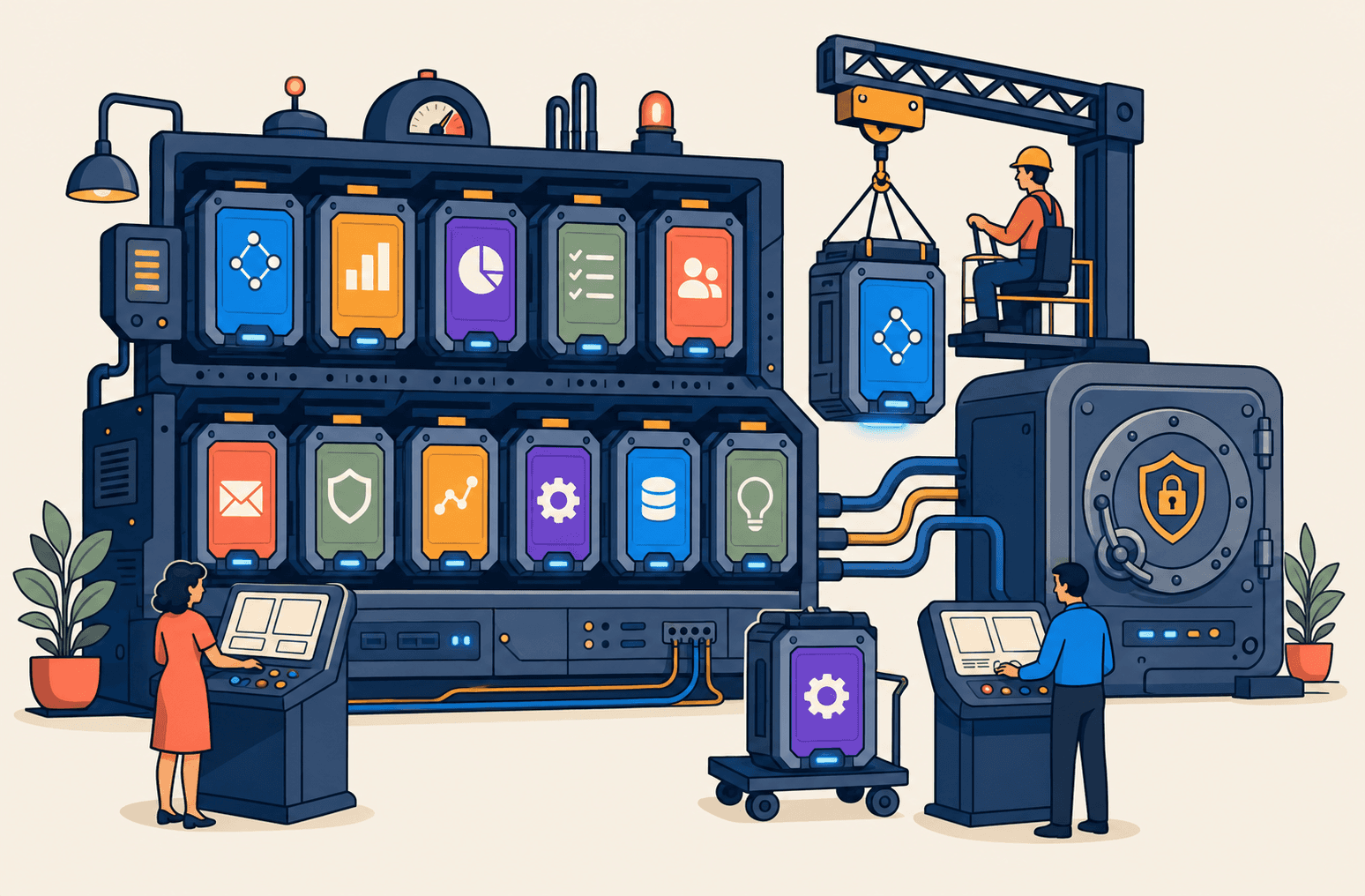
The consequence for the architecture is clear: the knowledge layer must be separated from the model. Contexts, customer data, business logic, and evaluations live in their own layer that any model can access — and which is preserved when the model underneath is replaced. We built the acceleraid Assistant according to exactly this principle: it is model-agnostic, the model used can be changed at any time, and the accumulated knowledge — configurations, contexts, connected data — is fully preserved. The model change is thus transformed from a migration decision into a setting.
What model independence additionally achieves in the financial sector
For banks and financial service providers, the principle has a second, regulatory dimension. Exit strategies for critical IT service providers are firmly anchored in European financial regulation — since DORA, this explicitly also applies to dealing with concentration risks with third-party providers. An AI stack that is provably model-independent answers the exit question structurally rather than documentarily: the switch is not an emergency plan in a folder, but a proven property of the architecture.
The cost side also speaks the same language. The price differences between models of comparable quality are significant and constantly changing. Organizations that can flexibly assign tasks to the respective fitting model negotiate from a different position — and automatically benefit when a new provider drives down the price level.
From principle to practice: three levers
In implementation, model independence is less of a major project than a question of discipline in three areas. First, the interface: All applications speak to an internal model interface, never directly to the provider — the change then takes place in exactly one spot, not in dozens of integrations. Second, the evaluation: Your own versioned set of test cases from real use cases makes new models comparable in days; without it, every model decision remains a gut feeling, and generic leaderboards are no substitute because they do not know your specific tasks. Third, procurement: Contracts with model providers should design terms, data usage rights, and termination periods in such a way that architectural freedom is not commercially clawed back. The effort involved is predominantly a one-off: Once the interface is established and the evaluation basis is built, every subsequent model switch becomes cheaper than the previous one — and the exception becomes routine.
Four touchstones for your own organization
Whether an AI landscape is actually model-independent can be honestly answered with four questions:
Could we change our main model within four weeks? If the answer needs explanations, it is no.
Do we own our evaluation data? Without your own test cases and quality benchmarks, a new model cannot be seriously evaluated — switching providers remains a flight in the dark.
Where does the knowledge lie? Prompts, contexts, and connected data belong in a layer that survives the model switch.
Do we actually test the switch? Portability that has never been rehearsed is just an assumption. Regular comparative runs with alternative models keep the option real.
Contextualization
The model question will not settle down in the coming years — rather the opposite: open-weight models are catching up to the top, hyperscalers are opening their catalogs, and labs are competing harder than ever before. For user companies, this is good news, but only if their own architecture can actually deliver on freedom of choice. Model independence is the entry ticket for this: not a feature, but a design principle. Those who anchor it early transform the volatility of the model market from a risk into a permanent negotiating and cost advantage.
Illustration: AI-generated. AI-supported content: In creating our posts, we use AI technologies and automated agents, including those from Microsoft, Google, OpenAI, Anthropic, and other providers. Topics, professional orientation, and final approval rest with our team.
Further Insights
We use cookies 🍪
Strictly necessary cookies (e.g. Pipedrive forms) remain active. With your consent, we also use Google Analytics (analytics) and Leadfeeder (visitor identification). Learn more in our Privacy Policy.