AI & Banking
The model is replaceable, the knowledge is not: What Perplexity, you.com, and others are demonstrating
Perplexity, you.com and others show: The model is replaceable, the knowledge is not. Why the knowledge layer is the real capital.
•
acceleraid Editorial Team
5 min read
01
Acquire
Recognize signals
02
Onboard
Control activation
03
Grow
Next Best Action
04
Retain
Reduce churn
05
Reactivate
Reclaim potential
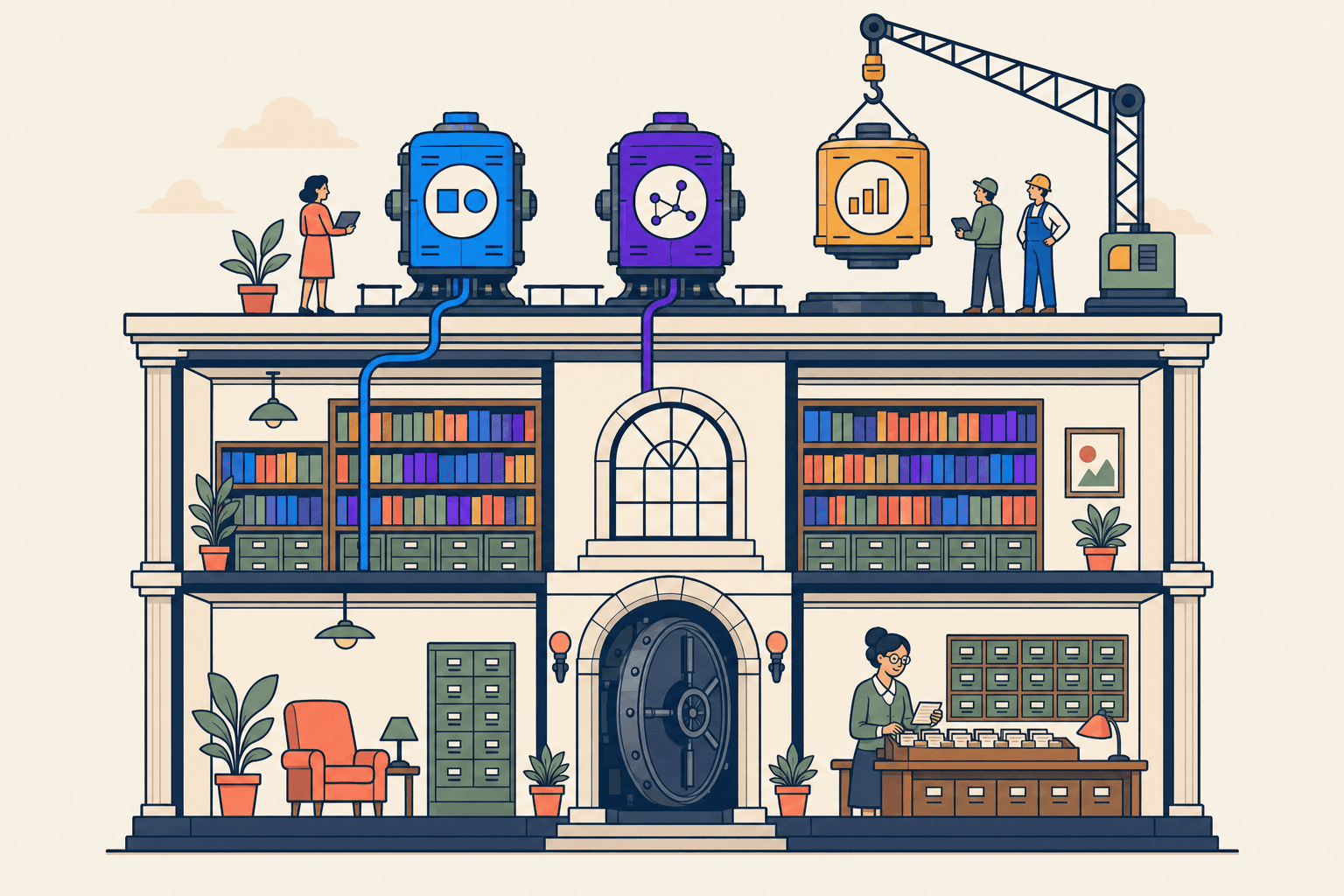
The most interesting shift in the AI market of 2026 is not taking place between model providers, but above them. A new layer of services has established itself whose business model is precisely not to own the best model — but to make every model usable. In its computer agent system, Perplexity orchestrates around 20 models from different providers and lets them switch depending on the task; with the Model Council, queries even run in parallel across several top models, whose answers are merged by a synthesis model. you.com positions itself as a model-agnostic enterprise platform that routes every query to the appropriate model — Claude, OpenAI, Llama, or Grok. The message of these services is the same, and it is strategically remarkable: The model is interchangeable. The value lies elsewhere.
Why the Orchestration Layer Wins
Behind this approach is an empirical observation that is clearly evident in the usage data of providers: The performance of top models varies significantly depending on the task. One model leads in deep reasoning, another in long contexts, a third in speed and cost, a fourth in image or video generation. In 2025 alone, dozens of new models came onto the market; no single one held the top position across all disciplines. Anyone who commits to one model is therefore second-rate in most disciplines — and on the losing side with every shift in leadership.
The orchestration services draw the logical conclusion from this: They treat models as interchangeable labor and shift the intelligence to the mediation layer — which model gets which task, with which context, at what cost. This logic has reached the market remarkably quickly: According to Perplexity data, around 44 percent of corporate organizations were already using more than one model by 2025, after two models had dominated over 90 percent of usage at the beginning of the year.
The Real Insight: Only the Knowledge Layer is Constant
For corporate decision-makers, the interesting aspect of these services is less the individual product than the architectural principle behind it. If models can change monthly, the question arises: what actually remains? The answer: everything the company itself contributes. The connected data sources. The built-up contexts and configurations. The prompts and workflows. The evaluation standards with which quality is measured. The history of what has worked. In short: the knowledge.
This knowledge layer is the actual capital of an AI deployment — and it is all the more valuable the more consistently it is separated from the model. If it depends on the model of a single provider, every change starts from scratch, and theoretical freedom of choice becomes practical captivity. If it resides in its own layer, switching models becomes a routine setting: The new model steps in, the knowledge remains.
The Same Principle in the Customer Lifecycle
We built the acceleraid Assistant from the ground up according to precisely this principle. It is model-agnostic: Which language model works in the background is a configuration decision, not a system decision. Customers can change the model at any time — because a new model is better or cheaper, because internal guidelines require it, or because a provider changes its terms. The accumulated knowledge is fully preserved: the connected data sources, the contexts, the configurations, the established workflows. The Assistant is not reset by the model change, but simply uses a different tool — with the same knowledge.
In customer lifecycle management, this separation is particularly consequential because this is where value is generated from continuity: from the understanding of customer segments, signals, and effective measures built up over time. Coupling this understanding to the lifespan of a single model would be negligent — model generations now change faster than campaign cycles.
Orchestration is More Than Routing
A look at the services also shows what is practically involved in model diversity — and what DIY approaches often underestimate. A model change only becomes a setting when three capabilities come together. First, ongoing evaluation: New models must be tested against your own tasks, not against generic leaderboards — what leads on paper can disappoint in a concrete use case. Second, cost control: If tasks are automatically assigned to the cheapest sufficient model, a lasting efficiency gain is created; if, on the other hand, every query runs to the most expensive model, you pay for diversity without benefit. Third, traceability: Especially in regulated industries, it must be documented which model processed which task with which context — otherwise flexibility becomes an audit problem. These three capabilities — evaluation, cost routing, logging — are the real core of the orchestration layer; model routing is only its most visible result. For decision-makers, this means: Anyone evaluating model-agnostic services should closely examine this machinery, not the length of the model list. Twenty connectable models without an evaluation and control layer are not independence, but merely selection.
What Decision-Makers Should Look For in Model-Agnostic Services
The term "model-agnostic" has become a marketing buzzword. Whether there is substance behind it is shown by four test questions:
What exactly is preserved during a model change? The honest answer should be: everything except the model. Contexts, data, configurations, history.
How quickly are new models available? An agnostic claim that lags behind new models for months is not one.
Who decides on the routing? Transparency about which model is used, when, and why is a prerequisite for governance — especially in regulated industries.
Where does the data reside? Model freedom without clear data management only shifts the problem. The knowledge layer needs the same governance standard as any other core system.
Assessment
The service layer above the models — from Perplexity and you.com to specialized enterprise assistants — is not a fad, but the logical response to a market in which no single model leads permanently. For user companies, it is the most practical form of model independence: freedom of choice as an built-in feature rather than a migration project. The guiding question for any selection is not "Which model is the best?", but rather: "Does our knowledge remain our knowledge — no matter which model is currently working?" Anyone who can answer this question with yes has permanently defused the model question.
Illustration: AI-generated. AI-supported content: In creating our articles, we use AI technologies and automated agents, including those from Microsoft, Google, OpenAI, Anthropic, and other providers. Topics, professional orientation, and final approval rest with our team.
Further Insights
We use cookies 🍪
Strictly necessary cookies (e.g. Pipedrive forms) remain active. With your consent, we also use Google Analytics (analytics) and Leadfeeder (visitor identification). Learn more in our Privacy Policy.