Regulation & Compliance
Labeling obligation for AI content: What Article 50 of the EU AI Act actually requires
Art. 50 of the AI Act does not require a blanket AI labeling. An explainer on technical marking, deepfake disclosure, and deadlines.
•
acceleraid Editorial Team
7 min. read
01
Acquire
Recognize signals
02
Onboard
Control activation
03
Grow
Next Best Action
04
Retain
Reduce churn
05
Reactivate
Reclaim potential

Since yesterday, August 2, 2026, a regulation has been in force across the entire EU that has caused significant uncertainty in recent weeks: Article 50 of Regulation (EU) 2024/1689, better known as the EU AI Act. Since then, many companies have been wondering whether every AI-generated image and every AI-supported text must now be visibly marked with a label such as "AI-generated". The answer is: no — and the distinction as to why this is the case is the core of this article.
The AI Act precisely does not demand a general, visible labeling of all AI content. Rather, it distinguishes between two completely different obligations with different addressees: a technical marking that falls upon the provider of an AI system, and a disclosure obligation that falls upon the user or publisher. Anyone who is not aware of this distinction is likely to significantly overestimate their obligations in most cases — or, in individual cases, overlook the exact situation in which disclosure is actually required. The full text of the regulation is available on EUR-Lex, and the current consolidated version following the latest amendments can be found in the consolidated version of July 27, 2026.
1. Technical labeling of all synthetic content — Art. 50 Para. 2
The first obligation is not directed at companies that use AI tools, but at the providers of these systems themselves — i.e., companies like OpenAI, Google, or Adobe that provide models for generating audio, image, video, or text content. Art. 50 Para. 2 requires that the outputs of such systems are "marked in a machine-readable format and detectable as artificially generated or manipulated". The key word is "machine-readable": this refers to technical methods such as metadata, watermarks, or cryptographic provenance features — not a human-visible caption or text highlight.
In doing so, the provider must ensure that the technical solution is "effective, interoperable, robust, and reliable" as far as this is technically feasible — the regulation explicitly takes into account costs, the state of the art, and the specific characteristics of different types of content. Two practically important exceptions also apply: The obligation is waived if an AI system merely performs a supporting function in standard editing, or if it does not significantly alter the input data or its meaning. Therefore, anyone who uses an AI tool only for spell checking or minor exposure adjustment does not trigger a labeling obligation under Para. 2 — if only because this obligation lies with the system provider and not the user anyway.
For the practical operations of companies that merely deploy AI tools, this means: Art. 50 Para. 2 is generally not an independent compliance issue. Technical marking is the responsibility of the model providers, not the users.
2. Visible disclosure for deepfakes — Art. 50 Para. 4 Subparagraph 1
The second, significantly more practically relevant obligation concerns deployers or users of AI systems — i.e., those who actually publish or use a generated content. According to Art. 50 Para. 4 Subparagraph 1, deployers who generate or manipulate image, audio, or video content that constitutes a deepfake must disclose that the content has been artificially generated or manipulated.
The decisive factor here is the definition of a deepfake in Art. 3 No. 60: A deepfake is "AI-generated or manipulated image, audio, or video content that resembles existing persons, objects, places, entities, or events and would falsely appear to a person to be authentic or truthful". This definition is deliberately narrow and specifically does not cover every AI-generated image, but only content with a concrete reference to reality and potential for deception. A realistic AI image of a real person, a manipulated video of a board member or politician, a synthetic voice assigned to a real person, or the representation of an event that never took place — these are the classic use cases. A purely fictional, obviously stylized illustrative motif with no connection to a real person or real event, on the other hand, typically does not fall under this definition.
For artistic, creative, satirical, or fictional works, the regulation provides relief: here, disclosure may be made "in an appropriate manner" and must not impede the display or enjoyment of the work. The legislator does not prescribe a specific phrasing or positioning — labels such as "AI-generated image", "This image was created using artificial intelligence", or "Synthetic representation – not an authentic recording" are permissible. The only critical factor is that the disclosure complies with the requirements of Para. 5 (see below).
3. Texts: Disclosure obligation only in specific cases — Art. 50 Para. 4 Subparagraph 2
A narrower rule applies to texts. Art. 50 Para. 4 Subparagraph 2 obligates deployers who publish a text to inform the public on matters of public interest to disclose that "the text has been artificially generated or manipulated". Two conditions must be met cumulatively for this: First, the text must be published, and second, it must serve to inform the public on a matter of public interest — such as journalistic, political, social, economic, or official topics.
The key exception, which is particularly relevant for corporate blogs like this one, follows immediately in the subsequent wording: No labeling is required if the content has undergone a human review or editorial control and a natural or legal person holds editorial responsibility for the publication. If both conditions are met, the obligation under Para. 4 Subparagraph 2 is completely waived — regardless of the extent to which AI tools assisted in the text generation.
For corporate practice, it follows that: Pure promotional texts, product descriptions, landing pages, or general corporate communications are typically not subject to any labeling obligation under Art. 50 Para. 4 anyway, as they do not usually concern a matter of public interest within the meaning of the regulation. And even for content that does reach this threshold — such as a blog post on a regulatory development like this one —, the obligation is waived as soon as a human has reviewed the content and carries editorial responsibility for it.
4. How must disclosure be made? — Art. 50 Para. 5
Where a disclosure obligation actually exists, Art. 50 Para. 5 regulates how it is to be fulfilled. The relevant information must be provided "in a clear and distinguished manner", at the latest at the time of the first interaction or exposure, and must be accessible to people with disabilities. The regulation does not prescribe a specific phrasing, font size, color, or position — but it does require that the notice is perceptible where the audience can actually see it. A notice hidden exclusively in the terms and conditions or only in invisible metadata does not meet this requirement if disclosure to the public is necessary.
These requirements are important for practice: anyone who must disclose must do so in a way that the information actually gets through — but at the same time, they have considerable creative freedom in how they implement this.
Summary of Results
The following table summarizes when a visible labeling obligation under Art. 50 actually applies:
Content | Visible labeling required? |
|---|---|
Normal illustrative AI image without deceptive character | Generally no; technical labeling by system provider |
Realistic-looking image of a real person / apparently real event | Yes, if a deepfake |
Artistic/satirical deepfake | Yes, but unobtrusive disclosure permissible |
Fully automatically published AI text on matters of public interest | Yes |
AI text with human review and editorial responsibility | No |
AI-supported corporate/marketing/product text | Typically no |
Pure spelling/translation/standard editing | Typically no obligation |
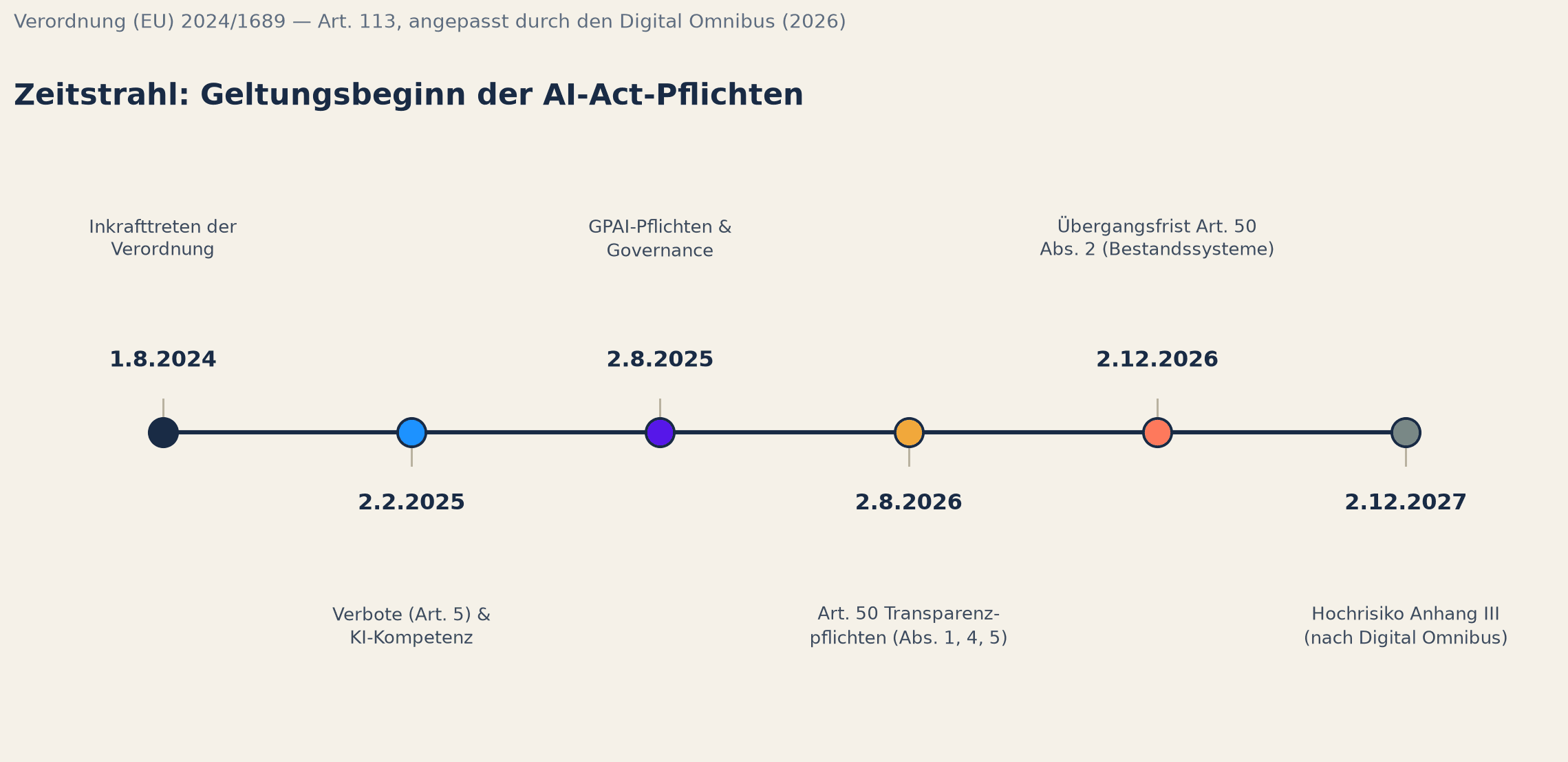
Regarding the timeline: The general transparency obligations from Art. 50 — including the disclosure obligation for deepfakes under Para. 4 and the implementation requirements under Para. 5 — have applied since August 2, 2026, the general date of application of the regulation according to Art. 113. For the technical labeling obligation of providers under Para. 2, a four-month transition period until December 2, 2026, applies to systems that were already on the market before this date — a refinement that was decided as part of the so-called Digital Omnibus without affecting the remaining paragraphs of Art. 50.
How Acceleraid implements this
At Acceleraid, we also use AI tools and automated agents to create our blog posts — from research drafts to text elaboration. According to the system described above, there is no obligation for visible labeling: topic selection, professional alignment, and final approval of each post lie with our editorial team, which holds editorial responsibility within the meaning of Art. 50 Para. 4 Subparagraph 2. Nevertheless, we voluntarily indicate the use of AI technologies at the end of each post — not because the regulation requires it, but because we believe transparency towards our readers is valuable.
This stance on transparency and comprehensible processes also extends to our product: the Acceleraid Assistant is deliberately built to be model-agnostic. The underlying AI model can be changed at any time without losing knowledge, context, or configurations. Anyone who wants to keep an eye on regulatory developments like these benefits from an architecture that is not tied to a single provider or model.
Checklist Questions for Your Own Practice
Does our company deploy AI systems that generate or manipulate image, audio, or video content that could resemble a real person or a real event?
Do we publish texts that inform the public on matters of public interest without a documented human review taking place?
Is it clearly defined within our company who holds editorial responsibility for published AI-supported content?
Does our disclosure practice — if required — meet the requirements of Art. 50 Para. 5 regarding clarity, distinctness, and accessibility?
This article is for general information purposes only and does not constitute legal advice.
Illustration: AI-generated. AI-supported content: In creating our posts, we use AI technologies and automated agents, including those from Microsoft, Google, OpenAI, Anthropic, and other providers. Topics, professional alignment, and final approval lie with our team.
Further Insights
We use cookies 🍪
Strictly necessary cookies (e.g. Pipedrive forms) remain active. With your consent, we also use Google Analytics (analytics) and Leadfeeder (visitor identification). Learn more in our Privacy Policy.