Data & Technology
From Cloud Lock-In to Freedom of Choice: Hyperscaler Model Catalogs and Europe's Sovereign Alternatives
GPT on AWS, Claude at Microsoft: The model catalogs are open. What the new freedom of choice means for banks — and where Europe is becoming sovereign.
•
acceleraid Editorial Team
5 min read
01
Acquire
Recognize signals
02
Onboard
Control activation
03
Grow
Next Best Action
04
Retain
Reduce churn
05
Reactivate
Reclaim potential
For years, a simple map applied to enterprise AI: if you wanted GPT, you went to Microsoft Azure. If you wanted Claude, you went to AWS. The choice of cloud determined access to the model — and tied both together. Since the summer of 2026, this map is history. On June 1st, AWS announced the general availability of OpenAI's GPT-5.5, GPT-5.4, and Codex on Amazon Bedrock; a few weeks later, Anthropic's Claude models became generally available in Microsoft's Foundry platform. Both frontier families now run on both platforms. The era in which you chose a cloud to reach a lab is effectively over — and that fundamentally changes the bargaining position of user enterprises.
Model catalogs instead of exclusive contracts
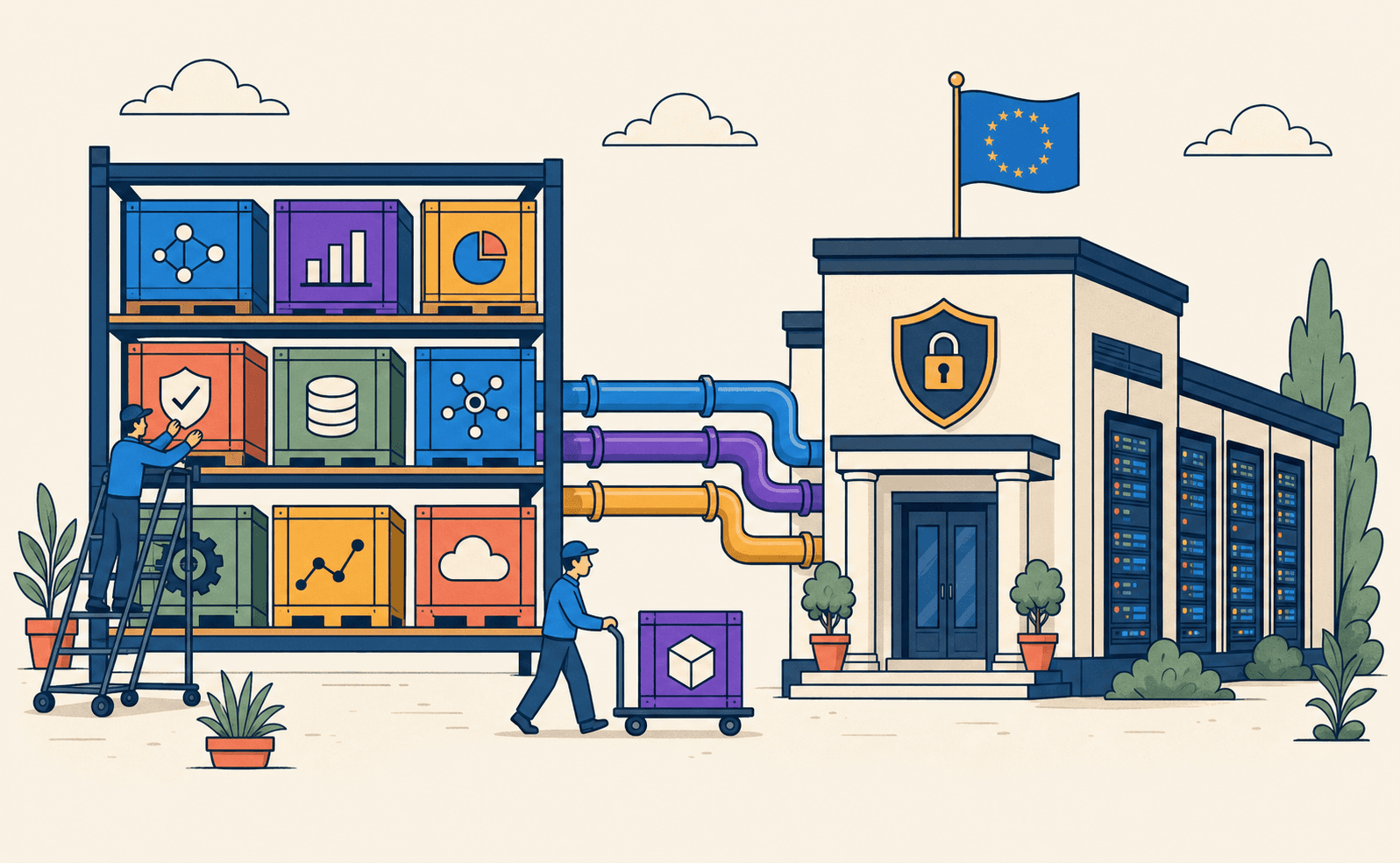
The hyperscalers are thus finally positioning themselves as model marketplaces. According to its own documentation, Microsoft's Foundry carries over 1,900 models, from OpenAI to Anthropic, Meta, Mistral, and DeepSeek to a deep Hugging Face integration. Amazon Bedrock relies on a curated catalog, which now bundles 18 providers and well over 100 individually addressable model variants behind a single, unified API. Google's Vertex AI pursues the same approach with its Model Garden and is considered particularly open to different models.
For businesses, this is structurally good news: models from different labs can be compared and switched within the same governance boundary — with unified identity management, unified billing, and a unified audit trail. Switching models no longer requires switching clouds. This dramatically reduces the switching costs at the model level.
The trap one level deeper
However, that is precisely where the new trap lies: the lock-in shifts from the model to the platform. Those who integrate their AI workflows deeply into a hyperscaler's proprietary agent frameworks, data formats, and additional services have traded model lock-in for platform lock-in — which is heavier because it encompasses the entire data and process landscape. The lesson from the model level applies unchanged one level higher: portability does not arise from the provider's promise, but from your own architecture. Having your own prompts, your own evaluation datasets, a platform-neutral knowledge layer, and standardized interfaces is the insurance policy you buy before you need it.
Europe's answer: sovereignty becomes measurable
In parallel with the opening of the catalogs, the European regulatory framework has accelerated. In June 2026, the European Commission presented the Cloud and AI Development Act as the centerpiece of its technology sovereignty package. For the first time, it creates a uniform, auditable framework that allows cloud services to be assessed across four sovereignty levels — from self-declaration to a fully sovereign service — and aims to triple European data center capacity by 2030.
The market is reacting from two sides. Hyperscalers are building sovereign offerings: AWS put its European Sovereign Cloud into operation in January 2026 — an independent infrastructure operated entirely within the EU. At the same time, in April, the Commission targeted cloud framework contracts specifically at European providers such as STACKIT from the Schwarz Group, Scaleway, and a consortium led by OVHcloud — explicitly to avoid dependencies on individual providers. For regulated industries, this creates a genuine spectrum of sourcing paths: hyperscaler catalog, sovereign hyperscaler region, European cloud provider, or in-house operation of open-weight models.
Price competition and new bargaining power
The most immediate consequence of the open catalogs is commercial. When the same models are available across multiple platforms and alternatives are only an API call away, exclusivity and bundling lose their power as pricing arguments. For the first time, user enterprises can tender model performance like a tradable resource: same task, same quality benchmark, comparing multiple providers. This disciplines prices on both levels — for the model as well as for the platform. In addition, the rise of powerful open-weight models exerts pressure from below: wherever an open model delivers the required quality, it defines the price ceiling for any proprietary offering. The scales are significant: between top models and capable mid-range models, token prices regularly differ by factors, not percentage points.
Procurement departments that build this dynamic into their contract cycles — shorter terms, benchmark clauses, defined switching paths — translate market competition directly into their own cost curve. The prerequisite here, too, is technical switchability: without it, every benchmark clause remains a blunt sword, because the other party knows that the switch cannot be meant seriously. And the platforms themselves are also in stronger competition: those who merely pass models through must differentiate themselves via operations, security, integration depth, and price — a competition from which users benefit in every dimension.
What this means specifically for banks
For financial institutions, this new freedom of choice translates into three practical consequences:
The model strategy can be decoupled from the cloud strategy. The question "Which model?" no longer has to be answered with "Which cloud?". This allows for cleaner decisions: cloud according to governance, cost, and integration criteria; model according to task and performance.
Concentration risks can be addressed structurally. DORA requires institutions to consciously manage dependencies on critical ICT third-party providers. A setup that can source models via multiple delivery channels — and has demonstrably mastered the switch — answers this requirement better than any contractual agreement.
Sovereignty becomes a graduated decision instead of a leap of faith. Not every workload needs the highest level of sovereignty. A credit process involving sensitive data has different requirements than internal research. The new assessment grids allow workloads to be mapped differentially — and to invest in sovereignty precisely where it reduces risk.
You must be able to afford freedom of choice — architecturally
The development in 2026 has significantly improved the AI market for user enterprises: more models, more sourcing channels, more sovereignty options, fiercer price competition. But freedom of choice on paper is worthless if your own architecture cannot deliver on it. Those who organize workflows, knowledge, and data today in such a way that models and platforms remain interchangeable components are buying the ability to profit from any future market shift — instead of suffering from it. The catalogs are open, sourcing channels are multiplying, and for the first time, regulation provides reliable standards for sovereignty. The question is no longer whether the market offers freedom of choice — but whether your own architecture can deliver on it.
Illustration: AI-generated. AI-supported content: In creating our articles, we use AI technologies and automated agents, including those from Microsoft, Google, OpenAI, Anthropic, and other providers. Topics, editorial direction, and final approval remain with our team.
Further Insights
We use cookies 🍪
Strictly necessary cookies (e.g. Pipedrive forms) remain active. With your consent, we also use Google Analytics (analytics) and Leadfeeder (visitor identification). Learn more in our Privacy Policy.