Automation
From email to WhatsApp and in-app: orchestration across all channels
82% weekly WhatsApp usage in Germany: Why channel orchestration is more important than new channels.
•
acceleraid Editorial Team
5 min read
01
Acquire
Recognize signals
02
Onboard
Control activation
03
Grow
Next Best Action
04
Retain
Reduce churn
05
Reactivate
Reclaim potential

Part 2 of 2 of our "Future-Ready Martech" series — the first part focused on integration instead of replatforming. This final part shows how an intelligence layer orchestrates across all channels without the need for new delivery systems.
A Channel with Unprecedented Reach
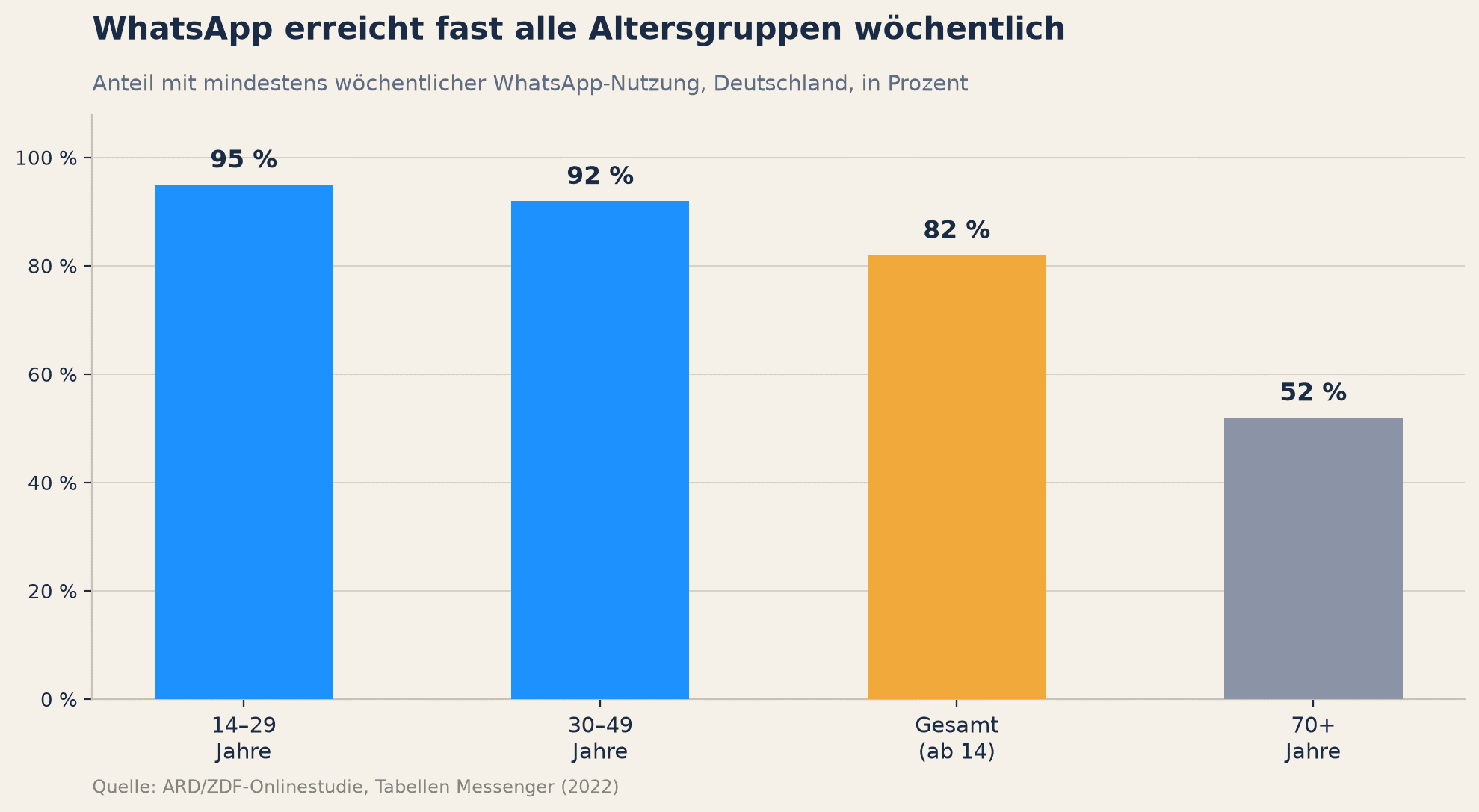
According to WhatsApp itself, WhatsApp reaches more than 3 billion people in over 180 countries — no other messenger in Germany comes anywhere close. The ARD/ZDF Online Study puts weekly usage in Germany at 82% of the population aged 14 and over, rising to 95% for 14- to 29-year-olds, and 92% for 30- to 49-year-olds. Even in the 70+ age group, weekly usage is still at 52%. By comparison, Telegram only achieves 13% weekly usage in the same survey, Signal 11%, and Threema 6%. For banks wishing to reach customers across their entire lifecycle, WhatsApp is no longer an optional nice-to-have channel, but the channel with the greatest reach across almost all age groups.
Reach is Not the Same as Permission: Opt-In and Legal Status
Reach must not be confused with freedom of use. The WhatsApp Business Platform distinguishes between free-form messages and template messages; template messages may only be sent to users with prior opt-in and must also be approved in advance by Meta. According to the WhatsApp Business Messaging Policy from November 2024, the opt-in must clearly state that messages will be sent via WhatsApp and must clearly name the company — the concrete opt-in method is the responsibility of the company, which is also liable for its legal compliance.
In Germany, this requirement is tightened by Section 7 (2) No. 2 of the UWG (German Unfair Competition Act): Advertising using electronic mail without prior express consent is always deemed an unacceptable nuisance. Important for banking marketing teams: The exception for existing customers provided for in the law applies exclusively to email addresses from a previous sale of goods for similar own products — this exception does not apply to WhatsApp marketing. A clean, documented opt-in is therefore a mandatory requirement for every WhatsApp contact, regardless of whether a customer relationship already exists.
How Banks are Already Using WhatsApp
The financial sector has been using the channel for a long time, albeit with different focuses. According to its own press release, Deutsche Bank enables clients to communicate in a compliant manner with bank employees via WhatsApp using Symphony Connect — with explicit fulfillment of communications monitoring and data storage, as is necessary in the regulated banking environment. This shows that compliance-ready WhatsApp usage in banking is technically solved, not just theoretically possible.
The extent of the commercial leverage can be seen in a case study published by the provider itself: According to the WhatsApp Business Success Story on Banco Mercantil — to be classified as a vendor case study with self-reported results — the Brazilian bank achieved a 33% conversion rate from WhatsApp marketing messages between June 2024 and June 2025, eleven times higher than via SMS, as well as a threefold higher average loan renewal rate within twelve months. Accordingly, 51% of all customers who started a WhatsApp conversation purchased at least one loan product. These figures originate from a target group aged 50+ and should be read as a provider success story, not as an independently verified study — but they illustrate the potential that a direct, high-frequency channel can have in the lending business when opt-in and compliance are cleanly handled.
Push and In-App: The Quiet but Robust Channel
Alongside WhatsApp, push messaging remains a core component of the channel strategy — with specific industry benchmarks for banking/finance. According to the Push Notification Benchmark 2025 by Batch — based on over 800 billion messages and more than 1.2 billion unique visitors between July 2024 and July 2025 — the banking sector leads in generic push campaigns with an open rate of 8.8% on Android and 7.2% on iOS. By comparison, contextual, personalized push messages achieve a 14.4% open rate across all industries, compared to just 4.19% for generic messages — proof that relevance makes the decisive difference. In in-app messaging, promo code campaigns with a 16.1% (Android) and 17.9% (iOS) click rate are well ahead of pop-ups at 12.8% and 11.2% respectively. Push opt-in rates average 61% (Android 67%, iOS 56%), with Android recording a decline from a previous 85% since version 13.
Channel / Metric | Value | Source |
|---|---|---|
WhatsApp worldwide | > 3 billion users | |
WhatsApp weekly (DE, total) | 82% | |
Push open rate banking (Android) | 8.8% | |
Push open rate contextual vs. generic | 14.4% vs. 4.19% | |
WhatsApp conversion Banco Mercantil (Vendor Case) | 33% (11× SMS) |
Orchestration Instead of Channel Silos: Frequency, Preference, Consent
The real challenge lies not in adding another channel, but in orchestrating all channels consistently. A customer who receives a push notification, an email, and a WhatsApp message on the same topic within a single week does not perceive this as added value, but as a nuisance — with a corresponding risk for opt-out rates and, in the worst case, for compliance with Section 7 of the UWG for electronic advertising. Future-ready therefore does not primarily mean "more channels", but rather a central orchestration logic that enforces three things simultaneously: the channel preference of the individual customer, a hard limit on contact frequency across all channels, and a robust, documented consent per channel.
This is precisely where CLM/CVM Orchestration from Acceleraid comes in: It manages engagement from the moment of acquisition to retention with configurable contact frequency limits and individual channel preferences per customer. The NBA engine combines propensity scores, lifecycle phase, channel preferences, regulatory requirements, and commercial goals into a single decision — which channel, which message, which timing. This decision is outputted in real time to online banking, apps, email, and branch CRMs. The same logic applies to WhatsApp and in-app messaging as a capability of the platform: The centrally calculated NBA decision can be delivered to the channel preferred by the customer via the respective documented interfaces of the delivery systems — as described in the first part of this series — without the need to build a separate, competing campaign tool.
Conclusion: Future-ready Means Orchestrated, Not Overloaded
The data in this article paints a clear picture: WhatsApp offers a reach that no other channel can match, push remains a reliable, measurable building block in banking, and both channels require strict opt-in and compliance discipline. However, the decisive competitive advantage does not come from adding more channels, but from an orchestration layer that enforces frequency, preference, and consent across all channels — based on the existing stack, as described in the first part of this series. You can find more about CLM/CVM orchestration and other platform modules on our Platform page and on the Banking page.
Illustration: AI-generated. AI-supported content: In creating our posts, we use AI technologies and automated agents, including those from Microsoft, Google, OpenAI, Anthropic, and other providers. Topics, technical direction, and final approval rest with our team.
Further Insights
We use cookies 🍪
Strictly necessary cookies (e.g. Pipedrive forms) remain active. With your consent, we also use Google Analytics (analytics) and Leadfeeder (visitor identification). Learn more in our Privacy Policy.