Regulation & Compliance
Europe's Compliance Edge: Why Banks See AI Screening as a Competitive Advantage
How banks set up data-driven AML, fraud, and sanction screening to translate compliance into trust and speed.
•
acceleraid Editorial Team
5 min read
01
Acquire
Recognize signals
02
Onboard
Control activation
03
Grow
Next Best Action
04
Retain
Reduce churn
05
Reactivate
Reclaim potential

Part 1 of our series on regulation & compliance in banking. While our article on AI Personalisation, EU AI Act, GDPR and MaRisk outlines the rules for personalised decisions and "Data is the Key for AI" sheds light on the database, this post focuses on AML, fraud, and sanction screening as an operational competitive factor. For banks, the competitive edge is not created through less control, but through less friction while maintaining the same depth of control.
Author: acceleraid Editorial Team
Europe's starting position: high pressure, clear investment direction
Compliance is often treated as an unavoidable cost block. This is too short-sighted. It determines speed in payment transactions, a resilient customer relationship in onboarding, and the capacity of specialists in ongoing operations. Where screening decisions are comprehensible, fast, and consistent, the demand for control does not decrease – the unnecessary work surrounding unclear matches decreases.
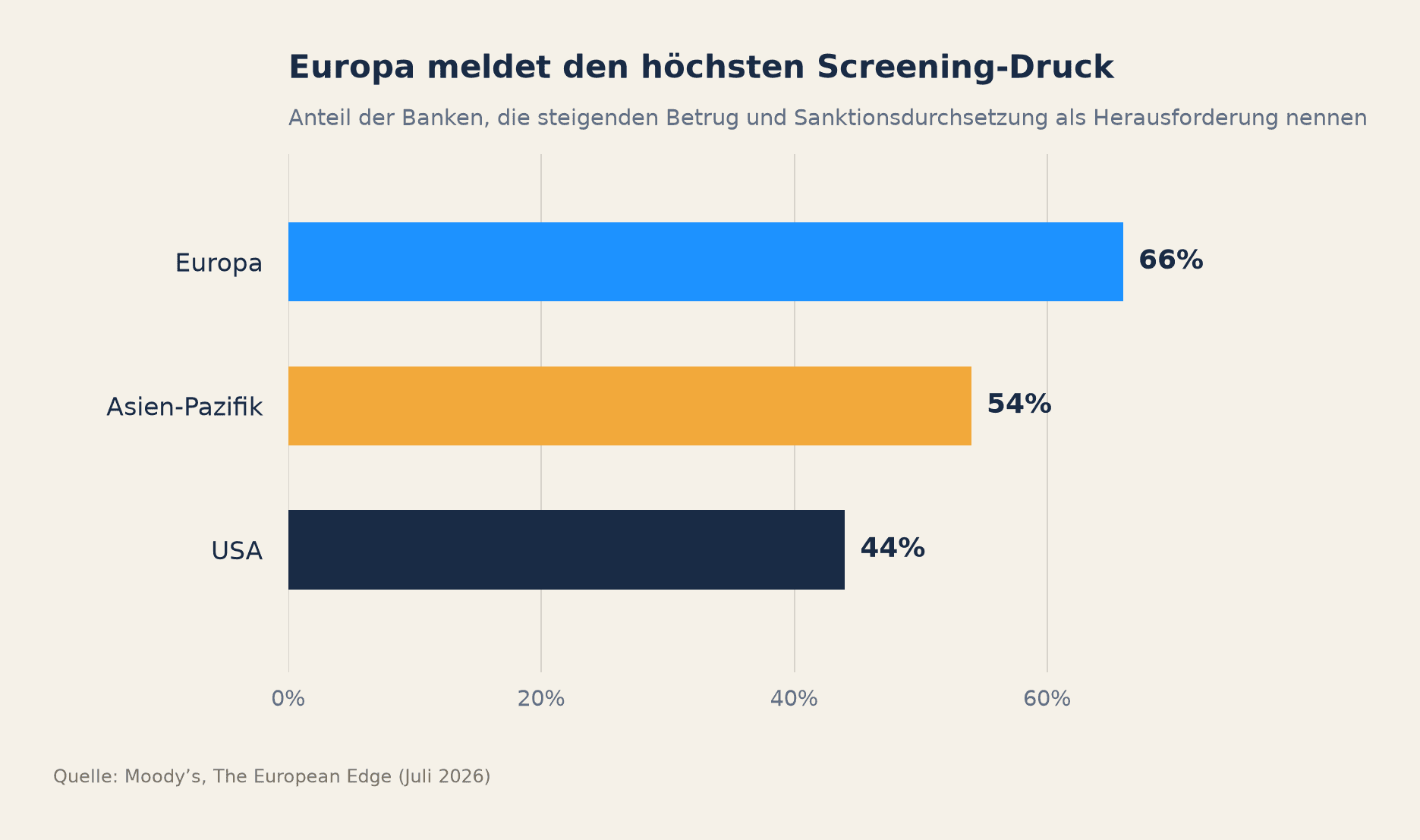
The starting position is particularly clear in Europe. In Moody's white paper "The European Edge", 66% of European banks cited rising fraud and stronger sanctions enforcement as a challenge; in the US, it was 44% and in the Asia-Pacific region 54%. This 66% is explicitly a challenge metric, not an investment driver. The study is based on a survey of 348 senior decision-makers in February and March 2026, as well as 20 executive interviews.
Moody's shows investment decisions separately: 60% of European risk officers direct investments towards fraud and financial crime, and 69% of European compliance officers invest in financial crime compliance. This separation is important for management: a perceived threat explains the pressure to act; a target vision for data, processes, and responsibilities determines whether this becomes an effective capability.
Regulation shifts the rhythm of screening
The European framework turns process quality into a leadership and architecture topic. The Anti-Money Laundering Authority is based in Frankfurt; according to its own schedule, it began operations in the summer of 2025, is scheduled to select the 40 directly supervised obliged entities in 2027, and start direct supervision in 2028 (AMLA). In parallel, the Anti-Money Laundering Regulation (AMLR) applies from 10 July 2027, with a different deadline for certain obliged entities.
The new process logic becomes particularly concrete with Instant Payments. The regulation requires payment service providers to check their customers for new or amended targeted financial sanctions immediately and at least once per calendar day. At the same time, it prohibits transaction-based sanction screening during execution in the relevant context; the specifications applied as of 9 January 2025. This is not a detail of scheduling. It shifts the control from a potentially delaying moment in the transaction to a reliable, repeatable customer check.
The legislator explicitly justifies this change with a very high number of flagged transfers, the vast majority of which do not concern a sanctioned person or entity upon review. With Instant Payments, a full check within the short execution period would not be feasible (EUR-Lex, Recital 25). The strategic question is therefore not: How is an additional check integrated? It is: How do the data, matching, and case handling logic become so reliable that speed and control go hand in hand?
The False-Positive problem is a question of prioritisation
Screening systems must achieve both: identify relevant names and not unnecessarily send uncritical cases to investigation. The tension is real. A peer-reviewed study reports that over 90% of alerts in current sanction screening programs can turn out to be false positives. Although their NLP-based fuzzy matching increased sensitivity, it lowered overall accuracy – a clear indication that an isolated metric is not an adequate management tool.
Supervision provides a second, more practical perspective. The Swedish Finansinspektionen tested 19 active banks with 5,000 names from UN and EU sanction lists. For exactly written names, the hit rates were 86.3% in customer screening and 96.1% in transaction screening; for manipulated spellings, they fell to 63.9% and 88.4% respectively (Finansinspektionen, Analysis of Sanction Screening Systems). This shows that data quality, name variants, and a clean review process belong together. A higher alert output does not automatically mean better compliance.
This leads to a different management logic. Teams should not only report hits and alerts, but differentiate cases by risk, data completeness, processing time, and outcome. The business side must be able to decide which thresholds and matching strategies correspond to the risk appetite. The data and model view must be able to show why a case was prioritised. And the operations side needs a queue that directs scarce human review to the cases with the highest clarification value. AI can recognize patterns, reduce false positives in queues, and prepare decisions; the final decision remains in the human-in-the-loop process, as Moody's describes the application.
From cost program to trust and speed advantage
The economic pressure explains why this shift is more than just a compliance project. According to LexisNexis, the total cost of financial crime compliance in EMEA was 85 billion US dollars. In the same survey, 98% of institutions reported rising costs and 78% higher screening alert volumes. The study does not prove a separate value for Europe only; it should therefore be read as an EMEA benchmark.
A sustainable advantage is not created by claiming that AI replaces compliance specialists. It is created through a better operating model: fewer avoidable escalations, clearer reasons for case prioritisation, reproducible decisions, and faster processing of uncritical customer transactions. This improves the customer experience not at the expense of compliance, but through better compliance.
A practical target vision includes these components:
Establish data foundation: Master data, identities, list statuses, and data lineage must be versionable and available for review and reconstruction.
Treat matching as a management rule: Spellings, aliases, and risk thresholds are business decisions. They need testing, approvals, and traceable changes.
Prioritise review intelligently: Automation should bundle evidence and structure cases, not hide an unexplainable final decision.
Measure impact: In addition to risk coverage, alert quality, throughput time, override reasons, and recurring data errors belong in a common management dashboard.
This order prevents typical developments in the wrong direction: buying an isolated AI tool without a resilient database, and optimizing processing times without checking the quality of the cases. At the same time, it makes compliance connectable to operations, risk, data, and product teams.
Data architecture and AI support: the right role of the platform
A sanction screening tool is different from a customer data or orchestration platform. The roles should not be mixed. For banks, however, the same foundation remains crucial: consistent data, documented origin, effective protection of personal information, and verifiable decision logic.
This is where Acceleraid can support the surrounding data and activation architecture. The CDP & Data Governance module consolidates data from CRM, core banking, and card processing, and manages consent, lineage, and PII protection. The Prediction Engine delivers explainable, auditable scores; the Regulatory Reporting module supports, among other things, MaRisk reporting as well as FINREP, COREP, and AnaCredit (Acceleraid Platform). None of these functions replaces a specialized sanction screening or the professional responsibility of compliance. However, it can strengthen the comprehensibility and data quality on which a resilient screening process depends.
Compliance as the ability to make quick, reasoned decisions
Europe's lead is not automatically given. Moody's figures show higher perceived pressure, not a guarantee of better execution. Banks that organise this topic as an ongoing capability can turn exactly this pressure into an advantage: they check customer-related instead of transaction-delaying, they concentrate specialist capacity on relevant cases, and they document decisions in such a way that they remain explainable.
This is the core of a data-driven compliance model: not less control, but controllable speed. For specific legal interpretation and institution-specific implementation, banks should involve their compliance, legal, and risk functions.
Illustration: AI-generated. AI-supported content: We use AI technologies and automated agents, including those from Microsoft, Google, OpenAI, Anthropic, and other providers, to create our posts. Topics, professional direction, and final approval remain with our team.
Further Insights
We use cookies 🍪
Strictly necessary cookies (e.g. Pipedrive forms) remain active. With your consent, we also use Google Analytics (analytics) and Leadfeeder (visitor identification). Learn more in our Privacy Policy.