Regulation & Compliance
EU Banking Competition 2026: What the Reform Agenda Means for Technology and Customer Processes
EU Reform Agenda 2026: Potential impacts on data architecture, reporting, and cross-border customer processes in banks.
•
acceleraid Editorial Team
5 min read
01
Acquire
Recognize signals
02
Onboard
Control activation
03
Grow
Next Best Action
04
Retain
Reduce churn
05
Reactivate
Reclaim potential
Author: acceleraid Editorial Team | August 17, 2026
On July 17, 2026, the European Commission adopted a communication on the competitiveness of the EU banking sector. It outlines measures for a more integrated, efficient, and competitive single market for banking; it is not yet an applicable law. European Commission, July 17, 2026
For banks, the correct reading is crucial: the Commission describes a political agenda and announces legislative proposals for the first quarter of 2027. The content, negotiation outcome, legal form, and timing of any subsequent application therefore remain open. European Commission, July 30, 2026
Nevertheless, the agenda is a sensible opportunity to review technology and customer processes for their adaptability. Not because a single target image is already prescribed, but because cross-border management, traceable supervisory data, and consistent processes can become more important in the event of further integration.
The reform agenda: three obstacles, no finished rulebook
The Commission identifies three obstacles: nationally fragmented markets, an implementation of global standards that does not always reflect the specificities of the European banking system, and parts of the regulatory framework that are too complex and burdensome. European Commission, July 30, 2026
Its goal is not deregulation for its own sake. The communication links a better balance in the rulebook with resilience, financial stability, and better services for households and businesses. European Commission, July 17, 2026
The context explains the economic relevance: according to the factsheet, banks provide 75% of corporate debt financing in the EU. At the same time, the Commission describes the Banking Union and the single market for banking as incomplete. Factsheet of the European Commission, July 2026
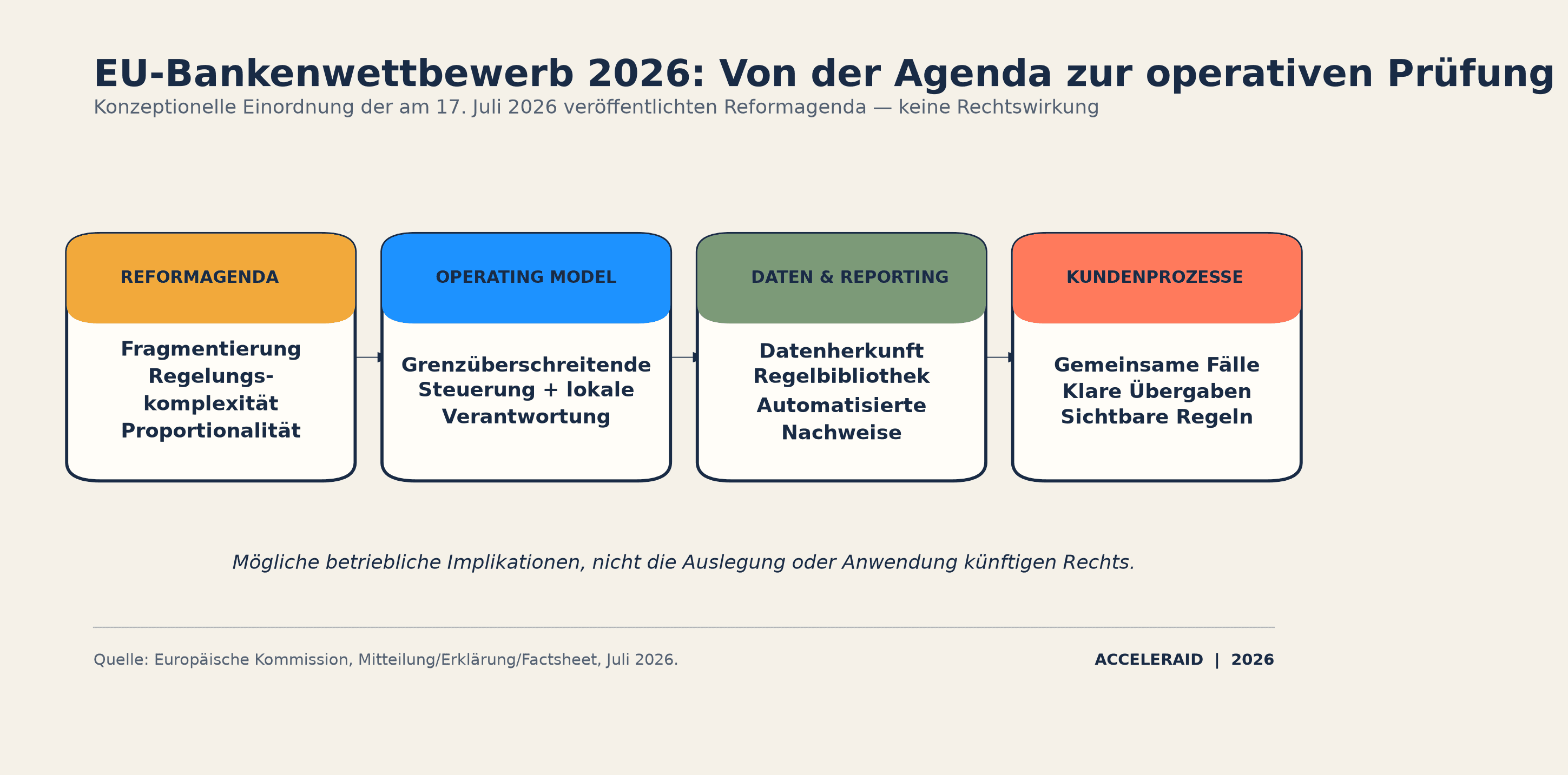
For decision-makers, this is not an invitation to anticipate future requirements. They should distinguish between three levels: applicable requirements, the published agenda, and their own improvement measures, which are useful independently of the legislative process. This separation prevents programs from being based on supposed obligations that do not yet exist.
Fragmentation as a process and data question
The Commission wants to enable cross-border banking groups to manage capital and liquidity more efficiently within the EU, while at the same time mentioning additional safeguards and a new path for a common deposit guarantee scheme. European Commission, July 30, 2026
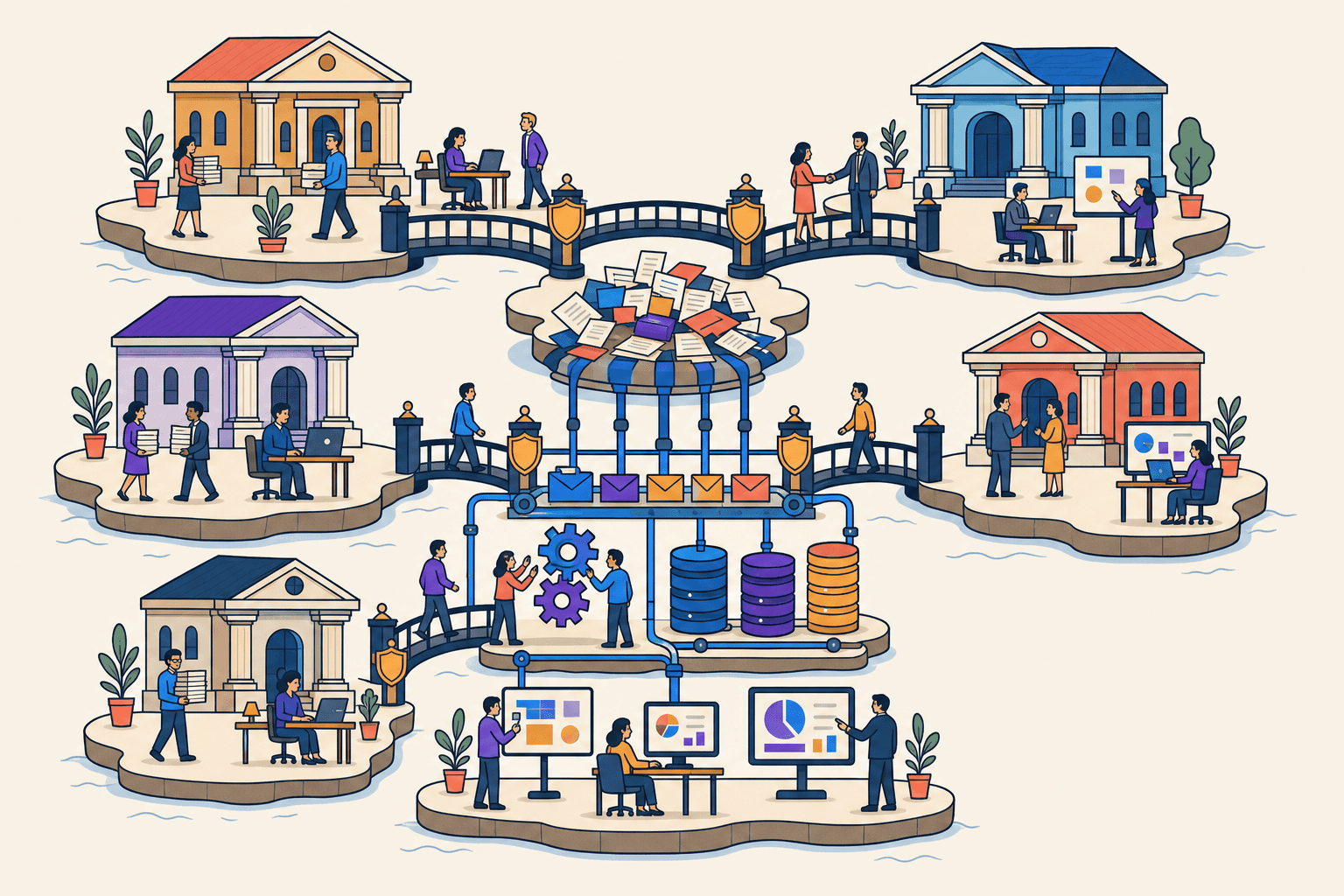
This is initially a policy-side project, not an instruction that every bank must centralize its operations. For groups operating across multiple countries, however, it highlights where operational architecture often creates friction: disparate master data, locally separated case processing, deviating documentation logics, and interfaces designed only for a single national workflow.
A resilient countermodel separates common foundations from legally or commercially required local variations. Common data concepts for customer, contract, case, product, consent, and risk event facilitate translation between entities. Local rules, languages, responsibilities, and deadlines remain visible as a configurable layer, rather than disappearing into copies of the same process.
This is not an assumption about future regulation. It is an architectural principle: a bank can build centralized standards, clear data lineage, and reusable process building blocks without blurring the responsibility of a local entity. If the European framework changes, such a separation shortens the analysis effort; if it does not change, it still improves controllability.
Reducing complexity means building traceability
The Commission announces that it will reduce unnecessary complexity and make requirements for banks and authorities more predictable and transparent. Its explanation also emphasizes that confidence in the banking system requires strong safeguards. European Commission, July 30, 2026
Simplification would therefore not be synonymous with less control. For technology programs, the practical focus is rather on the question: Can the bank show which data it used, which rule was applied, who decided on an exception, and which version of a report resulted from it?
A reporting stack that manually compiles data before each submission is difficult to explain and costly to change in this regard. A traceable chain consisting of a functional data model, data lineage, quality-assured transformations, functionally approved KPI definitions, and a reproducible report run is much more robust. Control points belong in the workflow, not in a retrospective spreadsheet check.
Proportionality and automated supervisory data
The factsheet lists greater proportionality for smaller banks and simplified, proportionate, and automated supervisory reporting as elements of the planned measures. It also mentions more targeted and transparent bank-specific requirements and supervisory guidelines. Factsheet of the European Commission, July 2026
It is not possible to deduce from this which specific report will be discontinued or automated in the future, or for which institutions different thresholds will apply. The announced proposals are not expected until the first quarter of 2027. European Commission, July 30, 2026
However, banks can already treat reporting as a product: with clear data owners, a controlled rule library, traceable deviation handling, and tests that make functional changes visible before the monthly or quarterly close. Automation then has a precise purpose: to execute recurring data flows, validations, and verifications more reliably. It replaces neither professional judgment nor supervisory dialogue.
For smaller institutions, a common core of standardized interfaces and reusable controls can be particularly useful. Proportionality does not demand less clean work. It suggests coupling scope and effort to risk, business model, and actual complexity — as far as the applicable framework allows.
Customer processes: consistency without false standardization
The communication agenda links competitiveness with better services for households and businesses. European Commission, July 17, 2026
For Customer Lifecycle Management, no automatism follows from this: a more integrated banking group does not deliver better journeys for that reason alone. Customer benefit only arises when a cross-border process provides relevant information, a clear status, and a reliable next step at the right moment.
Suitable starting points are processes with a high need for coordination: onboarding, identification, address or master data changes, service cases, complaints, and the handoff between digital and assisted channels. A common event and case reference prevents a customer from having to provide data again in one channel while another department is already processing the same transaction.
At the same time, teams must explicitly model the boundaries: Which data may be used for which purpose? What communication should be suppressed in an open complaint case? When must a local caseworker take over? A good platform answers these questions through visible rules, permissions, statuses, and audit trails — not by assuming that "one customer view" replaces every local decision.
A pragmatic roadmap until the Commission's proposal
Until the announced package is presented, banks can start four tasks in parallel. First: create a map of regulatory data flows, manual reworks, and local custom logic. Second: establish binding data lineage, owners, and quality controls for the most important KPIs and customer events. Third: redesign one or two cross-border processes with clear handoffs and local variations. Fourth: set up a change management system that brings together legislation, supervisory guidance, business units, and technology at an early stage.
The benchmark here is not the number of centralized systems. It is the ability to implement a change in a controlled manner: identifying impacts, adapting data and rules, testing local variants, empowering employees, and monitoring the impact on customers.
The reform agenda provides a direction for this, but not yet a final set of specifications. Banks that invest now in transparent data chains, configurable processes, and clear responsibilities create a resilient starting position — regardless of how the 2027 proposals turn out in detail.
Illustration: AI-generated. AI-supported content: In creating our articles, we use AI technologies and automated agents, including those from Microsoft, Google, OpenAI, Anthropic, and other providers. Topics, professional orientation, and final approval remain with our team.
Further Insights
We use cookies 🍪
Strictly necessary cookies (e.g. Pipedrive forms) remain active. With your consent, we also use Google Analytics (analytics) and Leadfeeder (visitor identification). Learn more in our Privacy Policy.