Data & Technology
Dynamic Banking Engagement Platforms: The Missing Layer Between Core and Customer Dialogue
Why dynamic engagement platforms bridge the gap between core banking, decisions, channels, and customer interaction.
•
acceleraid Editorial Team
6 min. read

A bank can modernize its core, introduce a new front end, and still fail due to a practical problem: a relevant customer event is recognized but not reliably converted into an appropriate, compliant, and traceable interaction. A connecting layer is then missing between booking systems and customer dialogue.
Forrester groups this layer under the term Digital Banking Engagement Platform (DBEP). In its evaluation for the second quarter of 2026, Forrester describes DBEPs as continuing to be crucial for banks. However, their role is shifting: away from a pre-packaged collection of digital offerings, toward a platform on which banks and partners can explore ideas and quickly develop new capabilities. Forrester's classification of the DBEP wave 2026 is therefore not a call to replace the core. It directs attention to the ability to connect data, decisions, and interactions across existing systems.
Author: acceleraid Editorial Team
Date: August 13, 2026
The missing layer is an execution problem
The core is the system of record: it manages accounts, balances, bookings, and product contracts. It must operate stably, correctly, and in a controlled manner. A customer dialogue demands something else. It needs context, rules for contact frequency and consent, a decision on the next best action, and delivery in the appropriate channel or to the appropriate employee.
A DBEP can bring these tasks together without burdening the core with every new journey. The separation is important: a digital engagement system does not process the business truth about a booking instead of the core. It uses agreed-upon interfaces to form a context for interaction and work. A platform provider accordingly describes this level as software between core banking and daily customer interactions that coordinates data, workflows, and interactions across mobile, web, branch, and operations. This architectural definition by Backbase is a useful distinction, not a general product evaluation.
For this very reason, a DBEP is not simply a new mobile app. An app is a single access channel. It can improve an interface, but it does not automatically solve the question of how a decision is coordinated with web, contact center, advisory workspace, and other channels. Nor does it inherently create traceable feedback about what happened after an interaction.
Forrester also observes that the target audience for the platforms is expanding. DBEPs are increasingly being connected to a larger number of internal and external systems; at the same time, providers are expanding low-code and no-code features without replacing professional development in core areas. Forrester's DBEP analysis thus describes a change in the way of working, not just a new operating concept.
An architectural model with five connected layers
A clear layered model helps with selection and implementation. It is not a standardized target state and not a template for a specific product suite. It makes visible where responsibility should lie.
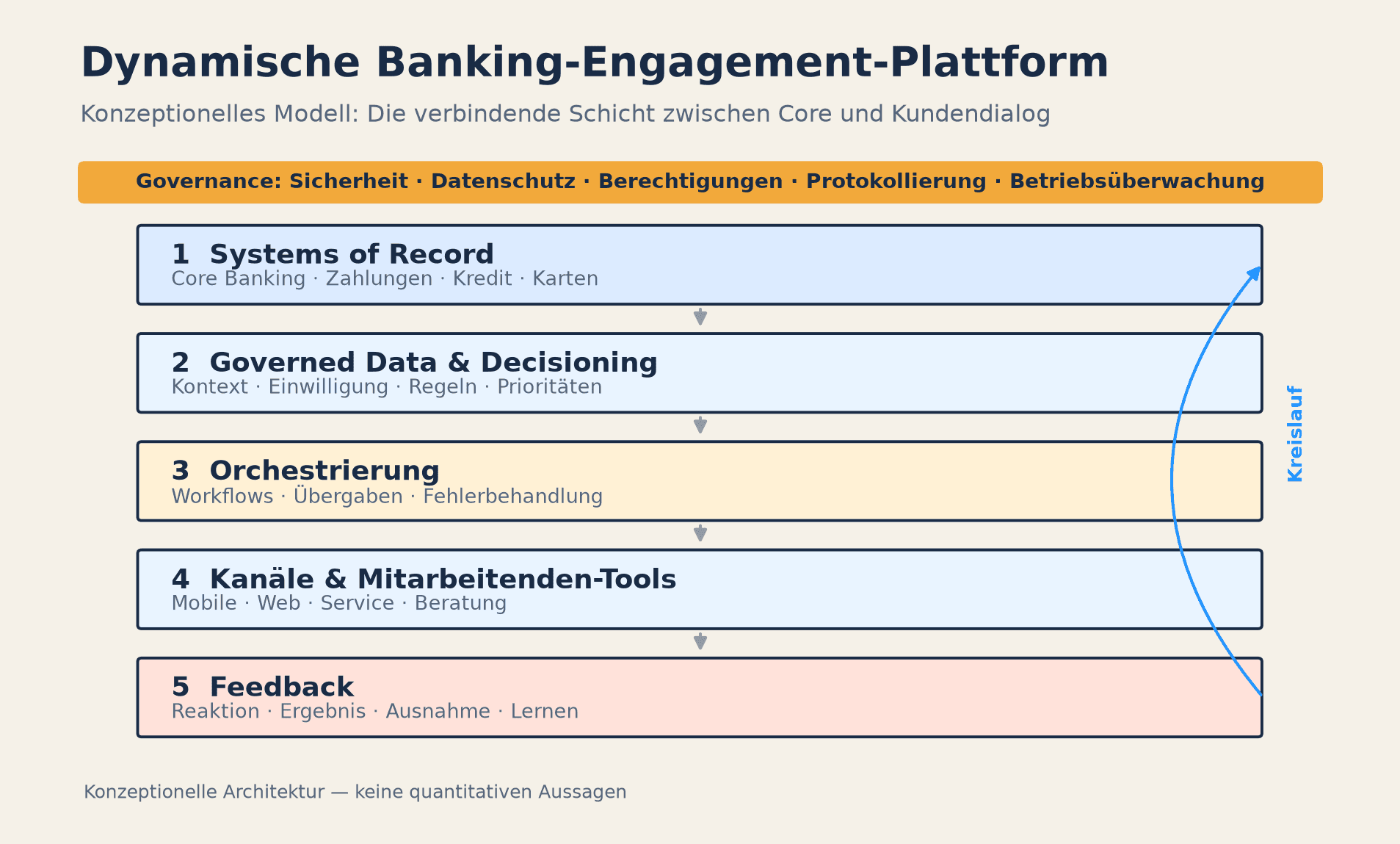
1. Systems of Record. Core banking, payment transactions, credit and card platforms, and other leading systems remain the source of the respective authoritative data and processes. The engagement layer must not silently add new business truths to these systems. It needs clear contracts for read access, events, write operations, and error cases.
2. Governed Data and Decisioning. This layer connects compliant customer signals, identities, consents, product, and context data. It also contains rules, models, and decision logic: such as exclusions, eligibility limits, priorities, and the "do not contact" case. The key is not to gather as much data as possible, but to clarify origin, timeliness, purpose limitation, and owners.
3. Orchestration. Here, a decision becomes a controllable process. Orchestration triggers steps, handles dependencies, establishes sequences, and hands cases over to humans when automated processing is insufficient. It should also organize competing demands: service communication, a warning, and a product offer must not compete uncoordinated for the same customer moment.
4. Channels and Employee Tools. Mobile and web are delivery points, not the platform itself. Additionally, there are email, messages, contact center, branch, and advisory workspaces. Good architecture ensures that employees see the context, the permitted action, and the previous history. This prevents a customer from starting an interaction in one channel and having to explain everything again in the next.
5. Feedback. Delivery, response, cancellation, manual override, and subsequent events must flow back. Feedback is more than a campaign report. It is the basis for testing rules, improving journeys, and recognizing whether a decision was actually helpful.
Security, data protection, permissions, logging, and operational monitoring run across all levels. These requirements are not an afterthought control ring. They determine what data may be used in a decision, who can change a rule, and when a human must intervene.
The shift in role: from ready-made experiences to a build and runtime environment
The recent DBEP discussion is not about whether every bank should develop all user interfaces itself. The central point is adaptability. Forrester describes leading platforms as a means for banks and third-party partners to quickly test and build new ideas and capabilities. The report also refers to tools for testing and measuring new products.
This has consequences for the operating model. Business departments require a way to configure content, sequences, and clearly defined journeys. Technology and security teams must be responsible for the reusable integration, identity, and control building blocks. Risk, compliance, and data privacy belong early in the lifecycle of a decision: in data usage, rule definition, release, and ongoing review. No single team can sensibly manage the entire platform alone.
Also, "API-first" is not a sufficient selection criterion. Forrester points out that almost all analyzed providers put APIs at the center of their positioning, while in practice banks sometimes encounter non-functioning interfaces or significantly more difficult integrations than expected. This warning from Forrester argues for tests on real interfaces, genuine error patterns, and own security requirements instead of a decision based on architectural slides.
The same applies to AI features. A conversational interface or a generator for workflows can be useful, but it does not replace decision-making rights, data controls, and escalation paths. The resilient test is: Can the bank explain what data and rules triggered an action, what the employee is allowed to change, and how the impact is monitored?
Selection questions that a product demo does not answer
A sensible pre-selection does not start with a list of features, but with concrete interactions. These questions help to test the architecture and the operating model:
System boundaries: Which systems remain authoritative for which data and transactions? Are read, write, and event interfaces documented and testable in your own environment?
Decision governance: How are consent, contact rules, eligibility requirements, priorities, and deliberate non-contact enforced together?
Traceability: Can it be shown for an individual interaction which data, rules, content, and approvals were used?
Orchestration: How does the platform handle errors, time-delayed processes, duplicate events, and handovers to employees?
Omnichannel work: Do customers and employees receive a consistent history, or do separate dialogues arise for each channel?
Adaptability with control: What are business users allowed to configure, what requires development, and which changes need a prior review?
Feedback and operations: Which events flow back? Who monitors data quality, rule effectiveness, delivery, and exceptions in day-to-day operations?
Portability: How can data, content, rules, and integrations be documented and transferred in an orderly manner in the event of a change of provider?
A dynamic banking engagement platform is thus neither a cosmetic frontend relaunch nor a replacement project for the core. It is a connecting operating and execution layer. Its value is created when a bank can control and transfer decisions across systems and channels into dialogue and work — and learn from the result again.
Illustration: AI-generated. AI-supported content: In creating our posts, we use AI technologies and automated agents, including those from Microsoft, Google, OpenAI, Anthropic, and other providers. Topics, professional orientation, and final approval lie with our team.
Further Insights
We use cookies 🍪
Strictly necessary cookies (e.g. Pipedrive forms) remain active. With your consent, we also use Google Analytics (analytics) and Leadfeeder (visitor identification). Learn more in our Privacy Policy.