CLM & CVM
Customer Lifecycle Management for Banks: The Operating Model
Customer Lifecycle Management for banks: teams, processes, governance and RACI explained in the operating model.
•
acceleraid Editorial Team
5 min read
01
Acquire
Recognize signals
02
Onboard
Control activation
03
Grow
Next Best Action
04
Retain
Reduce churn
05
Reactivate
Reclaim potential

Customer Lifecycle Management for banks rarely fails because of technology — usually because of the organization behind it. This article concludes our mini-series on Customer Lifecycle Management for banks and describes the operating model: which teams, processes, cadences, and decision-making rights a functioning CLM program actually needs — with proven figures from transformations that have already undergone this reorganization.
Customer Lifecycle Management for Banks: Why the Operating Model is the Bottleneck
McKinsey explicitly lists an agile operating model in 2024 as one of five key personalization priorities in retail banking — alongside value-based use case prioritization, rapid activation at scale, MarTech/360° data enablement, and talent (McKinsey, October 2024). The governance gap behind this is well documented: Only 14% of banks have a specific AI governance framework, and only 16% have standardized protocols for algorithm development (McKinsey, "Getting personal: How banks can win with consumers", 07/19/2022). Without clear governance, even the best CLM platform remains a tool without an operating manual.
The economic leverage of a functioning operating model is substantial: agile marketing squads test and realize new ideas 5 to 10 times faster, execute campaigns 2 to 3 times faster, reduce marketing execution costs by 10–30%, and typically increase marketing revenues by 20–30% (McKinsey, "When agile marketing breaks the agency model", 09/29/2021). Realistically, however, the path there remains rocky: only 3% of executives described the transition to agile marketing as "smooth", and over 80% reported obstacles — an assessment from supporting over 150 transformations (McKinsey, 09/29/2021).
The Team Structure: Pods, Squads, and Two-Pizza Teams
The basic operational model is consistent across multiple studies: small, dedicated teams of no more than 8–12 people ("two-pizza teams"), freed from day-to-day operations and co-located in a war room; a scrum master is responsible for prioritization, the backlog, and sprints, which usually last 1–2 weeks, with daily stand-ups (McKinsey, "Agile marketing: A step-by-step guide", 11/09/2016). A pod typically consists of developers, data analysts, testers, journey experts, and UI designers; members are 100% dedicated, and deliverables change every two weeks, sometimes daily (McKinsey, 09/29/2021).
Specifically for banks, McKinsey describes a two-tier model: "Customer Pods" for ideation and CLV insights and "Enabling Pods" for reusable assets, managed via a steering committee of analytics, marketing, and product areas (McKinsey, 07/19/2022). Scaling is done via a "control tower" that coordinates multiple teams, distributes best practices, and runs the performance dashboard — a global retailer scaled to 13 parallel war rooms in this way (McKinsey, 11/09/2016).
Governance and RACI: Who Decides, Who is Only Informed
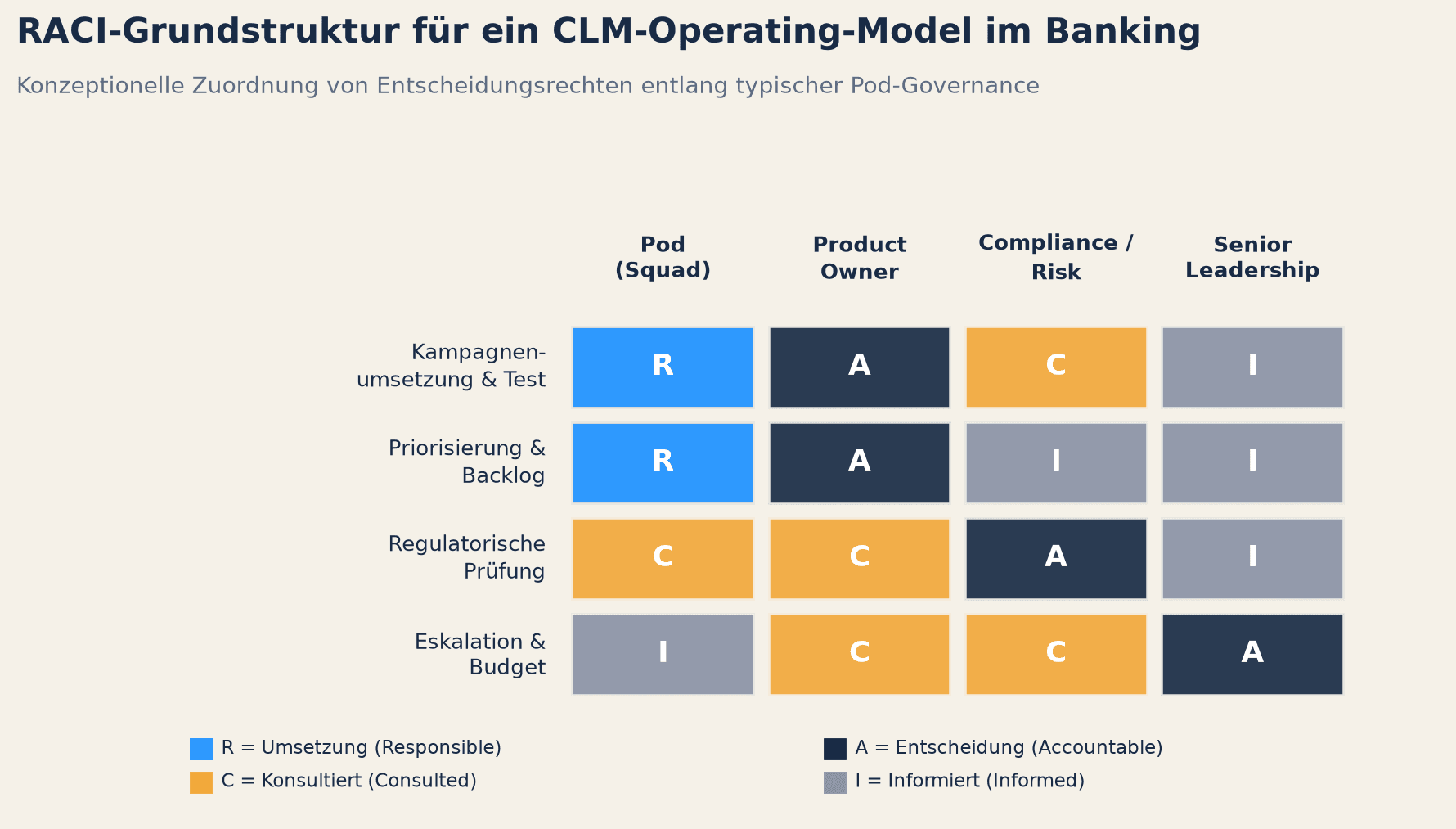
Governance does not start with a committee, but with clear contact persons: SLAs and named contacts in Legal, Procurement, IT, Compliance/Risk, and Finance are prerequisites before a pod can even start operating. Senior leaders deliberately intervene only lightly — about every 3–4 weeks, supported by automated dashboards instead of manual status reports (McKinsey, 11/09/2016). This structure can be directly translated into a RACI matrix: the pod is "Responsible" for implementation and testing, the Product Owner is "Accountable" for prioritization, Compliance/Risk is "Consulted" for regulatorily relevant use cases, and Senior Leadership is "Informed" via the dashboard. How this governance meshes with the NBA decision logic itself is detailed in our article on Next Best Action in Banking.
Centralization pays off measurably: banks with codified, unified, and centralized analytics processes achieve 5–15% higher campaign revenues and launch campaigns 2 to 4 times faster — the time-to-market is cut in half or quartered, and the cadence shifts from monthly/quarterly to daily/weekly (McKinsey, 07/19/2022). Reusability is a governance principle in its own right: a European bank trained several hundred data scientists, maintained over 200 use cases in a shared asset library, and achieved a 9-fold improvement in conversion rate; the subsequent rollout to six divisions delivered over 120 million US dollars in value (McKinsey, 07/19/2022). An Asian bank halved the implementation time for over 150 analytics use cases simply through standardized procedures (McKinsey, 07/19/2022).
Proven Results from Ongoing Transformations
The numbers behind these operating model reorganizations are concrete. A North American retailer achieved a fourfold campaign throughput, +30% customer satisfaction, and doubled digital revenues after 18 months; a European bank increased its conversion rate by more than tenfold through weekly media tests; digital marketing organizations overall saw a 20–40% increase in revenue (McKinsey, 11/09/2016). A specific cycle time benchmark: an international bank previously needed 8 weeks to prepare a new email offer test — after the reorganization, it took under 2 weeks from idea to offer (McKinsey, 11/09/2016). A Western European bank ran over 100 AI-personalized campaigns with a 3- to 5-fold increase in conversion and reduced campaign duration from several months to under four weeks (McKinsey, October 2024).
Cadence of Change: Waves Instead of Big Bang
How quickly an operating model should be rebuilt is also documented — and the answer is not "all at once". BCG recommends iterative scaling in six-month waves, supported by an incubator outside of day-to-day business; "all-at-once" step-change approaches typically fail under this classification (BCG, "What Does Personalization in Banking Really Mean?", 2019). This wave rhythm can be directly linked to the data side: without a reliable, centrally accessible data basis, even the most well-set-up pod model runs into a void. How to build this data basis is covered in our article Data is the Key for AI.
How Acceleraid Supports the Operating Model
An operating model needs not only people and processes, but also a platform that technically enables a fast cadence. Acceleraid's CLM/CVM orchestration is designed so that pods can independently run campaigns from idea to execution, while contact frequency limits and channel preferences are centrally stored as guardrails (Acceleraid Platform). The prediction engine delivers explainable, auditable scores that fit directly into a RACI model: model outputs are comprehensible for Compliance/Risk without each campaign having to go through a committee individually (Acceleraid Banking). Over 15 years of experience and more than 250 enterprise deployments stand for the fact that this interaction of team, governance, and platform has proven itself in practice (Acceleraid Platform).
Conclusion: Customer Lifecycle Management for Banks Only Scales via the Operating Model
Framework and software decisions alone do not deliver a functioning Customer Lifecycle Management for banks — only the operating model turns it into a repeatable, scalable process. The evidence is clear: small, dedicated teams, lightweight but clear governance, and a wave-like rhythm in scaling deliver demonstrably higher campaign revenues and shorter cycle times. This closes the circle of this mini-series — from the framework to the software decision to organizational anchoring.
Illustration: AI-generated. AI-supported content: In creating our articles, we use AI technologies and automated agents, including those from Microsoft, Google, OpenAI, Anthropic, and other providers. Topics, technical direction, and final approval lie with our team.
Further Insights
We use cookies 🍪
Strictly necessary cookies (e.g. Pipedrive forms) remain active. With your consent, we also use Google Analytics (analytics) and Leadfeeder (visitor identification). Learn more in our Privacy Policy.