Data & Technology
Customer Data Platform for Financial Services: The 2026 Guide
Customer Data Platform for Financial Services Providers: Overview of Definition, Architecture, Regulatory Law, and Differentiation from DWH and CRM.
•
acceleraid Editorial Team
5 min read
01
Acquire
Recognize signals
02
Onboard
Control activation
03
Grow
Next Best Action
04
Retain
Reduce churn
05
Reactivate
Reclaim potential

This post opens a new series on Customer Data Platforms in the financial sector. Part 2 deals with selection criteria and RFP questions, Part 3 with costs and business cases. For those already working with Next Best Action logic, our supplementary series on Next Best Action in Banking is also available.
A Customer Data Platform for financial service providers is more than just another data tool in the marketing stack — it is the prerequisite for banks and insurers to be able to use customer data in real time, consistently and in compliance with regulations. According to the CDP Institute's definition, a CDP is "software that creates and maintains a persistent, unified customer record that is accessible to other systems" and bears the primary responsibility for maintaining customer identity and data structure over time (CDP Institute). For financial service providers, an additional layer of requirements is added: regulatory law, data residency and integration with core banking systems, which play no role in other industries.
What a Customer Data Platform must deliver for financial service providers
The CDP Institute has defined seven verifiable core capabilities for RealCDP certification: ingest data from any source — structured, semi-structured, unstructured —, capture the full level of detail, store data persistently, create unified profiles of identified individuals, share data with any connected system, respond in real time, and govern customer data in compliance with local privacy and security standards (CDP Institute, RealCDP Certification). The depth of detail is crucial here: a true CDP "is able to retain all details of input data indefinitely" — in contrast to systems that aggregate data or discard it after deadlines (CDP Institute).
The real-time claim is also concretely measurable: RealCDP requires a response time of "under one second" both for ingesting new data and for responding to a profile query — a significantly stricter standard than the previous benchmark of 30 seconds (CDP Institute, RealCDP). Gartner's marketing glossary defines a CDP similarly functionally: as martech that unifies customer data from marketing and other channels to optimize customer modeling as well as the timing and targeting of messages and offers (Gartner Marketing Glossary).
Why a Customer Data Platform looks different for financial service providers
The core capabilities mentioned apply across all industries. What distinguishes a Customer Data Platform for financial service providers from a generic Martech CDP is the regulatory envelope in which it must be embedded. Three aspects are particularly relevant here:
Outsourcing and supervision. The EBA guidelines on outsourcing arrangements have been in force since September 30, 2019 (EBA/GL/2019/02). They require the outsourcing register to contain the data location — specifically "the country or countries where the service is to be performed, including the location … of the data" (para. 54(f)) as well as service and deployment models in the case of cloud services (para. 54(h)) (EBA/GL/2019/02). A CDP that cannot provide this information simply cannot be classified under outsourcing law in a bank.
DORA and data repatriation. Since January 17, 2025, the Digital Operational Resilience Act (DORA) has been applicable without any further transition period (BaFin, DORA Overview). BaFin also expects institutions to be able to access and repatriate their data stored with a cloud provider "quickly and without restriction at any time" — ideally via "platform-independent standard data formats" (BaFin, Cloud Supervision Guidance). A CDP without open export formats creates a tangible compliance risk here.
Data location as a geopolitical issue. BaFin requires an "assessment of the location where data is stored or processed, the location of the cloud provider's corporate headquarters, the geopolitical situation … and the applicable laws … in the jurisdictions concerned" (BaFin, Cloud Supervision Guidance). Stating the location of the data center is generally sufficient, but the exact address must be provided upon request (BaFin, Cloud Supervision Guidance).
Architecture: from data source to activation
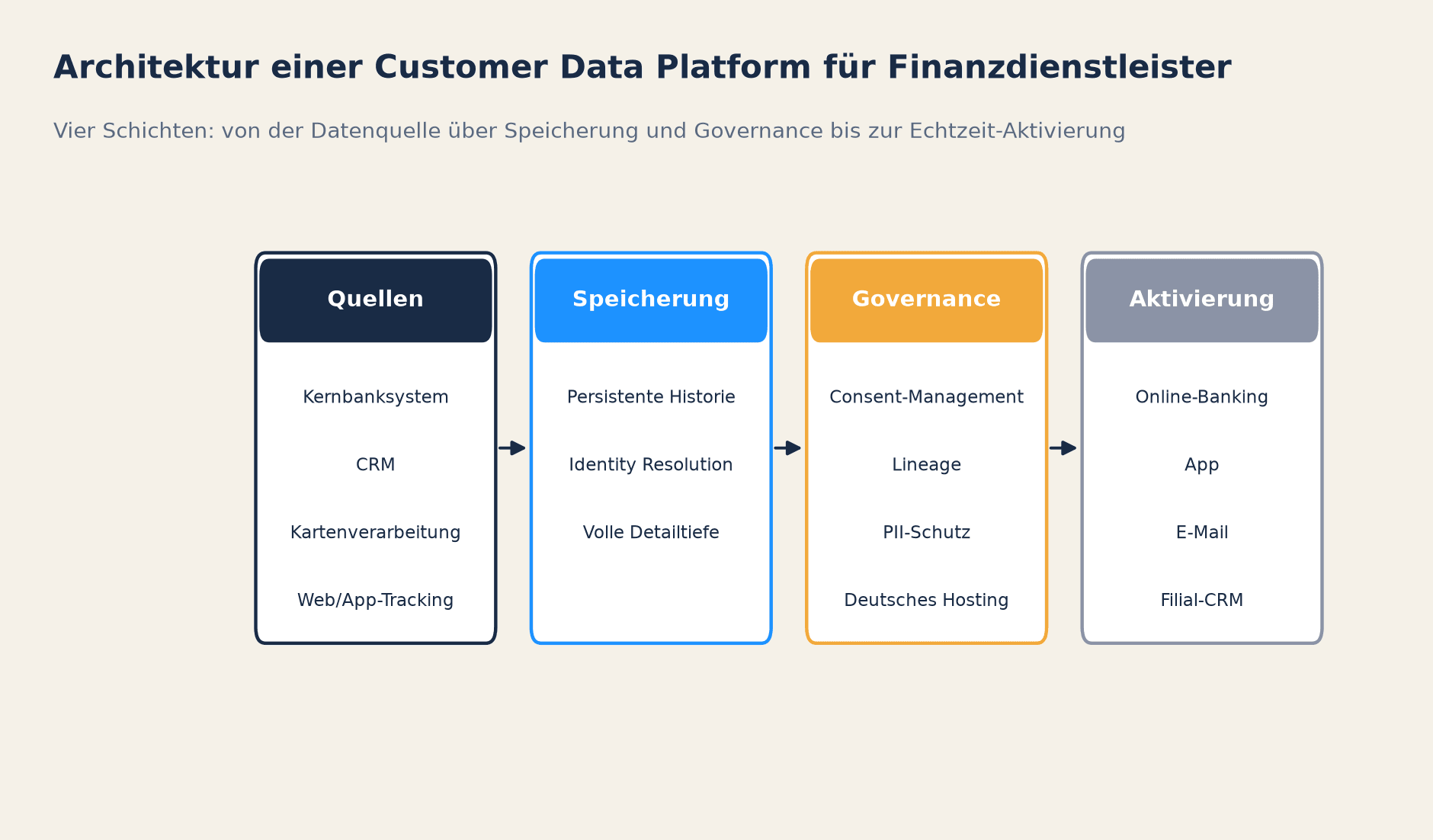
A functional architecture follows four layers: Ingestion from core banking, CRM and card processing; persistent, identity-resolving storage; governance layer for consent, lineage and PII protection; and finally the activation layer, which plays out scores and segments in real time to online banking, app, email or branch CRM. According to the provider, precisely this combination — real-time data from CRM, core banking system and card processing with consent management, lineage documentation, PII protection and German hosting according to GDPR-by-design principles — forms the core of Acceleraid's CDP & Data Governance module (Acceleraid Platform).
A McKinsey survey shows why this architecture is more than just grey theory: only about 28% of banks are currently able to quickly integrate internal structured customer data into their AI models (McKinsey, Getting personal). This integration gap is usually not a question of missing models, but of a lack of underlying data infrastructure.
Differentiation: CDP versus Data Warehouse versus CRM
Confusing a CDP with a Data Warehouse (DWH) and CRM is the most common conceptual mistake when introducing a CDP. A DWH is primarily built for analytical queries by data teams, not for real-time activation in operational business. A CRM primarily manages explicitly captured sales and service relationships, not a customer's full behavioral and transactional profile. A CDP closes this gap by acting, according to the CDP Institute, as a "unified interface" "through which customer data services are governed and made operational" (CDP Institute) — and supports three deployment models: "packaged", "warehouse-native" (composable) and "dual-mode" (CDP Institute).
Feature | Data Warehouse | CRM | Customer Data Platform |
|---|---|---|---|
Primary Purpose | Analytical Reporting | Sales/Service Relationship | Real-Time Activation & Governance |
Data Depth | Aggregated/historicized | Explicitly captured interactions | Full detail depth, all sources |
Response Time | Batch/hours | User-driven | Under 1 second (RealCDP standard) |
Governance Focus | Data quality | Contact data maintenance | Consent, lineage, PII |
Source: CDP Institute, RealCDP Certification; DWH/CRM classification by editorial staff based on the CDP Institute definition.
Maturity: where the market actually stands
The CDP market is no longer a niche phenomenon in 2026: industry revenue is at USD 2.9 billion, spread across 217 providers with 19,813 employees and a cumulative USD 10.5 billion in funding (CDP Institute / Customer Data Alliance). At the same time, the member survey from January 2025 shows a leap in maturity: 57% of respondents reported a unified customer database for the first time, and 68% reported a CDP already in production (CDP Institute News). However, the report "Unified Data, Uneven Outcomes" puts this progress into perspective: despite widespread CDP and AI adoption and growing use of warehouse-first and composable architectures, outcomes remain uneven — with governance, integration, skills and value realization cited as key barriers (CDP Institute, 2025 Member Survey).
For financial service providers, this means: implementing a CDP does not automatically solve the data problem. It merely creates the technical prerequisite — the actual value is only unlocked when governance processes, model training and activation logic are consistently aligned with it.
Practical Classification for Marketing and Data Managers
A simple assessment framework can be derived from the facts mentioned above before a bank or financial service provider starts a CDP initiative:
Data Source Inventory: Which systems — core banking, card processing, CRM, web tracking — need to be connected in real time, and where are the largest integration gaps?
Regulatory Framework First: Outsourcing registers, DORA compliance and data residency are not afterthoughts, but selection criteria from day one.
Governance Before Models: Without consent management, lineage and PII protection, any downstream AI model remains on shaky ground.
Define Activation Path: A CDP without connected channels for online banking, app, email and branch remains an expensive data warehouse.
These four points are also the basis for the specific vendor selection, which is the focus of the second part of this series — including an RFP checklist and red flags when evaluating proposals.
One aspect is regularly underestimated in practice: the question of whether a Customer Data Platform for financial service providers is introduced as a "packaged" solution, as a "warehouse-native" (composable) approach based on the existing Data Warehouse, or as a "dual-mode" combination of both models, largely determines integration effort and subsequent operating costs (CDP Institute). Banks with an already heavily developed Snowflake or Cloud Data Warehouse increasingly tend towards warehouse-native architectures because they avoid duplicate data storage — a topic we delve into in our series Data is the Key for AI.
The question of explainability also belongs to this early stage: if scores or automated Next Best Action decisions are generated on the basis of CDP data, the architecture must support auditable, comprehensible model logic from the very beginning — rather than being added as an afterthought. How such decision logic is set up in practice is shown in our article on how a Next Best Action engine decides.
For institutions that are still at the very beginning today, it is worth taking a sober look at their own status quo: how many of the seven RealCDP core capabilities are already covered in the existing data stack — even without a CDP label — and where do the biggest gaps exist between aspirations and actual real-time capability? This inventory is the actual starting point of any successful CDP initiative in the financial sector — even before the first vendor demo.
Illustration: AI-generated. AI-supported content: In creating our articles, we use AI technologies and automated agents, including those from Microsoft, Google, OpenAI, Anthropic and other providers. Topics, professional direction and final approval remain with our team.
Further Insights
We use cookies 🍪
Strictly necessary cookies (e.g. Pipedrive forms) remain active. With your consent, we also use Google Analytics (analytics) and Leadfeeder (visitor identification). Learn more in our Privacy Policy.