Data & Technology
Chinese AI Models: Performance, Risks – and Europe's Path to Greater Independence
Kimi K3, DeepSeek V4, and GLM-5.2 are among the frontrunners. What Chinese AI models can do, where the risks lie, and how Europe can become more independent.
•
acceleraid Editorial Team
5 min read
01
Acquire
Recognize signals
02
Onboard
Control activation
03
Grow
Next Best Action
04
Retain
Reduce churn
05
Reactivate
Reclaim potential
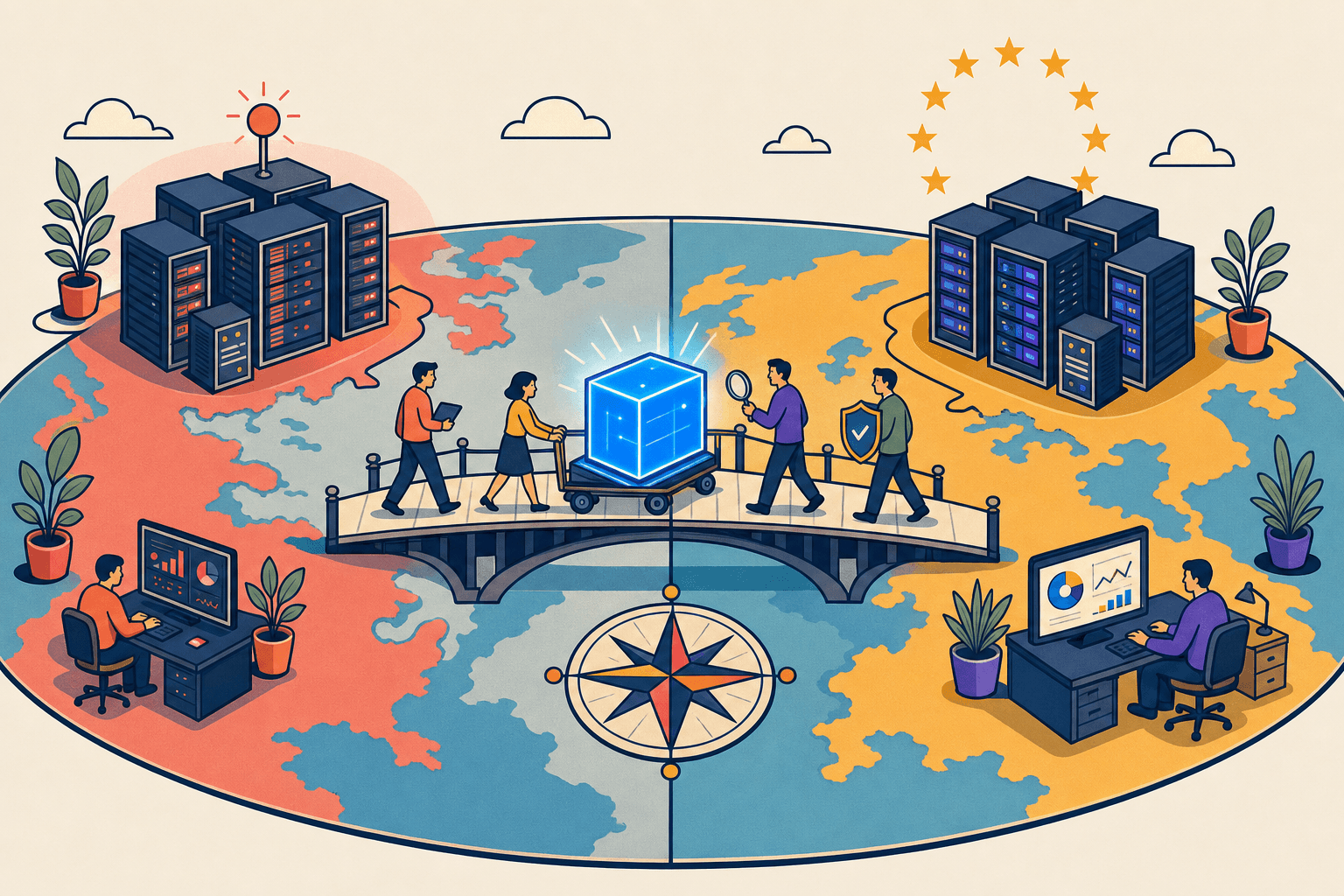
On July 26, 2026, the Chinese company Moonshot AI made the weights of its flagship model Kimi K3 available for free download — 2.8 trillion parameters, a context window of one million tokens. In the Artificial Analysis Intelligence Index, K3 ranks fourth out of 167 models with 57.1 percent, just barely behind the top models from Anthropic and OpenAI. Chinese AI models have thus definitively arrived at the peak of performance. For European banks and financial service providers, a dual question arises: What risks does the use of these models entail — and what does their rise mean for Europe's already uncomfortable dependence on US providers?
Catch-up with open weights
The pace of Chinese providers is remarkable. DeepSeek released the V4 family under the MIT license with open weights in April 2026: V4-Pro with 1.6 trillion total parameters and V4-Flash as a compact variant, both with a one-million-token context. Zhipu/Z.ai followed in June with GLM-5.2, also MIT-licensed and ahead of many Western models in benchmarks. MiniMax undercuts almost all competitors with its M3 API at 0.30 US dollars per million input tokens.
The counter-movement at Alibaba is interesting: The new Qwen flagships 3.7-Max and 3.8-Max-Preview are now only released as a closed API — the last open Qwen general model dates from April 2026, as an analysis by Digital Applied traces. The market is therefore splitting: one portion of Chinese providers continues to rely on open weights as a distribution strategy, while another is pivoting to the proprietary business model of the US competition.
That the performance gap is shrinking is not an isolated observation. Major European banks reacted early: according to the Economist, HSBC, NatWest, and BBVA were already testing DeepSeek models alongside OpenAI and Google in early 2025 — at a time when US banks were still avoiding the topic.
The flip side: Data protection, censorship, regulation
The risks can be classified into three levels. The first is legal: For European institutions, using Chinese cloud APIs is generally not feasible in a GDPR-compliant manner. According to a German legal analysis by Compound Law, the DeepSeek service lacks a data processing agreement, standard contractual clauses for transfers to China, and for a long time, an EU representative. The Italian data protection authority Garante imposed a processing ban as early as January 2025, which remains in force today; authorities in the Czech Republic, South Korea, Australia, and the US followed with bans or binding orders.
The second level concerns content. A study published in PNAS Nexus compared Chinese and Western models using 145 questions about Chinese politics: Chinese models significantly more frequently refused to answer, answered more briefly, and more frequently incorrectly — all models developed in China must be state-approved before release, as Phys.org reports on the study. For banking use cases like document analysis or customer communication, political censorship is rarely directly relevant, but for research and knowledge applications, it very much is.
The third level is the decisive one: The risk fundamentally depends on the procurement route. An open model running on one's own or European infrastructure does not transfer any data to China. The cited legal analysis explicitly considers self-hosting of DeepSeek models on EU infrastructure to be viable — all that is required then is a contract with the EU infrastructure provider, not with the model manufacturer. In short: The model is not the compliance problem, the API is.
The real strategic problem: Dependence on the US
Anyone who only discusses Chinese models as a risk misses the second half of the equation. Today, Europe's AI landscape depends far more heavily on the US than on China: according to an Allianz report cited by Euronews, US providers hold 80 percent of the European cloud market, control up to 40 percent of Europe's operational computing capacity, and almost half of the planned data center projects. Added to this is the US CLOUD Act: US authorities can compel American providers to hand over data — even if it is stored in EU regions. EU data residency alone does not protect against this.
Against this background, high-performance open models — regardless of origin — are strategically valuable: they create bargaining power and genuine alternative options. The assessment of venture investors, cited by the Financial Times, is noteworthy: European companies increasingly view a self-hosted model as the safer choice — regardless of the country of origin, because control remains with their own institution.
What European institutions can concretely do
Three paths have emerged in practice. First: Hyperscalers with EU data zones. Microsoft has been offering DeepSeek V4 in Foundry with EU data residency since May 2026 (West Europe, Sweden Central); Google Vertex AI runs DeepSeek models with EU data processing guarantees in Belgium and the Netherlands; AWS launched its European Sovereign Cloud in Brandenburg in January 2026 and is investing over 7.8 billion euros there. This solves the data residency question, but not the CLOUD Act question.
Second: European providers. Mistral offers competitive models from France, Aleph Alpha addresses regulated industries with PhariaAI, and OVHcloud operates a serverless inference API with Zero Data Retention through its AI Endpoints, which explicitly also includes Qwen and DeepSeek models. Third: complete self-hosting. The German Sparkassen show with the S-KIPilot that an AI solution for around 200,000 employees can be operated entirely on-premises with open models — without a US cloud and without a proprietary language model.
Which path is the right one depends on data classification, volume, and internal expertise. Common to all three is: they only work if one's own application landscape allows for a model change in the first place.
Procurement route | Examples | Solves | Remains open |
|---|---|---|---|
Chinese cloud API | DeepSeek API, Qwen API | Price, performance | GDPR compliance (DPA, SCC), data transfer to China |
Hyperscaler with EU data zone | Azure Foundry (West Europe), Vertex AI (Belgium/NL), AWS European Sovereign Cloud | Data residency, operation | US CLOUD Act |
European providers | Mistral, Aleph Alpha, OVHcloud AI Endpoints | Residency and jurisdiction | limited model selection |
Complete self-hosting | S-KIPilot of the Sparkassen | full control, no data leakage | Costs, operating expertise, time to production |
As of August 2026; details and sources in the text.
Model independence as an architectural principle
This is precisely where the lesson from both developments lies — the rise of Chinese models and US dependency: the model landscape shifts faster than procurement cycles in banks take. A model that is leading today can be regulatory problematic, commercially unattractive, or technically outdated tomorrow. Anyone who hardwires their AI applications to a single provider turns every one of these shifts into a migration project.
That is why we built our Assistant at Acceleraid to be model-agnostic from the very beginning. The underlying language model can be replaced at any time — for example, with a European-hosted open model if sovereignty requirements demand it, or with a higher-performing model when the ranking shifts. Knowledge, contexts, and configurations remain fully preserved. Sovereignty does not begin with the question of which model you use, but with the question of how easily you can change it again.
The geopolitical situation surrounding AI will continue to shift — in which direction is open. The only certainty is that institutions that anchor changeability as an architectural principle can respond to any of these shifts without starting from scratch.
Illustration: AI-generated. AI-supported content: In creating our articles, we use AI technologies and automated agents, including from Microsoft, Google, OpenAI, Anthropic, and other providers. Topics, professional orientation, and final approval rest with our team.
Further Insights
We use cookies 🍪
Strictly necessary cookies (e.g. Pipedrive forms) remain active. With your consent, we also use Google Analytics (analytics) and Leadfeeder (visitor identification). Learn more in our Privacy Policy.